60 mins


 China
China  India
India  Japan
Japan  Philippines
  Singapore
  South Africa
  Sri Lanka
  Thailand
  Colombia
  Ecuador
  Austria
  Denmark
  Finland
  France
  Germany
  Hungary
  Norway
  Poland
  Portugal
  Romania
  Spain
Spain  Sweden
  Switzerland
  United Kingdom
  UAE
UAE  Canada
  Mexico
  United States

.svg)




Modern hospitals today rely on dozens of clinical systems, often between 50 and 100. Yet these systems rarely speak the same language. As a result, critical patient information becomes scattered across electronic health records, laboratory systems, imaging archives, pharmacy databases, and various operational tools. This fragmentation has a profound impact on hospital efficiency, clinical safety, and decision-making.
Unified Patient Data Integration (UPDI) offers a different approach. Instead of forcing hospitals to choose between costly system replacements or fragile point-to-point integrations, UPDI establishes a unified, standards-based data foundation designed to bring coherence, speed, and intelligence to hospital operations.
The challenge of fragmented hospital data
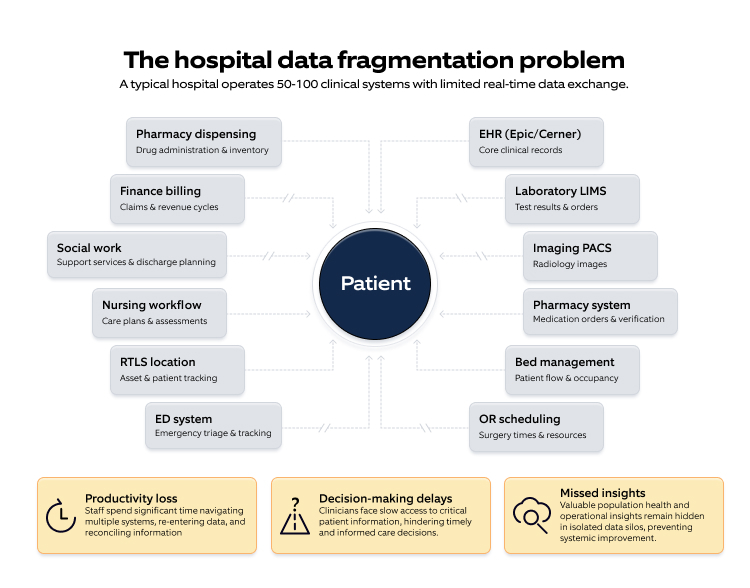
Figure 1: The Hospital Data Fragmentation Problem
Hospital data fragmentation leads to three major operational challenges:
Productivity loss
Clinicians and operational staff must often search across multiple disconnected systems to find routine information. Time that should be spent on patient care is instead spent on navigation, reconciliation, and manual cross-referencing.
Decision-making delays
When critical information is not available in real time, operational decisions slow down. A bed manager, for instance, may struggle to understand why an ICU bed is unavailable, simply because relevant data sits in isolated systems.
Missed insights
Hospitals generate massive amounts of data that could optimize patient flow, medication safety, or resource utilization. Yet extracting patterns is difficult because the insights remain trapped inside individual systems, requiring manual effort few hospitals can sustain.
UPDI Vision and architecture
Reimagining healthcare data
The UPDI vision is to reimagine healthcare data, not as a technical burden but as a strategic asset. Instead of replacing legacy systems, it unlocks their value by integrating each source system once and making that data broadly usable across current and future applications.
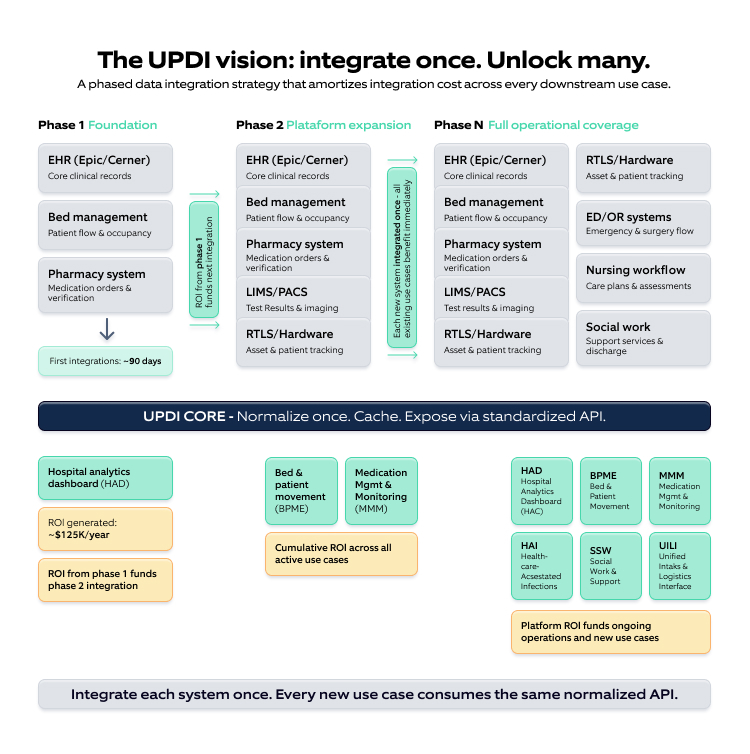 Figure 2: The UPDI Vision
This unified foundation enables hospitals to deploy intelligent, agentic systems capable of automating workflows, surfacing insights, and supporting clinical and operational staff with real-time intelligence.
The approach is intentionally phased: every integration adds exponential value because it supports all use cases that follow.
A three-component architecture for transformation
UPDI’s architecture is built on three core components that work together to eliminate fragmentation and enable real-time intelligence.
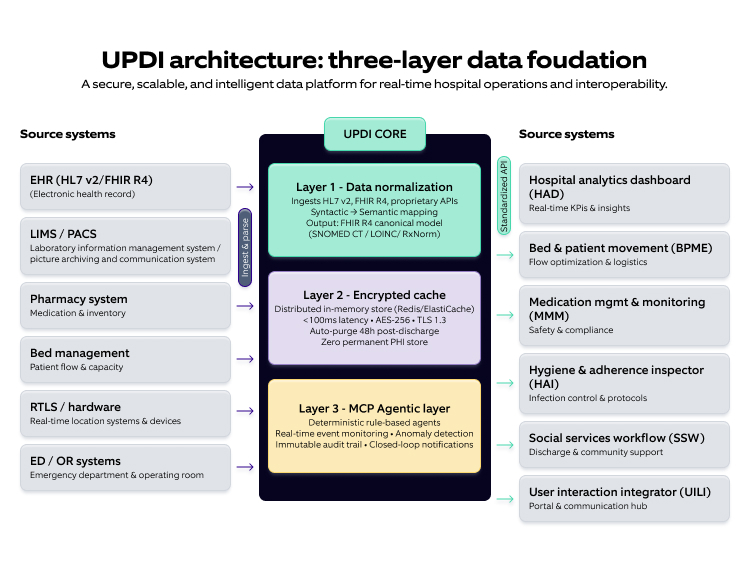 Figure 3: UPDI Architecture
1. Unified data normalization
UPDI ingests data from all connected clinical and operational systems and normalizes it into FHIR R4 format. This eliminates silos and creates a single source of truth for patient and operational information.
2. Intelligent caching
A distributed, encrypted cache stores normalized data, enabling sub-100ms query speeds for dashboards and analytics. Applications interact with this cache, not with the source systems, ensuring reliability and performance at scale.
3. An MCP agentic layer
Built atop the unified data foundation, a Model Context Protocol (MCP) layer exposes deterministic, rule-based agentic tools. These agents monitor operations, detect anomalies, and trigger actions with complete auditability for compliance.
Why this approach matters now
Regulatory pressure is accelerating the shift toward open, standards-based interoperability. The CMS Interoperability and Patient Access rules, along with the ONC 21st Century Cures Act, require certified EHR systems to support standardized FHIR R4 APIs.
Forward-looking hospitals recognize these mandates not as obligations but as opportunities to build an internal foundation for innovation: one that UPDI is directly aligned with.
A pragmatic and proven approach to integration
UPDI’s methodology reflects real-world hospital IT environments:
Phased and modular
Critical data sources are integrated first, delivering rapid wins and enabling ROI-driven expansion.
Established healthcare patterns
Integration relies on proven standards such as HL7 v2 messaging, FHIR APIs, and event-driven architectures for scalability.
Security and compliance by design
HIPAA-compliant encryption, role-based access controls, and immutable audit logging are foundational to UPDI’s implementation model. The value that hospitals gain through UPDI
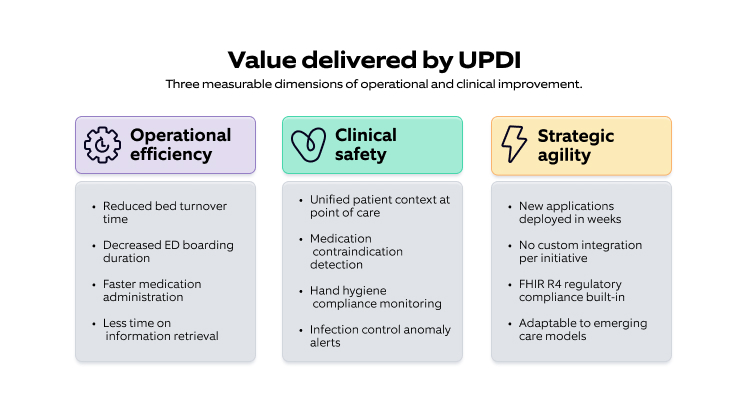 Figure 4: Value delivered by UPDI
UPDI unlocks tangible operational and clinical advantages:
Operational efficiency
Unified access and intelligent agents help reduce bed turnover time, ease emergency department boarding, and streamline medication administration.
Clinical safety
With a unified patient context and agentic monitoring, hospitals can proactively detect and prevent adverse events related to medication safety and compliance processes such as hand hygiene.
Strategic agility
New use cases and applications that once required months of integration can now be deployed in weeks. Each implementation becomes cheaper and faster as all systems draw from the same normalized data foundation.
How Nagarro manages UPDI
We understand that a data foundation is not just a one-time activity but a continuous, ongoing capability that requires deep expertise in healthcare integration, cloud architecture, and clinical workflows. Nagarro provides deep expertise to successfully implement, manage, and extend the UPDI platform.
Custom EHR and Systems Integration
Our integration specialists have deep experience connecting with major EHR vendors (Epic, Cerner, Meditech) and other clinical and operational systems using HL7v2, FHIR, and proprietary APIs.
Cloud migration and modernization
We help hospitals design and implement the secure, scalable, and compliant cloud infrastructure on which UPDI runs, leveraging our extensive experience with AWS, Azure, and Google Cloud.
Managed integration services
We provide ongoing management, monitoring, and maintenance of the UPDI platform, ensuring data flows are reliable, performance is optimized, and the platform remains compliant with evolving regulations.
AI engineering and agentic systems
A data foundation is only as valuable as the applications built upon it. Nagarro specializes in designing, building, and deploying the intelligent, agentic systems that drive operational outcomes. Our expertise spans the full AI lifecycle, from developing custom predictive models and computer vision solutions to implementing large language model (LLM)-based agents that can reason, plan, and act on the unified data stream provided by the UPDI core.
Conclusion: A foundation for intelligent hospital operations Healthcare data
Fragmentation is more than an IT issue, it directly affects clinical outcomes, operational performance, and strategic resilience. UPDI establishes a mature, standards-aligned, and future-ready data foundation that allows hospitals to transform their operations without ripping out legacy systems. By treating unified data as a strategic asset, hospitals can deploy intelligent systems that deliver real-time insights, automate workflows, and elevate the quality and efficiency of care.