60 mins


 China
China  India
India  Japan
Japan  Philippines
  Singapore
  South Africa
  Sri Lanka
  Thailand
  Colombia
  Ecuador
  Austria
  Denmark
  Finland
  France
  Germany
  Hungary
  Norway
  Poland
  Portugal
  Romania
  Spain
Spain  Sweden
  Switzerland
  United Kingdom
  UAE
UAE  Canada
  Mexico
  United States

.svg)




Retail media didn’t just appear overnight, it’s a natural evolution of where data, commerce, and advertising have been heading all along.
As third‑party cookies continue to deprecate and performance marketing becomes harder to defend, marketers are being forced to rethink how performance is measured and proven. In that shift, retail media has quietly become one of the most dependable, measurable growth engines in digital advertising.
Global retail media spend already accounts for nearly one‑fifth of total digital ad spend and continues to grow at double‑digit rates, even as overall digital growth moderates.
The real question for brands and retailers is no longer whether retail media matters.
It’s whether you are building it as a strategic capability or treating it like yet another media line item.
(Sources: eMarketer Retail Media Forecast 2024–2025; IAB 2025 Digital Ad Spend Outlook)
The uncomfortable truth behind the opportunity
Retail media may be booming, but that doesn’t mean everyone is winning.
.png?width=7380&height=2925&name=Ecosystem%20Structural%20Frictions%20Illustration%20(1).png)
-
Fragmentation is the first reality check. With 200+ retail media networks globally, each with different ad formats, data definitions, and measurement approaches, scaling consistently is hard.
-
Measurement is the second. While retail media promises closed-loop attribution, last-click ROAS alone is no longer trusted. Over 70% of advertisers now prioritize incrementality as their primary success metric, replacing vanity ROAS.
-
Operational complexity is the third. Retail media sits at the intersection of marketing, commerce, and data teams, yet most organizations still run it through manual, siloed workflows, severely limiting speed and optimization.
The implication is clear: retail media rewards operational maturity, not just budget allocation.
(Sources: Mimbi Retail Media Networks Database; Moloco / ANA Incrementality Report 2024; IAB Retail Media Buyer’s Guide)
Retail Media in simple terms
Retail media means advertising embedded directly into the digital retail experience. Powered by retailers’ first-party shopper data and tied deterministically to actual transactions, it operates closer to the point of purchase than any other form of digital media. That proximity is the advantage.
Unlike traditional display or even search, retail media sits inside the buying moment, which is why it consistently outperforms other channels on conversion efficiency and attribution reliability.
Retailers aren’t stepping into the role of media companies by ambition, they’re growing into it because they already hold the most valuable asset in advertising today: verified intent.
(Source: Nielsen – The Future of Retail Media, 2025)
Mapping the retail media value chain
Think of retail media as a four‑lane highway. Traffic moves fast only when all lanes are connected.
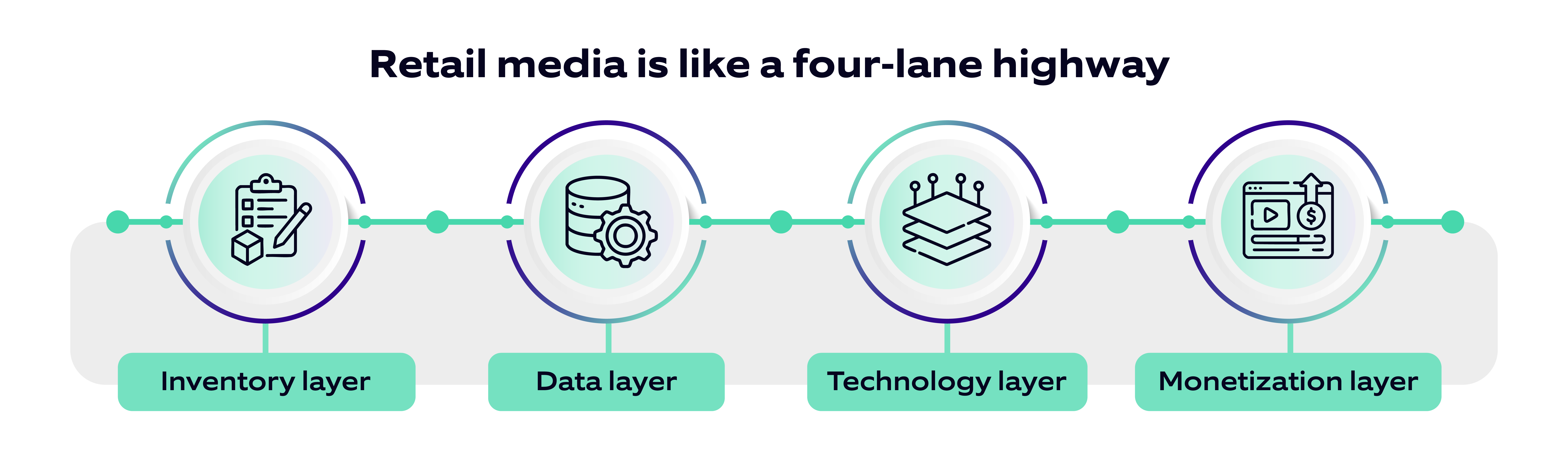
Inventory layer
Retail media inventory spans:
-
On‑site sponsored listings, display, and video
-
In‑app placements designed for mobile-first journeys
-
Off‑site extensions using retailer audiences via DSPs
-
In‑store digital screens and POS integrations
This diversification is not optional, it’s how retail media expands from performance into full‑funnel impact (IAB Retail Media Guide).
What leaders often get wrong
Reality: Inventory doesn’t scale value unless it scales relevance. |
Data layer
Data is retail media’s moat. Retailers leverage:
-
First‑party shopper behavior (browse, search, basket, purchase)
-
Loyalty and CRM signals
-
SKU‑level and category‑level intent
-
Privacy‑safe, deterministic identity frameworks
In a cookieless future, retailers don’t need probabilistic guesses, they’re working with actual purchase data. This is why GroupM describes retail media as “the most resilient data model in advertising”.
What leaders often get wrong
|
Technology layer
This layer determines scalability. Leading platforms today include:
-
Amazon Ads (Sponsored Products, DSP, AMC analytics)
-
Walmart Connect (omnichannel retail + off‑site reach)
-
Target Roundel and Kroger Precision Marketing (identity‑driven CPG targeting)
-
Instacart Ads (high‑intent grocery baskets)
-
Criteo Retail Media and CitrusAd (retail media infrastructure providers)
-
The Trade Desk (retail data partnerships for off‑site scale)
Where most tech stacks fall short is orchestration. This is where workflow automation and AI‑driven decisioning become the real differentiators, not inventory access.
(Sources: eMarketer RMN Landscape 2025; Tinuiti Retail Media Networks Report)
What leaders often get wrong
|
Monetization layer
For retailers, retail media is now one of the highest-margin revenue streams, often contributing a disproportionate share of operating income relative to retail sales.
For brands, monetization shows up as:
-
Higher ROAS through intent-driven targeting
-
Lower CAC
-
Measurable incremental sales, when measured correctly
Dynamic pricing models (CPM, CPC, hybrid) are becoming table stakes as RMNs mature
(Sources: Modern Retail, eMarketer Walmart Connect analysis; eMarketer, 2024)
What leaders often get wrong
Reality: Sustainable monetization balances yield performance, and simplicity. |
How to ride the wave (Without drowning in complexity)
Here’s the opinionated truth: Running retail media like paid search is a mistake. Winning brands do five things differently.
-
They rationalize RMN partnerships instead of spraying budgets across networks.
-
They integrate retail media into omnichannel planning to avoid cannibalization.
-
They operationalize first‑party data instead of treating it as retailer‑owned black boxes.
-
They invest in incrementality and marketing mix modeling alongside closed‑loop attribution.
-
And increasingly, they adopt AI‑driven optimization to scale.
Why Agentic AI changes the game
Traditional AI predicts. Agentic AI acts. In retail media, autonomous agents can:
-
Continuously reallocate bids and budgets by SKU, margin, and inventory
-
Dynamically generate and test creatives based on context
-
Trigger cross‑channel actions when performance thresholds are met
-
Compress cycle times from days to minutes
This shift from static dashboards to self-optimizing workflows is already becoming a norm across retail and advertising ecosystems.
The KPI advantage of full automation
When the retail media value chain is fully automated, the impact is measurable:
-
ROAS improves, driven by faster optimization and reduced waste
-
CAC decreases, thanks to deterministic targeting
-
Campaign launch timelines shrink by 40–60%, as manual trafficking is eliminated
-
Incremental ROAS becomes visible, enabling confident budget scaling
This is the difference between experimentation and fluidic enterprise capability.
(Sources: Adweek, 2024; Nielsen; Workday AI Agents Report, 2025; (Moloco, 2024)
Case study: Nagarro’s retail media execution in action
For a leading beauty retailer, Nagarro designed and implemented an end‑to‑end ad monetization platform that automated the retail media value chain.
The transformation replaced manual ad sales, introduced self‑service campaign management, enabled configurable pricing models (CPM/CPC), and delivered real‑time performance measurement across impressions, spend, and revenue.
The result went beyond just improved efficiency, it created a model for monetization that could scale, be clearly measured, and stay closely tied to overall business growth.
Read the full case study: https://www.nagarro.com/en/success-stories/ad-monetization-optimization-beauty-retailer
Where retail media is headed next
Retail media’s next chapter is not more ad units—it’s convergence.
Expect tighter integration with CTV and streaming, deeper AI‑driven personalization, and autonomous orchestration across RMNs and commerce platforms. Retail media will increasingly behave like Media‑as‑a‑Service, not a campaign channel.
(Sources: IAB 2025 Outlook; Nielsen; eMarketer)
Final take
Retail media has moved well past the experimental stage. It’s now a structural shift in how advertising, commerce, and data come together.
Those who approach it tactically often end up dealing with fragmentation and missed opportunities. Meanwhile, those who invest in value‑chain thinking, automation, and measurement discipline will build lasting advantage.
Think ahead, experiment small. Architect smart. Scale fast.