60 mins


 China
China  India
India  Japan
Japan  Philippines
  Singapore
  South Africa
  Sri Lanka
  Thailand
  Colombia
  Ecuador
  Austria
  Denmark
  Finland
  France
  Germany
  Hungary
  Norway
  Poland
  Portugal
  Romania
  Spain
Spain  Sweden
  Switzerland
  United Kingdom
  UAE
UAE  Canada
  Mexico
  United States

.svg)



The new reality: AI that doesn’t just answer, it acts.
For years, enterprise AI was defined by model performance, accuracy, latency, and scale. Today, those are baseline expectations. The real challenge is no longer building intelligent systems, but governing systems that can act.
Modern AI systems are increasingly capable of executing multi-step workflows, interacting across enterprise platforms, and making decisions under uncertainty.
AI is no longer confined to generating responses. It is influencing outcomes by:
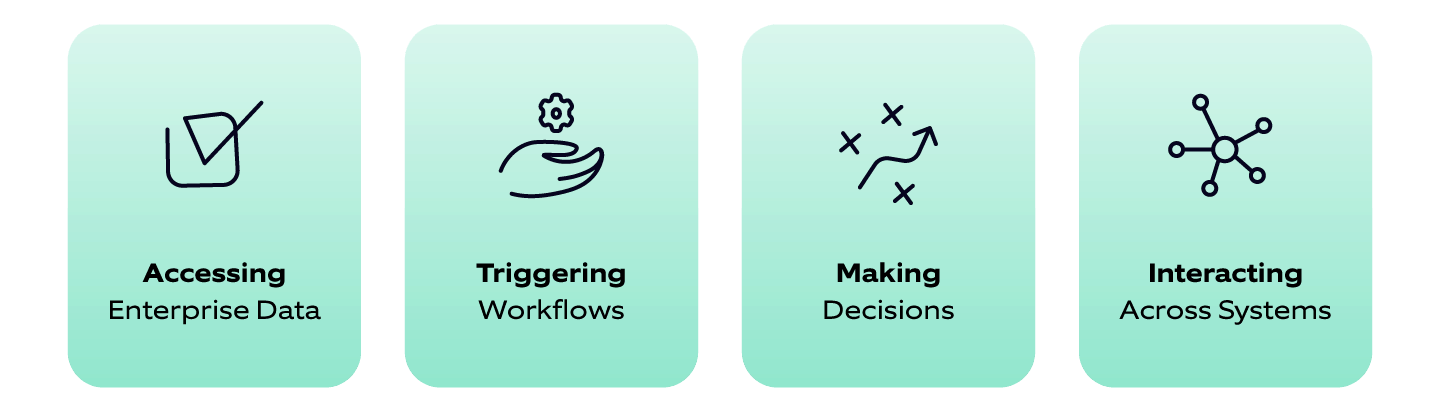
The biggest risk in enterprise AI is no longer model performance; it is uncontrolled behavior. When AI systems operate with partial autonomy or limited oversight, the implications become immediate:
-
Security vulnerabilities that evolve faster than controls
-
Unintended data exposure across interconnected systems
-
Business actions executed without deterministic guarantees
Most enterprises are not starting from scratch. They have established responsible AI principles, governance frameworks, and compliance processes. However, these often remain conceptual guidelines rather than enforceable system properties.
The illusion of control: Why enterprise AI feels governed, but isn’t
Many organizations do not ignore governance, they defer it. This delay creates an illusion of control.
On paper, enterprise AI systems appear governed: security reviews are completed, guardrails are added before deployment, and documentation is maintained. Yet governance introduced late in the lifecycle has limited impact.
By the time controls are applied, foundational architectural decisions have already been made, typically optimized for speed and experimentation rather than control. As a result:
-
Agents may operate with overly broad permissions
-
Prompts evolve without traceability
-
Data and instructions are tightly coupled
-
Access expands faster than oversight mechanisms
These are not isolated mistakes but common trade-offs in fast-moving environments. However, collectively, they lead to systems where behavior isn’t consistently enforced, risks aren’t effectively contained, and actions can’t be fully audited. And governance becomes an assurance mechanism rather than a control mechanism.
New governance challenges introduced by Agentic AI
Agentic AI changes the nature of risk. While traditional AI risks were mostly about what the system says, Agentic AI creates entirely new challenges: 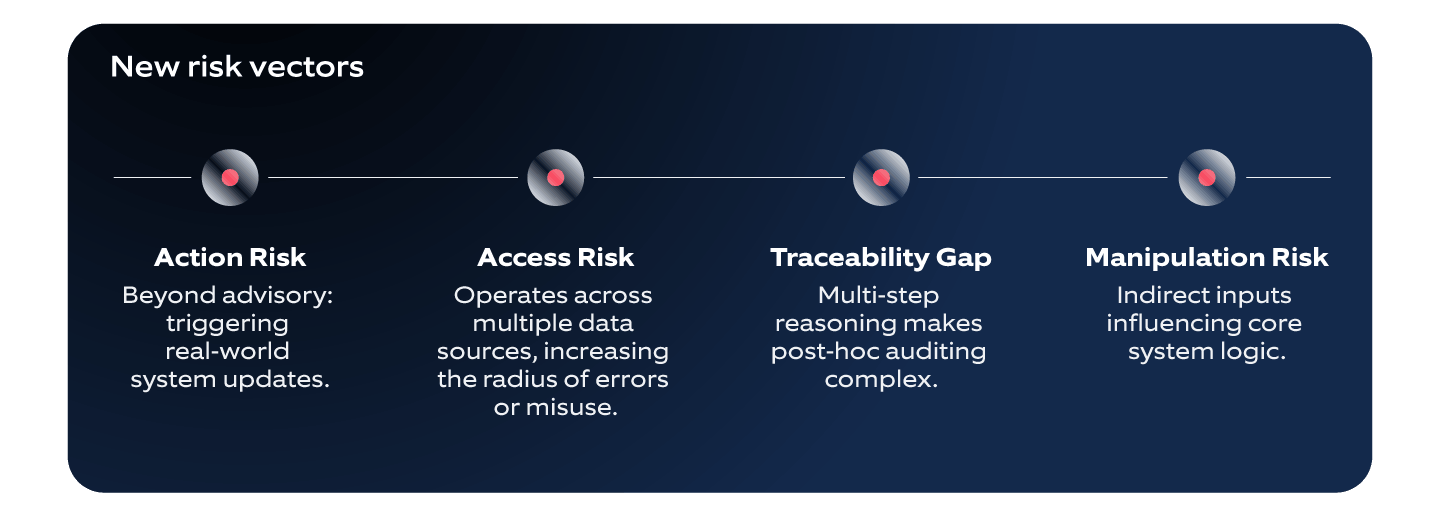
This is why traditional governance approaches, focused on outputs and policies, fall short. Because in agentic systems, risk is not just in what AI says, but in what it is allowed to do.
Governance pillars for enterprise Agentic AI
In practice, governing AI comes down to controlling five things:
-
What the AI says
-
How it behaves
-
What it sees
-
What it can do
-
Whether it aligns with business value and risk
Responsible AI demands that governance leads architecture, not follows it. Four governance pillars form the foundation of any trustworthy AI system: Model, Prompt, Data, and Agent. Together, they establish defense-in-depth, no single pillar provides complete protection, but their reinforcement of each other closes gaps that any one layer would leave exposed.
Model governance controls what model is used, how it is accessed, and how its outputs are validated. Every model invocation must pass through a governed access path, and a validation boundary must sit between model output and any downstream consumer. Without output enforcement, malformed or harmful responses propagate unchecked.
Example: The data pipeline rejects any response that’s missing required information. It also monitors accuracy for each field, helping catch issues that an overall score might miss. For instance, if invoice-number accuracy falls from 98% to 85%, the drop is flagged immediately rather than being hidden inside a passing overall result.
Prompt governance prompts must be managed carefully because they change often, and also control what the model is allowed to do. Core prompts should be locked in the code and changed only through a formal review process. More flexible prompts should be stored with version history. Safeguards such as sanitising user input, validating model output, and applying safety checks at multiple stages are essential parts of the design.
Example: A customer chatbot stores its main prompt directly in the code, so any update goes through review. Prompts for things like tone changes or new FAQs are kept in a versioned system, allowing quick rollback if quality drops.
Data governance keeps instructions clearly separate from data. Instructions and outside content should never be mixed in a prompt, as this can open the door to prompt injection attacks. Any configuration that changes more often than code should be kept outside the codebase, versioned, and easy to roll back instantly.
Example: A document processing system sends uploaded PDFs to the model as data only, not as part of the prompt itself. This prevents harmful documents from sneaking in instructions that could override the model’s rules.
Agent governance: Agents control when certain tasks are triggered and what actions they are allowed to take. They are designed for problems that require flexible decision making, multi-step reasoning, or coordination that cannot be fully planned in advance. Their access to systems and data should be limited. Instead of acting directly, agents trigger actions indirectly, such as sending a message to request a notification rather than having direct email access. They also request data through controlled checks, rather than querying systems on their own.
Example: A compliance agent works through unclear regulations. Instead of directly emailing people or updating databases, it asks the system to handle notifications and data access once it reaches a high confidence level.
These guardrails are not compliance add-ons; they are design inputs that determine whether a system can be governed at all.
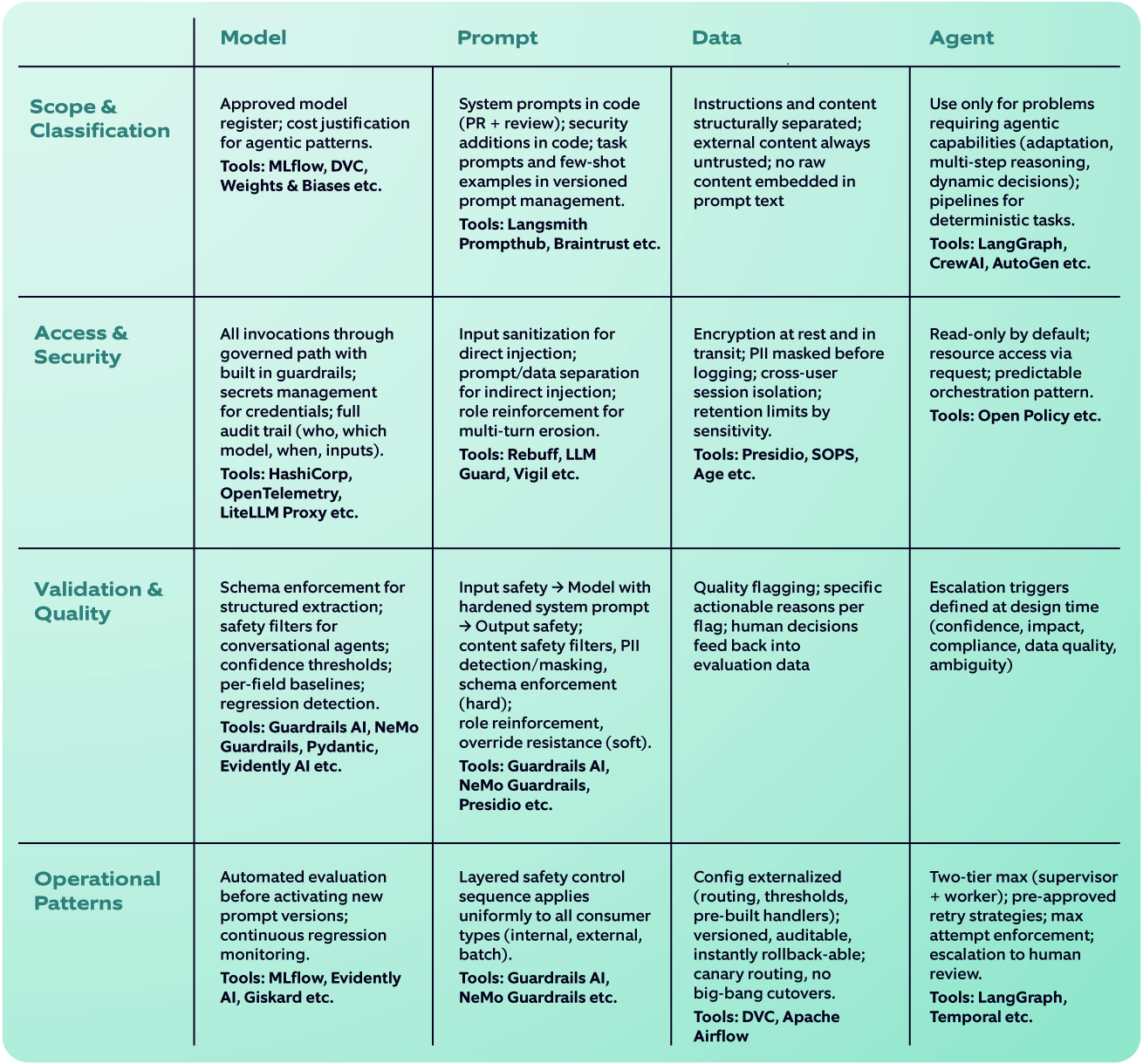
Architecting trust: Enterprise guidelines in practice
Enterprise guidelines translate governance pillars into architectural decisions that make trust measurable rather than aspirational.
Red teaming is central to this. Traditional security testing catches code vulnerabilities: AI red teaming stress-tests whether governance architecture holds under adversarial conditions. Red teaming is most effective when done early in the design phase, not just as a final pre-production check. Identifying security issues during design can take hours to fix, whereas discovering them weeks before launch can cost an entire development sprint. Tools such as Llama Guard from Meta, Promptfoo, and Guardion AI can support structured red team testing throughout the development process.
A structured red team engagement follows these steps:
Scoping: Define the application context: use case description, system prompts, custom goals, and the specific governance controls under test.
Access provisioning: Detail out endpoint URLs, authentication patterns, request/response formats, rate limits, and guardrail configurations.
Adversarial prompt generation: Security teams craft adversarial prompts targeting direct injection, indirect injection via documents and encoding-based bypasses.
Execution: Run the adversarial suite against the live system, probing prompt injection resistance, guardrail effectiveness, and boundary enforcement.
Analysis & findings: Categorize results by pillar: output validation gaps (Model), boundary crossings (Prompt), control/data separation violations (Data), and permission scope weaknesses (Agent).
Remediation loop: Feed findings back into architecture: tighten output validation, harden system prompts against discovered patterns, strengthen structural separation, and narrow agent permission scopes. Then re-test.
This creates a continuous cycle test, surface weaknesses, refine, repeat, that runs cheapest during design and most expensively right before launch.
Design that incites trust follows clear principles:
-
Configuration-driven behavior enables instant rollback without deployment.
-
Permission architectures default to deny, granting write access only with explicit approval and documentation.
-
Dual-signal quality flagging ensures no single metric creates blind spots.
-
Human-in-the-loop escalation triggers are defined at design time, not retrofitted when failures occur.
-
Every model invocation is auditable: who, which model, when, and with what inputs.
When governance pillars drive architecture from day one, responsible AI becomes the foundation that enables sustainable innovation.
Enterprise use cases: Where responsible AI matters most
Governance becomes critical wherever AI interacts with high-impact processes.
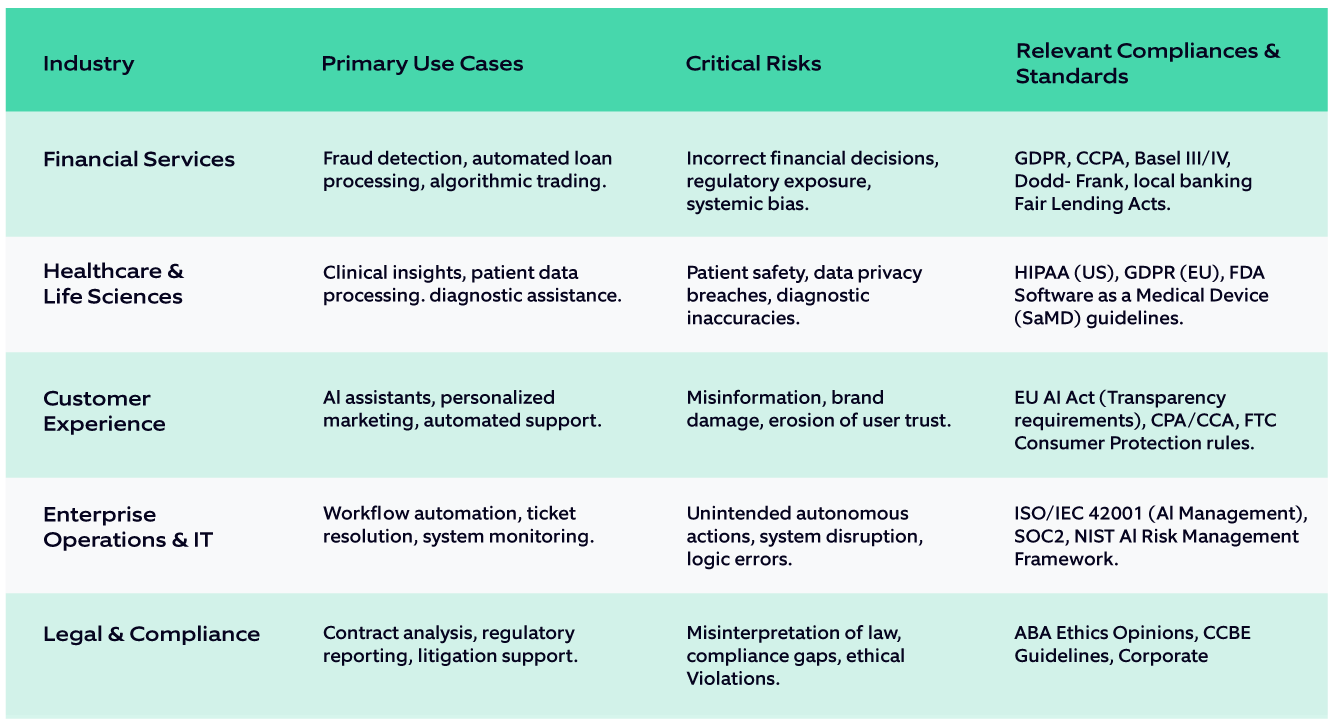
Pattern:
The more AI accesses sensitive data, drives decisions, and takes actions - the more governance becomes non-negotiable. Governance is no longer just about compliance; it becomes essential to protecting business outcomes.
Case study: Automating large-scale information extraction from complex financial documents
A global enterprise dealing with complex financial documents wanted to modernize its AI stack without giving up control, security, or trust. Processing over a million structured data points every month, across constantly evolving document formats, the system was hitting real limits around scale and risk.
Nagarro helped them adopt a governance-first AI approach, enabling a smooth shift from traditional AI to Vision LLMs and autonomous agents. From validated model outputs and version-controlled prompts to strict data separation and clearly defined agent privileges, we designed every layer for control and accountability.
In production, multi-layer guardrails, real-time observability, and human-in-the-loop oversight ensured that high-impact decisions were executed safely and with confidence. The outcome? A scalable, auditable, production-ready AI system, and a 5 Star Governance Rating from a major U.S. client for security, trust, and auditability.
Leadership takeaway
Enterprise AI is at an inflection point. The question is no longer: “Can we build it?” It is: “Can we control it?”
Responsible AI cannot remain a framework or checklist; it must evolve into an engineering discipline embedded in system design.
Because in the era of agentic AI:
-
Trust cannot be added later
-
Control cannot be retrofitted
-
Governance cannot be optional
The organizations that will lead are not those that adopt AI the fastest, but those that design for control from the outset, and scale it with confidence.

-Apr-23-2026-08-09-26-7807-AM.png?width=83&height=83&name=image%20(1)-Apr-23-2026-08-09-26-7807-AM.png)