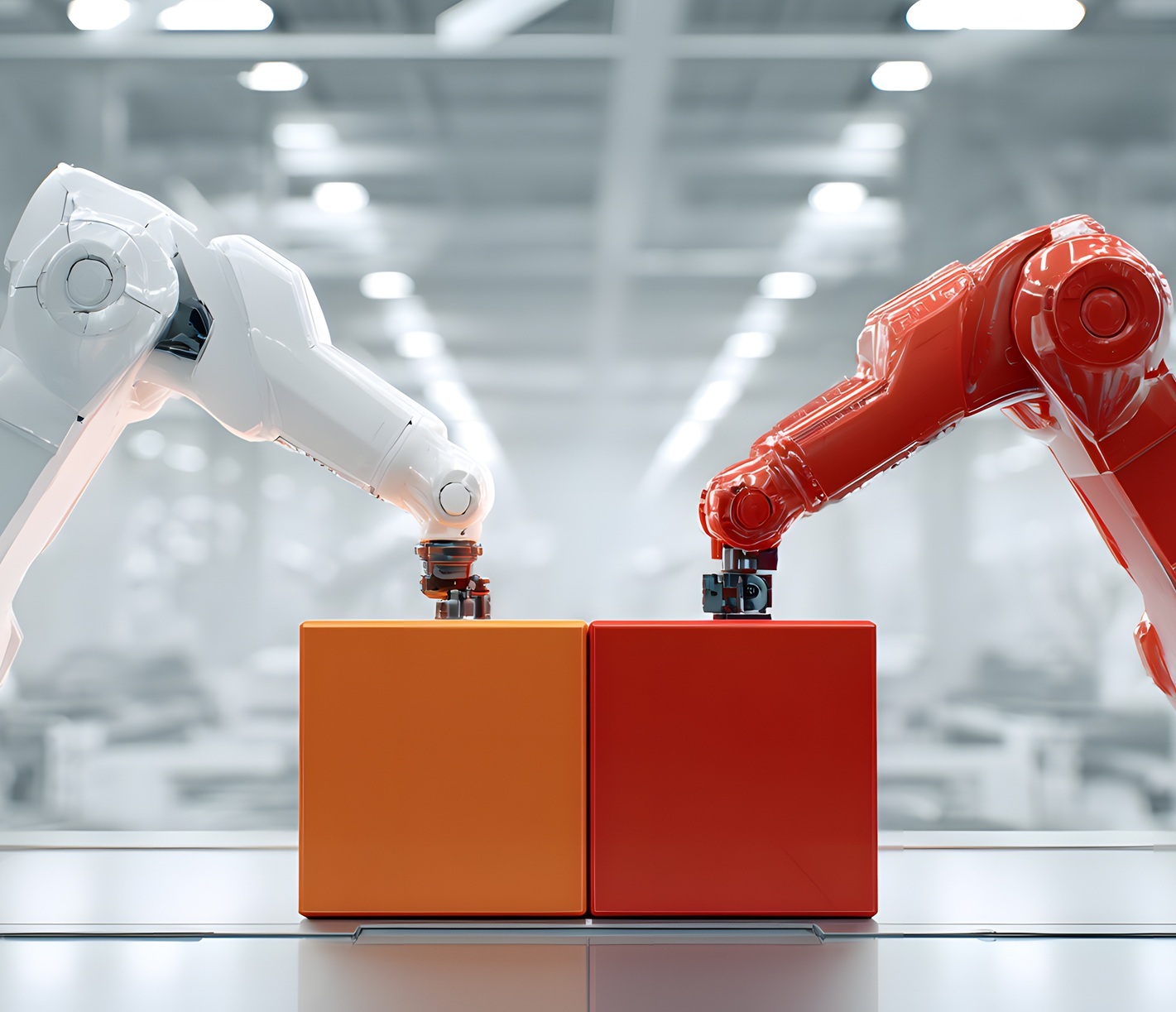
AI in production:
The market’s blind spot in enterprise AI implementation

insight
April 15, 2026
9 min read


Author

Thomas Steirer


Thomas Steirer is Chief Technology Officer (CTO) at Nagarro. His focus is on developing scalable and sustainable solutions that are primarily designed to deliver valuable information.


AI gets sold like a magic fix that’ll change everything, make life easier and leave the competition in the dust. On paper, it’s a compelling narrative. But the reality is quite different.  If you’ve been in tech, you know it’s never that simple. Most enterprise systems aren’t clean slates; they’re a tangled mesh of old legacy setups and newer cloud platforms, a layered, often fragile mess. Just to keep running is hard enough.

It comes as no surprise that support teams are stretching thin; QA is constantly playing catch-up, and compliance continues to evolve. When organizations attempt enterprise AI implementation in this environment, the strain compounds. While AI can accelerate outcomes, it also amplifies existing weaknesses. Without a strong foundation, running AI in production becomes unstable, and systems   break down under pressure.

When AI fails, it’s not subtle. The fallout is immediate and public, with quality issues escalating quickly, oversight lapses becoming more dangerous, outages spreading across systems, and model drift quietly building until it surfaces abruptly. And as ambitions grow, so does the scale of potential damage.

CIOs might joke about becoming “Chief Apology Officers,” but the underlying warning is serious. As AI takes center stage in business, the risk of “getting it wrong” is impossible to ignore. 

Four fault lines that break AI in production

Every time a company tries to pull AI out of the lab and make it work in the real world, it tends to get messy. It’s not necessarily just about bugs or broken code, but also about those moments when big hopes run straight into the bottleneck of “daily reality”. And when that happens, it’s people who feel the brunt of it: customers get frustrated; teams scramble to clean up the mess, and trust takes a hit that’s hard to repair.


1. Reactive systems: why AI in production exposes operational gaps

Most businesses are stuck reacting to issues after they have occurred. Something breaks down; a security hole gets exploited, a key process grinds to a halt, or someone makes a bad decision.  By the time the alarm sounds, the damage is already done. Fixing it usually falls on a few experts who know the system inside out, while the rest scramble to patch things up under pressure.

AI makes this messier. It doesn’t fail like old-school tech, in a deterministic and clear way that says, “there’s-your-problem!”  Because AI spreads decision-making across diverse systems, figuring out what went wrong is harder. Sometimes it does things no one expected or saw coming. It’s a whole new level of unpredictability that it brings in.

Counting on people to clean up every AI mess just won’t cut it anymore. You need systems that observe themselves, understand what’s happening in context, and step in before things go south. Without that, and as complexity grows, every new AI rollout will result in companies increasingly losing control, which is one of the biggest challenges faced by AIOps.


Without that, every new AI rollout only widens the gap between system complexity and control, one of the biggest challenges in AI operations (AIOps). 

2. Quality that slows down what AI speeds up

AI has turbocharged the pace of building things. Code gets generated faster; new features show almost overnight, and suddenly, complete apps are popping up from a single prompt. While everything else races ahead, quality assurance is stuck in the slow lane.

Most testing is still done manually; it’s scattered across teams and rarely keeps up with the speed of releases. While some parts of the code get plenty of attention, others, not so much, which can make the system vulnerable. Since testing often happens after development, and not in concurrence, invariably this causes a bottleneck.

So, with every new sprint, the gap widens. Testing starts to feel like a speed bump, slowing down everything AI is supposed to speed up. Problems slip through and only show up when it’s already very late. And then it’s incredibly stressful & frightfully expensive to fix. At the same time, risks pile up in the background, and when they finally hit production, the fallout is most damaging. If quality assurance can’t keep up, AI never gets to the point of being a force multiplier it’s designed to be, and instead, turns into a source of frustration. Teams lose trust, and leaders are forced to relearn a tough lesson: if you chase speed and forget about quality, you’re just creating bigger headaches down the line.


If quality cannot keep pace, running AI in production becomes a source of instability rather than acceleration.

3. Model drift: The hidden risk of AI in production

A lot of companies treat deployment like the finish line. Train a model, launch it, and move on to the next transformational initiative. The assumption is that it’ll just work now. But AI isn’t about a “set it and forget it” approach. Models drift as data changes, agents encounter situations they weren’t trained for, and performance quietly declines - until it suddenly collapses under the weight of unpreparedness.

If you don’t have an operational layer for the AI lifecycle continuously observing divergent behavior, detecting drift, and enforcing guardrails, things quietly go off the rails. The real question isn’t if a drift occurs, but whether you’ll spot it before your customers do. And take proactive action.


This is a core challenge in AI operations (AIOps), managing systems that continuously evolve after deployment.

4. Trust that is either blind or absent

Without continuous validation, organizations tend to fall into one of two traps. Some place blind trust in AI outputs, deploying systems they can’t fully explain into decisions, and can’t easily reverse them if the need arises. Others hesitate altogether, holding back from AI because they don’t trust systems that cannot be continuously validated. Both approaches are costly: blind trust increases operational and reputational risk, while a lack of trust stalls adoption, leaving AI investments trapped in prolonged pilot cycles.

Either way, the business pays. It shows up as costly failures due to overreliance, or as missed returns when AI initiatives never scale beyond experimentation.

The root cause is the same in both cases. Trust is treated as an afterthought rather than something deliberately built as it is assumed upfront, instead of earned through ongoing evidence and verification. And with this approach, systems quickly break down under real-world pressure.


Trust is not a one-time exercise; it is a continuous requirement in enterprise AI implementation.


The real divide: AI in production vs AI in pilots

Enterprise AI is either integrated or isolated.

Isolated AI is all those one-off pilots and impressive demos that never make it into daily operations. Since they’re disconnected, complexity grows and eventually value stalls. Invariably, teams move on to the next experiment. Integrated AI is what really makes the difference. It’s baked into operations, delivery, governance, and lifecycle management. It’s built to run every day, not just showcased in meetings to wow the Management.

It’s an integrated AI that creates lasting value.

The real divide- AI in production vs AI in pilots

A different starting point: running before building

AI in production refers to deploying, managing, and sustaining AI systems in real-world environments where performance, reliability, and accountability are critical.

Most AI roadmaps start with bold visions, innovation labs, and lofty promises. But rarely does anyone reflect: what does it take to run AI every day, at scale, without breaking what already works?

“AI in Run” demands a shift in perspective. It is a way of operating under real conditions, where systems are under constant load, and failure has severe consequences. Before any meaningful progress can happen, leaders must demonstrate that AI can carry operational responsibility consistently, securely, and without breaking down, as complexity and volumes increase manifold.

A different starting point-running before building-1

What it actually takes to run AI

Running AI at scale requires more than just dashboards and governance checklists: It needs integrated capabilities that work together as a single operating layer, designed for systems that continuously learn, adapt, and even drift over time.

Autonomous AI Operations (AIOps): Operations with AI in the control loop

Dashboards only tell you what’s already happened; they lag in providing real-time visibility. You need AI inside the loop, detecting incidents as they emerge, connecting the dots across systems, intervening before failures to escalate, and remaining constantly vigilant on security. It’s a couple of steps ahead of classically automated scripts. AI in the loop can interpret context, adjust in real time, and act even when situations don’t follow known patterns.


That shift allows operations teams to move away from constant firefighting toward deliberate control, from executing runbooks to refining how systems behave over time, kickstarting a meaningful evolution in role re-definition.

Operating AI as infrastructure in enterprise systems

Models, agents, and workflows are now critical assets; they need to be managed with the same discipline as core systems like databases or APIs. That means versioning, rollbacks, coordinated releases, monitoring drift or unexpected behavior, and governance that is built in from the start. If governance is bolted on later, the system is already vulnerable.


AI that sits outside operations is outside your control. Once it’s in play, it must be managed like any other mission-critical system, or it quickly turns into technical debt, accumulating hidden risk and escalating costs.

Accelerated quality: Quality that flows with delivery

Quality can’t be a roadblock. It can no longer sit on the sidelines as a reluctant gatekeeper, approving or rejecting changes only after the fact has occurred. Instead, it needs to move quickly with the pipeline, built in from the start, and evolve alongside it. AI-driven tests can scale coverage at the same pace as code generation, while CI/CD should embed validation early, alerting on risks well before they reach production.


When quality keeps up, speed is sustainable. If not, speed quickly turns into instability. It’s not a trade-off between speed and quality; real-time quality is what makes speed viable in the first place.

Continuous trust and validation in AI operations

Trust isn’t a box you check at the end. It’s a discipline built in from the outset and sustained across the AI lifecycle. Performance, bias, robustness, explainability and compliance must be validated, not just before go-live, but continuously in production.


AI systems change; data changes; context shifts. That’s why trust isn’t permanent: It has to be earned repeatedly, through evidence rather than assumption, and certainly not through optimism alone.

Why this is an operations problem not an innovation one

Innovation teams explore the Art of the Possible. Operations teams are responsible for what actually endures. While the speed of innovation is undeniably important, organizations that run AI reliably at scale, without introducing fragility or unmanaged risk, are the ones that pull ahead of the competition.

To add, AI advantage increasingly belongs to those who understand operations, quality, and accountability, not those who remain confined to experimentation without operational discipline.

Businesswoman hand touch cube as symbol of problem solving

What leaders must do to scale AI in production

You don’t have to give up on ambition. But stop measuring AI success by how many pilots you launch or how many impressive demos you showcase.

Instead,

Start measuring uptime: how reliably does AI hold up under real operational pressure? 
Adoption: do people trust it enough to depend on it for their day-to-day work?
Resilience: can it absorb change without breaking or degrading silently?
Trust: can you explain and stand behind the decisions it makes & when it matters most?
Treat AI like infrastructure, not a feature.

Infrastructure gets continuously managed, monitored, secured, and governed, because failure is not an option. Features, by contrast, are added and removed. Confusing the two is where most systems begin to fail under pressure. 

Invest in the foundation before you accelerate.

Speed is tempting, but if you go too fast on a shaky foundation, things will fall apart. Build the operational core first. It may feel slower at the start, but it prevents breakdowns later, and that’s what sustains real momentum. 

 AI isn’t just about speed. It’s about building systems that can respond to change, as new ways of data engineering approaches emerge, business needs evolve, and models inevitably drift over time.

Start with the foundation

AI really can transform industries. But any AI transformation without a robust foundation carries with it a very high risk, even when it tries to cover that risk by the promise of “oh-so-cool” innovation.

Start with operations. Start with quality. Start with trust. Build AI that can run, every day, at scale, in the real world. Transformation will come because you built something solid, not just because you chased the hype. 

Start with the foundation

Q&A

What leaders need to know about AI in production

AI in production: The market’s blind spot in enterprise AI implementation

Get in touch