60 mins


 China
China  India
India  Japan
Japan  Philippines
  Singapore
  South Africa
  Sri Lanka
  Thailand
  Colombia
  Ecuador
  Austria
  Denmark
  Finland
  France
  Germany
  Hungary
  Norway
  Poland
  Portugal
  Romania
  Spain
Spain  Sweden
  Switzerland
  United Kingdom
  UAE
UAE  Canada
  Mexico
  United States

.svg)


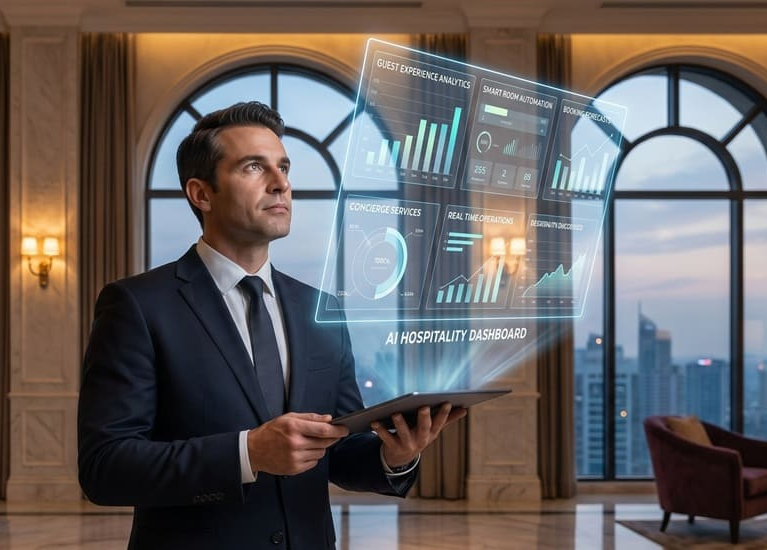
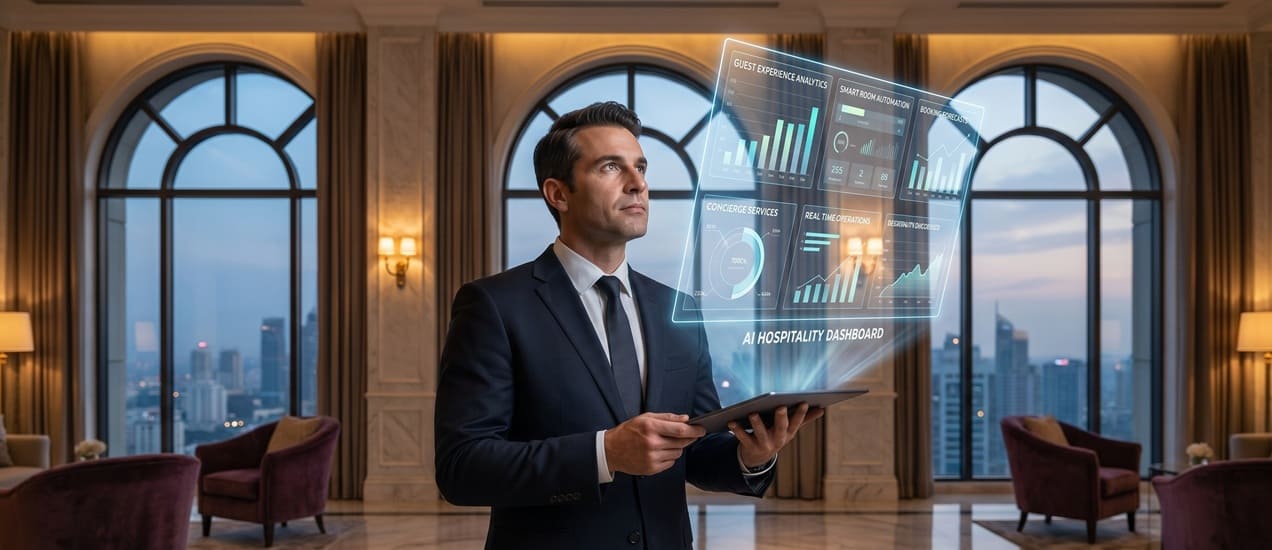
Why does an industry so focused on guest experiences accept so much friction internally?
I spent years in the hospitality industry, and what I remember most is the waiting. For data, systems to sync, the right person to pull the right report, and the context to travel across teams. Once the numbers finally landed, I spent hours chasing the why behind them. Why did the RevPAR drop? Why did guest flows shift this month? Why is this impacting business?
I was not alone in that experience. Ask any Regional Revenue Manager, VP of Operations, commercial teams and even the GMs, and you will hear the same story. The data and the intelligence exist, but they don't flow. It sits in the legacy systems, in multiple dashboards, in people’s heads, and in departments that never talk to each other.
And here's what strikes me the most: this is an industry that has spent decades perfecting the guest experience. We invest in personalization, pay attention to every touchpoint, every moment of friction, every second a guest has to wait. Because there is only one chance to make a good first impression.
And yet, somewhere along the way, we have normalized that the people running the operations would live with the very same friction they will never tolerate for a guest.
The hidden cost of fragmentation is not disconnected systems.
 Most hospitality organizations are using technologies that were never designed to work together. PMS, CRS, CRM, RMS and loyalty systems were all sound investments in their own right. Together, they now create a different kind of problem.
In a Hospitality Technology survey, 69% of the respondents said that new technology integration is the hospitality industry’s top operational challenge. Also, almost half of hoteliers struggle to access data needed for revenue and operational decisions.
The result? Teams spend significant time looking for information, coordinating manually, and reacting to situations that could have been anticipated. But this points to a deeper issue: hospitality has always been a reactive industry by necessity. A guest requests a towel. A manager asks for last night’s numbers. An operational issue surfaces, and the team scrambles to resolve it.
The instinct to respond is one of hospitality’s greatest strengths, but when the entire operating model is built around reaction, it creates a ceiling on how proactive, efficient and intelligent the organization can become. In such circumstances, the opportunity AI creates is not to remove that human responsiveness, but to raise the baseline of the operation, so that by the time a guest needs something the team already knows, by the time a manager asks a question, the answer is already there.
When systems remain disconnected, the problem is not only technical, but also an operating model issue: data, people and processes are not moving together fast enough to support the guest in real time.
In many hospitality businesses, decisions that should take minutes take hours. Context that should flow across departments sits with one team. Performance that should be visible in real time, takes anything between a day to a week.
This is why the issue is bigger than systems integration. As Somera and Petrova put it, introducing new technology is not an isolated event but an integrative change process that affects culture, structure, and stakeholders. In hotels, this matters because technology only creates value when people can use it, trust it, and embed it into daily work. The same research notes that employee buy-in and customer satisfaction are ‘as important as the functionality of the technology itself’.
What's the missing half of personalization in hospitality?
Again, hospitality has spent a decade making the case that every guest deserves personalized experience. The value personalization brings is clear: loyalty, revenue, and satisfaction. A McKinsey report highlights that 71% of consumers expect companies to deliver personalized interactions, and 76% get frustrated when that does not happen.
The paradox is, while hospitality has embraced personalization for the guest, the industry has not always applied the same logic to the internal teams delivering the experience. Those teams are often supported by one-size-fits-all tools, rigid workflows, and dashboards that look the same whether you are a revenue manager, a general manager, or a marketing executive.
The guest experience and the employee experience are ideally the same conversation at different points in the same system.
Each person in the ecosystem needs intelligence tailored to their role, decisions, and context. This extends to the organization as a whole. Also, a city hotel, a luxury resort, and an all-inclusive destination do not operate in the same way. The tools that support them should not either.
When teams have the right tools, they are less frustrated, more effective, and more present for the guests.
The AI shift in hospitality isn't technical, it's cultural.
This may be one of the most important lessons about AI right now: value will not come from technology alone, but from the organizational model built around it, the way teams collaborate, make decisions, share accountability, and bring AI into the reality of daily work.
The evidence points in the same direction. RAND’s 2024 research found that more than 80% of AI projects fail, often because organizations misunderstand the problem they are trying to solve, optimize for the wrong metrics, lack the right data or build solutions that do not fit the business workflow. In hospitality, the gap is even more visible: a recent study by H2CS found that 78% of hotel chains are already using AI, but only 7% have a companywide AI strategy. From this, we can infer that the AI gap is more organizational than technical.
Operations leaders in hospitality businesses understand where friction lives and which decisions matter. Technology teams know what is architecturally possible. Data teams ensure information is trusted and governed. Change management professionals redesign ways of working. Governance teams define what an agent can do autonomously and when a human must remain in the loop.
AI creates value only when it is embedded into the reality of how an organization operates. That requires business, technology, data, and governance teams to work together from day one.
The value of AI doesn’t come from the LLM model—it comes from combining domain expertise, trusted data, workflow design and the right governance around human judgement.
A hotel workflow agent cannot be designed by engineers alone. A finance agent needs to understand approval hierarchies and local tax rules, not just how to extract data from a PDF. A performance agent needs commercial, operational, and market context, not just a clean data feed.
This is why AI in hospitality is multidisciplinary by nature: it is not merely a technology to be deployed but a working culture that reshapes how teams coordinate, processes flow, and decisions are made across departments. Organizations that treat AI as a cross-functional capability, embedding it into workflows, communication, and operational habits rather than isolating it as a tech initiative, are the ones achieving real, measurable outcomes.
AI must work beyond the demo, across every hospitality operation.
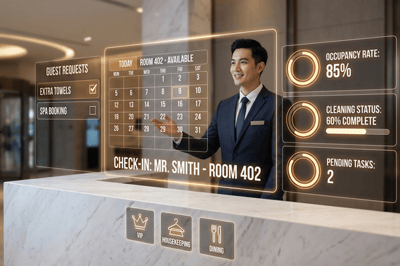 As mentioned earlier, organizations are no longer starting from scratch with respect to AI initiatives. Artificial intelligence is already present through pilots, proofs of concept, chatbots, and copilots in specific departments. But this is exactly where the next challenge begins. The question is no longer whether AI can produce something impressive in a controlled setting. What needs to be evaluated is whether this technology can become a repeatable capability that scales across the organization.
This is the useful idea behind the 'AI factory' metaphor: not a lab, not a collection of disconnected experiments, but a repeatable system for turning business needs into governed, tested, and reusable AI capabilities. For hospitality, however, the word ‘factory’ only goes so far. Hotels are not factories; they are living operations shaped by guests, teams, properties, brands, markets, and most importantly, moments.
So, the real opportunity here is not to industrialize hospitality, but to unlock organizational blockers for people running operations to use AI repeatedly without disrupting the guest experience. That means building foundations that can be adapted across operating realities such as a city hotel, a luxury resort, an all-inclusive destination, a regional office, a finance team, a front desk team, etc.
This is the difference between using AI as a tool and building strategic AI capabilities, and between a pilot and a transformation.
Intelligence keeps hospitality moving.
In many hospitality organizations today, intelligence exists, it just doesn’t flow. Data sits in the systems. Context sits with people. Decisions happen in meetings, and reports explain what happened last week. The operating model is reactive by design, not by choice.
Behind Nagarro’s Fluidic Intelligence approach, is the idea that intelligence should move continuously across the organization from data to insight, from insight to decision, from decision to action and from action back to learning. Without the friction of manual coordination, disconnected systems, or delayed reporting.
For hospitality, that means applying this logic to the daily moments when operations slow down: manual coordination, fragmented guest context, delayed reporting, disconnected systems, and decisions awaiting escalation.
The goal is not automating for the sake of automation. The goal is to remove friction from the operating model so teams can act faster, work smarter and stay focused on what matters the most—the guests.
When intelligence flows, a regional leader understands why performance has shifted across a market in seconds, not hours. The front desk has full visibility on their guests, because their identities and preferences travel with the guests regardless of the channel. The finance team closes the month more quickly, instead of after manual reconciliation.
This is what a 20% uplift in performance looks like in practice, not through one big change, but by removing friction across multiple daily moments.
Agentic AI adapts to real hospitality operations.
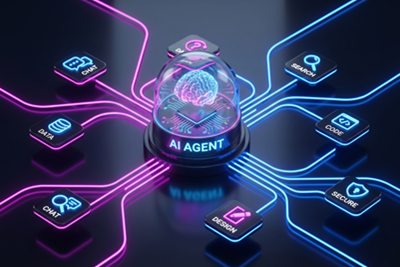 This is where traditional enterprise software has always struggled in hospitality. Different teams have different rhythms, constraints, ownership models and decision-making structures.
However, for years, the trade-off seemed unavoidable. Either organizations bought standardized systems that could scale but forced teams to adapt to the tool, or they invested in bespoke solutions that matched the business but were difficult to scale across the portfolio.
Agentic AI changes that equation. The answer is not endless customization, and it is not rigid standardization either. It is reusable, composable foundations, and enterprise-grade architecture that can be configured around the real operating reality of each organization, property, market, or role without starting from scratch every time.
In the age of agentic AI, customization and scalability are not opposites. Customization built on reusable foundations is how you achieve scalability.
At Nagarro, we built the Yedai Hospitality Performance Suite because we kept seeing the same problem across hospitality organizations of every size and shape. The intelligence was there, but it wasn’t flowing.
By integrating Yedai, we bring in Fluidic Hospitality, a more connected, agile and intelligent approach, one capable of creating a unified enterprise. Agents recommend, automate the routine, and highlight what needs attention. The decisions that require judgement, empathy, and accountability stay with people.
Fluidic Hospitality is not a technology vision. It is an operational one.
Hospitality has always been around, removing friction from the guest. Fluidic Hospitality applies the same ambition to the organization itself, removing friction for teams, decisions, and daily operations.
With the Fluidic Hospitality approach, a regional leader instantly understands why performance shifted across a market, not after a week of manual analysis. A front desk team immediately recognizes a returning guest regardless of which channel they booked through. A finance team closes the month faster because exceptions surface automatically. This approach ensures a well-rounded organization where every team member, regardless of role, property or market, has the intelligence they need to do their job efficiently and effectively.
This is what Fluidic Hospitality looks like—a connected, intelligent operating model that gives early adopters a lasting competitive advantage.
We would love to hear your feedback on this article! For thoughts on this topic, or a quick chat on how we can work together to achieve your business targets through technology, feel free to message me directly on LinkedIn.