60 mins


 China
China  India
India  Japan
Japan  Philippines
  Singapore
  South Africa
  Sri Lanka
  Thailand
  Colombia
  Ecuador
  Austria
  Denmark
  Finland
  France
  Germany
  Hungary
  Norway
  Poland
  Portugal
  Romania
  Spain
Spain  Sweden
  Switzerland
  United Kingdom
  UAE
UAE  Canada
  Mexico
  United States

.svg)




Why prototypes fail in production and the architectural blueprint for scaling AI-driven modernization
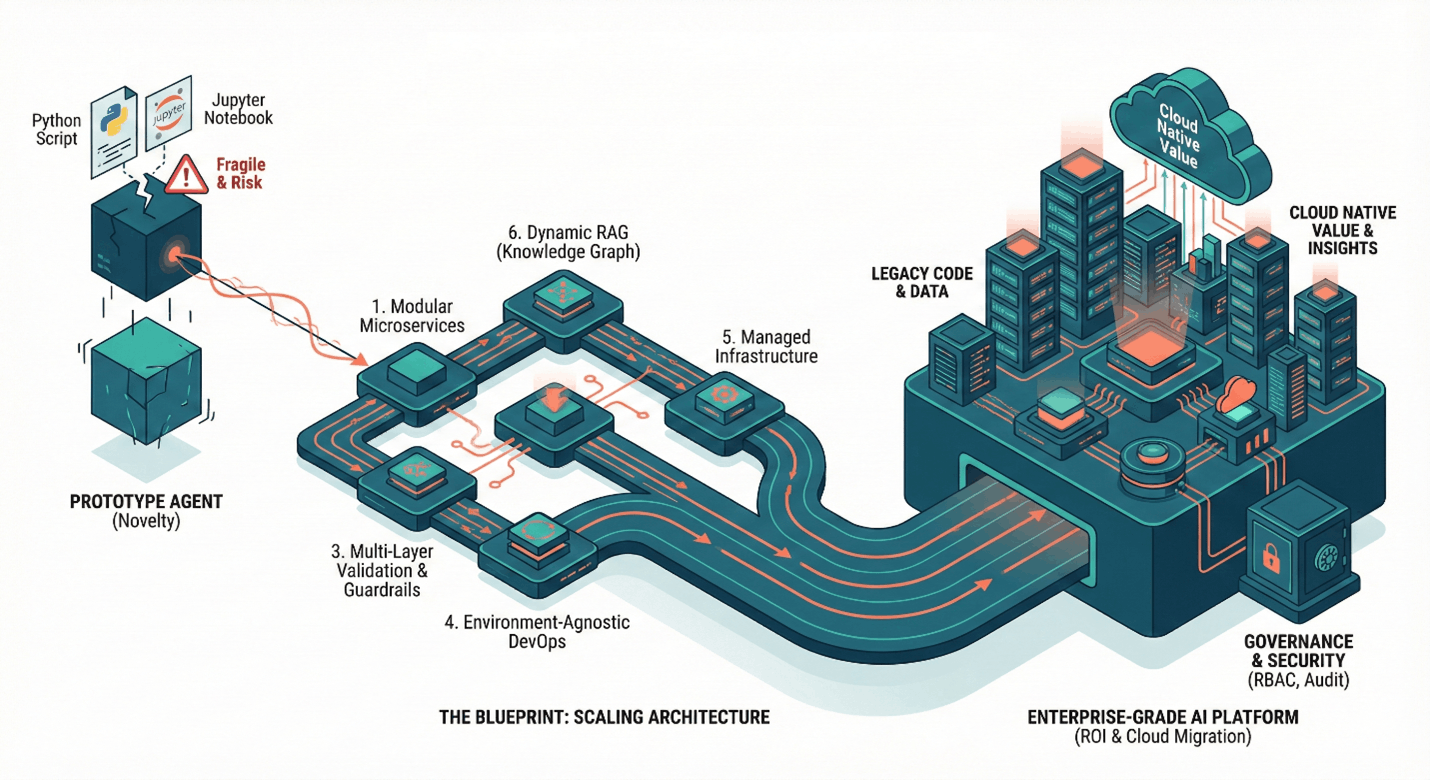
Organizations across industries are rapidly investing in enterprise AI agents and automation platforms to accelerate cloud transformation and modernize legacy workloads. The promise is enticing: feed a legacy codebase or a stack of PDF contracts into an AI Agent, and watch it autonomously migrate, refactor, or extract value in seconds.
However, moving from a functional proof-of-concept (PoC) to a reliable, enterprise-ready platform remains a challenge. Early agent-based solutions often demonstrate technical promise in a sandbox, but struggle with hallucinations, rate limits, security governance, and reproducibility when applied on enterprise data.
This article examines why "prototype thinking" creates technical debt and outlines the architectural principles required to build production-grade AI agents for complex migration and document-processing environments.
Key takeaways
- Prototypes don’t scale: notebook-style agents break in production, leading to unstable outputs, brittle integrations, and runaway costs.
- Architecture drives value: Enterprise AI agents need a modular, observable, and governed platform, not a single clever script.
- Ship products, not demos: Guardrails, HITL, managed infra, and CI/CD turn agents into reliable engines for cloud migration and modernization.
Why do AI agent prototypes fail in production?
Many organizations begin agent development with local experimentation—Jupyter notebooks, lightweight vector stores, and ad-hoc Python scripts. While this approach is excellent for rapid innovation, it creates a "fragile" architecture that breaks down under pressure.
When these prototypes are pushed into production, several ‘Day 2’ challenges emerge, such as:
- Non-deterministic outputs: Without rigorous guardrails, an agent might correctly execute a SQL query once but fail the next time.
- Observability black holes: Tracing why an agent made a specific decision is nearly impossible in monolithic scripts.
- Integration friction: Connecting a local Python script to a legacy SAP environment or a secure Oracle database often breaches enterprise security protocols.
- Cost & latency spikes: Unoptimized token usage and lack of caching can lead to astronomical API costs and slow user experiences.
The reality check
Feature |
Prototype/PoC Agent |
Production-grade enterprise agent |
|
Infrastructure |
Local scripts, notebooks, or single-container apps | Distributed microservices on Kubernetes or Serverless functions |
|
Data Context |
Static uploads with limited context windows | Dynamic RAG (Retrieval-Augmented Generation) with Knowledge Graphs |
|
Governance |
Ad-hoc access; secrets often hardcoded | Role-Based Access Control (RBAC), Secrets Management & Audit Logs |
|
Error Handling |
Often crashes on unhandled exceptions or bad input | Self-healing workflows, automated retries, and dead-letter queues |
|
Scalability |
Serial processing (one document at a time) | Parallel, asynchronous event-driven queues for high volume |
|
Observability |
Console print statements | Distributed tracing (e.g., Open Telemetry), cost tracking, and drift detection |
What does a production-ready enterprise AI agent platform look like?
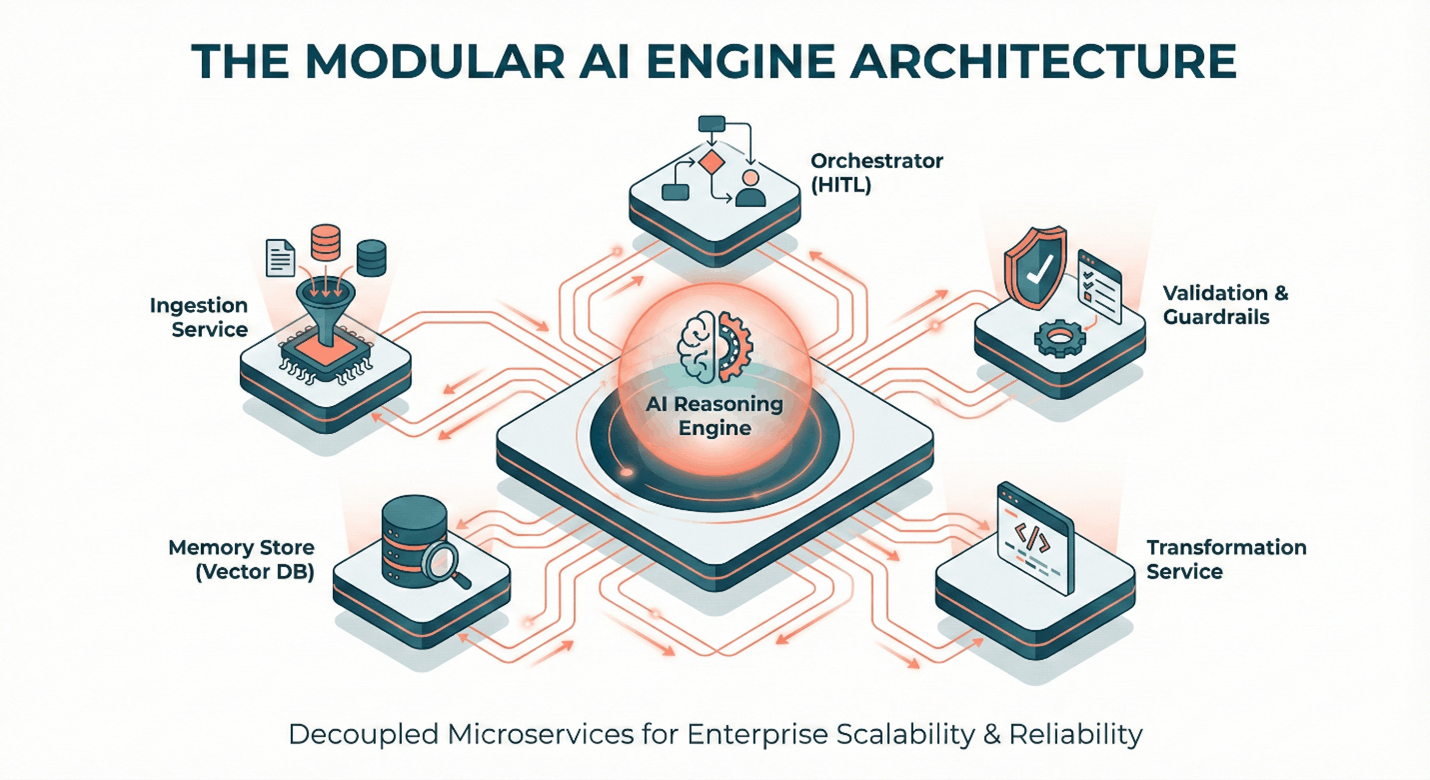
To transition from experiment to enterprise asset, organizations must treat AI Agents as software products, not magic boxes. Drawing experience from some of our projects with successful implementation patterns, here are some successful implementation core principles for building robust architecture:
1. Modular, production-appropriate architecture
Tightly coupled, single-script agents are hard to debug and harder to scale. A production platform should have a modular architecture aligned to its scale and risk profile, whether that is a well-structured monolith, a service-oriented design, or fully decoupled microservices:
- Ingestion service: Handles OCR, parsing, and chunking of data.
- Reasoning engine: The "brain" that interacts with LLMs (e.g., GPT-4, Claude, Llama 3)
- Memory store: Vector databases (like Pinecone or Milvus) for long-term semantic recall.
By enforcing clear boundaries and contracts between these capabilities (APIs, internal interfaces, or workflow steps), teams can swap LLM models or evolve components without rewriting the entire system.
2. Intelligent orchestration with human-in-the-loop (HITL)
Migration tasks are high-stakes. An agent shouldn't just ‘guess’ at a legacy code refactor; it should propose a confidence score.
- Low confidence: The system flags the output for human review.
- High confidence: The system proceeds automatically.
- Orchestrators: Tools like LangGraph or temporal workflows manage state, ensuring that if a step fails, the agent retries intelligently rather than crashing.
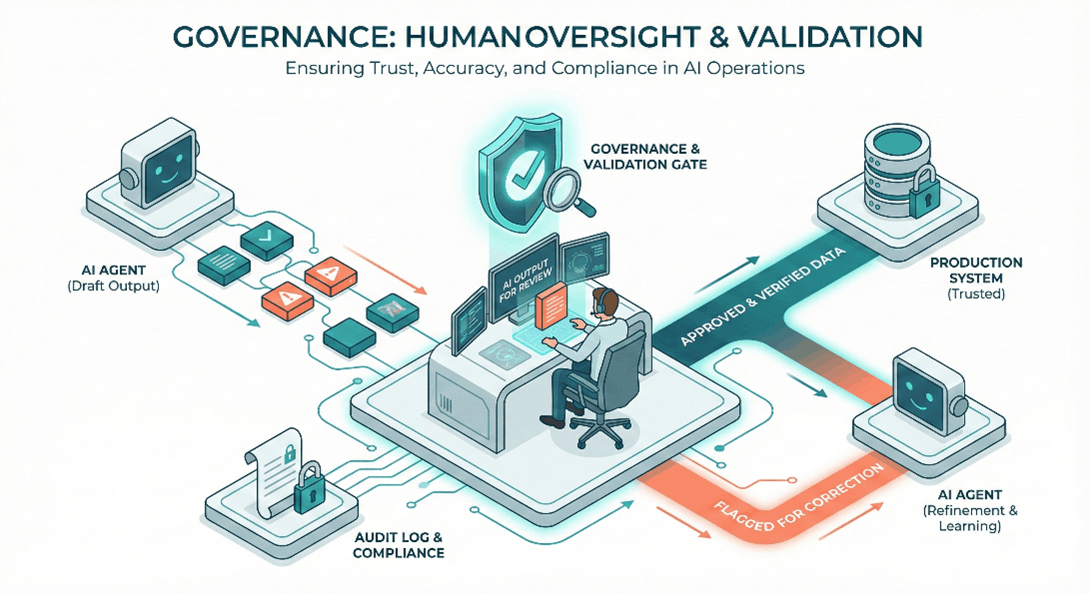
3. Multi-layer validation and guardrails
Never trust raw LLM output. Production systems employ a ‘Validator’ microservice that runs:
- Schema checks: Does the output JSON match the required database format?
- Domain rules: Does the extracted "Invoice Date" logically precede the "Payment Date"?
- Hallucination detection: Cross-referencing generated answers against source documents.
4. Environment-agnostic configuration (DevOps for AI)
Hardcoded API keys and file paths complicate scaling. It is crucial to decouple configurations, prompts, and temperature settings from code.
This allows you to promote an agent from Dev → QA → Prod using standard CI/CD pipelines, changing only the environment variables (e.g., switching from a smaller, cheaper model in Dev to a powerful reasoning model in Prod).
5. Managed infrastructure over custom builds
Resist the urge to build your own vector search engine. Leveraging cloud-native managed services such as Azure OpenAI, AWS Bedrock, or managed vector databases offloads the burden of patching, scaling, and high availability, allowing your team to focus on business logic.
How can enterprise AI agents modernize legacy monoliths?
To understand how these architectural principles come together, consider a typical high-stakes migration scenario: moving a 20-year-old mainframe application to the cloud.
In a traditional workflow, this requires manual reverse engineering, which is a slow, error-prone process.
By applying the production-grade agent architecture outlined above, the workflow shifts from manual effort to automated governance. Let’s dive deeper into this with a case study.
Imagine there is an organization that processes millions of lines of undocumented legacy code (e.g., COBOL or PL/SQL). The wish to refactor this into Java/Python microservices.
A simple prototype agent might translate code snippets but miss dependencies or introduce subtle logic errors.
The enterprise Agent solution
Instead of a single script, the production platform orchestrates a multi-agent workflow:
- Ingestion Agent: Scans the entire repository to build a Knowledge Graph, mapping variable dependencies and business logic across files.
- Refactoring Agent: Uses the Knowledge Graph to generate modern code, ensuring that shared logic is preserved correctly.
- Validator Agent (The ‘critic’): Rather than trusting the output, this agent automatically generates and runs unit tests against the new code. If a test fails, it triggers a retry loop with the refactoring Agent.
This approach ensures that the system doesn't just "translate" code; it delivers verified software artefacts, ensuring:
- Reliability: The Validator Agent catches the hallucinations before a human ever sees the code.
- Efficiency: Human developers shift their focus from writing boilerplate code to reviewing complex architectural decisions.
- Safety: Filters out security vulnerabilities during the generation phase via pre-configured guardrails.
The enterprise checklist: Are you ready for production?
Before you deploy your agent to a live environment, run through this readiness checklist:
- Observability: Do you have tracing (e.g., LangSmith, Azure Monitor) enabled to see the exact prompt and response for every error?
- Cost controls: Are there rate limits and budget alerts set up for token consumption?
- Fallback mechanisms: What happens if the primary LLM API goes down? Is there a backup model
- Data privacy: Is PII (Personally Identifiable Information) redacted before it is sent to the LLM?
- Evaluation framework: Do you have a "Golden Dataset" to test the agent against every time you update the prompt?
Conclusion: Scaling AI Agents beyond the prototype
AI-driven platforms have enormous potential to accelerate modernization, but the ‘potential’ depends more on architecture than production. Realizing the value of AI requires moving beyond the excitement of the "Hello World" demo and embracing the rigor of software engineering.
By employing managed services, modular designs, layered validation, and automated deployment practices, organizations can build intelligent agents that do not just "demo well" but deliver consistent, secure, and scalable outcomes for the enterprise.
The result is not just a faster migration today, but a future-ready foundation that evolves alongside the rapid advancements in AI.