60 mins


 China
China  India
India  Japan
Japan  Philippines
  Singapore
  South Africa
  Sri Lanka
  Thailand
  Colombia
  Ecuador
  Austria
  Denmark
  Finland
  France
  Germany
  Hungary
  Norway
  Poland
  Portugal
  Romania
  Spain
Spain  Sweden
  Switzerland
  United Kingdom
  UAE
UAE  Canada
  Mexico
  United States

.svg)


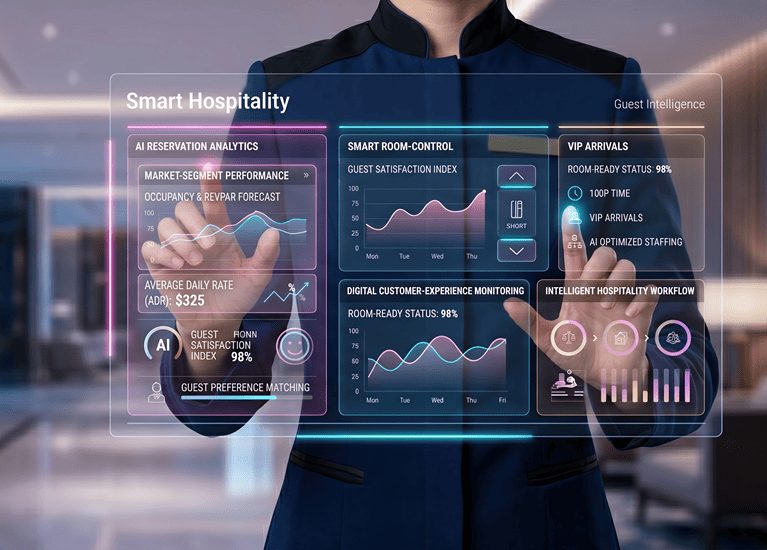

As a hospitality industry CXO, owner, investor or vendor, given that more than 55% of large enterprises were already using AI in 2025 (as per Eurostat's report), you most probably have been doing the exercise to adapt your strategy to AI impact. According to recent Q1 2026 results published by major industry players, most enterprises are cautious about announcing AI achievements. The reality is, industry leaders are investing in multiyear modernization and transformation programs and just starting to partner with tech giants to embed Gen AI in the journey.
At the same time, as we write this article, the global scenario has been shaken by an energy crisis due to the US-Iran war and a not-so-cold tech war between the US and China. Within the western world, four big tech-AI-focused firms consolidate an oligopoly in terms of LLM offerings: Anthropic, Google, OpenAI, and Grok. Every couple of weeks, we are surprised by the latest, more powerful model being launched. Corporations are not just increasing their tech budgets but also struggling to understand exactly what success looks like for their business, including AI.
The new hospitality battleground: Preserving strategic control in an AI-driven market
Our point of view is that the new relevant perspective and real strategic shift is not only about countries and organizations adopting AI as a 'tool', but also about preserving their core capabilities, decision-making authority, and relationships that will redefine competitiveness in the coming years. Leveraging AI means defining success before implementing projects. One of the problems we observe is that some companies do not have historic measurements of past KPIs to be able to compare with new AI-supported ones. Is that something that shall stop us? We believe it cannot be. In fact, sometimes we see the old KPIs no longer apply at all. The AI transformation requires much more than automation of current processes, and that’s what makes it challenging.
Most corporates are yet to establish clear measurement criteria for funding AI initiatives: how is new tech increasing sales teams' conversion rates? Is the impact of AI investments going to be 'on property', looking at how new projects directly impact hotel revenue? Or do we focus first on the 'above property' areas like legal, global finance, and supply chain, which are regional and headquarters disciplines with great potential?
Most corporates are yet to establish clear measurement criteria for funding AI initiatives.
From a business architecture perspective, in this scenario, it makes sense to review our mission, vision, guiding principles, and strategic priorities that drive results. Running a basic Porter's Five Forces analysis and SWOT considering Agentic AI as a key variable is an interesting exercise. The 'wait and see' approach has ended, and it’s critical to find out what our buying power really is and how much you can afford to invest now and in the future.
This factor turns out to be quite relevant as the rules of the game are being reshaped due to AI. Some investments like 'making content searchable for agents' might not be optional, but simply adaptive, meaning that there will be initiatives we fund because there is no other choice to keep ourselves in the good position we already are. If your distribution channel evolves, you just need to adapt to it; this is not incremental, it is adaptive. And who makes the move first could get more relevance, but it is not a guarantee of 'more value' in the EBITDA line.
Reevaluating control, dependencies, and future readiness for hospitality businesses
In practical terms, for the C-level, this means reassessing where your organization wishes to keep full control of its own tech IP, where it depends on third parties, and where AI may increase that dependency or reduce it for the mid and long term.
You may start with the following questions:
-
Do you have control and trust in your internal information system?
-
What are the contractual conditions and consequences of a potential exit from the current CRS, PMS, or payment gateway?
-
Who are your SaaS partners and how are they facing AI?
-
Are your core capabilities easier to replicate now than before?
-
Are you ready for the impact of compliance requirements across all geographies your business operates in?
According to an article in Futures and Foresight Science, foresight practice is associated with innovation capabilities, and all gurus emphasize the need to keep our human creativity and proactivity sharp. We have experienced that imagining future scenarios is an effort that unlocks opportunities and innovative ideas, so we definitely recommend your team to engage in the strategic planning exercise incorporating corporate foresight. For inspiration, do check the amazing work done by Hotelschool The Hague: you could make your own bet on what the hospitality industry’s future scenario is, with more probabilities.
Building the right foundations for successful AI initiatives in hospitality
Taking a position aligned with your own company’s future scenario is probably the most relevant decision you and your leadership team have taken or will need to take this year.
Many businesses did their homework a while ago and decided to invest in optimization of workflows, improvement of service efficiency, and better staff productivity. Most started with their data governance and infrastructure, as well as automation initiatives. Some did not, and are trying to catch up urgently with the advantages and disadvantages it implies. In any case, the high performance of agentic AI technology opens a whole new field of autonomous workflows that we could not have dreamt about just two years ago.
A boutique independent small hotel claims running 21 agents just in the last year, and with the time saved being able to allocate 1 FTE for maintenance work 'on call': something impossible a year ago. Now, is this scalable for a 1000-hotel chain? Can you just replicate the other business's success recipe? With the cost of code reduced, why would you copy someone else’s code repository instead of building the one that fits your specific process?
Software personalization is the new normal, due to which successful SaaS companies are investing heavily in AI features.
At the same time, while technology moves faster than ever, people and processes have inertia and pushing for a transformation at all levels would require more time. Marriott’s CEO, Anthony Campuano, explained on the earnings call of Q1 2026 that the focus has been clear on major foundational systems that are deployed in a multiyear program, while AI efforts have also started specifically at business transient sales, event planning, marketing campaigns, and real-time call assistance for customer engagement centers. Mr. Campuano also specified that success metrics are to differentiate on-property and above-property indicators, for example.
From a consultancy perspective, if you have done your business process management and enterprise architecture homework, the strategic planning of AI-related initiatives would not start from scratch. If your processes are chaotic, you need to start mapping your business value immediately.
Key sovereignty considerations we recommend for your AI-driven hospitality strategy
We believe that sovereignty is the real challenge in hospitality’s intricate and fragmented ecosystem, where AI is a new force reshaping priorities and players' roles. Don’t get us wrong: this is not about closing yourself defensively against the threats of our external environment. It is about preserving your ability to determine how you wish to relate to it.
The priority of each strategic initiative would depend on your current competitive situation and resources available. You will notice most of them are not merely 'tech-driven' initiatives. In fact, in the AI era, cross-functional projects make more sense than ever, and your ability to work across areas will be put to the test.
 1. Sovereignty over your energy sourcing
Optimize the energy you consume; invest in machine learning solutions to create ad hoc optimization models for your business. It's a fact that an enormous amount of investment is going into data centers and computing power all over the world. Running out of tokens in the era of AI will be like not having internet.
Ask yourself these questions:
-
What is the capacity you need to secure?
-
What are your sources and related costs?
-
Are you able to shift between energy sources swiftly?
This involves alignment with your infrastructure, security, investment, and maintenance teams, plus roping in experts on energy distribution and efficiency, asset management, and maintenance to evaluate the total cost of ownership (TCO) of your target scenario.
 2. Sovereignty over your data layer
Review your agreements and build clear internal ownership of your data model. If you use an operational SaaS PMS, do you have the right to export your data on a daily and monthly basis? Do they facilitate your API connections with different industry players? Are you already storing the right variables and traces? Also, do not underestimate the knowledge base that enables your contact center agents. Do you have a robust knowledge management and information management system in place? Is all the data your own, independent of the SaaS you choose to collaborate with?
Some 'easy-to-implement' products may be taking your hotel information hostage with a cheap subscription. Be aware where you put your schema, policies and processes data, and work proactively to keep your own information within your control. In this regard, is your data governance and master data management team fully equipped to take on the challenge together with IT procurement?
In February 2026, at the Bedbanks Arena, HBX Group and Dida Travel announced the joint development of future-ready distribution models designed for agent-based booking, real-time optimization, and fully automated decision-making. This is a clear sign of how the distribution will condition how our data shall adapt in the months to come. As commented, some of your initiatives may not be optional, but necessary adaptations to the new environment to stay competitive.
 3. Sovereignty over your customer data
There are so many examples of AI-led, futuristic customer experience personalization strategies. Nevertheless, to execute and stay compliant, we need to be ready to handle GDPR, CCPA, LGPD, and PIPL. The bigger the enterprise, the broader the regulatory landscape. You need to check whether you can manage the full cost of owning the knowledge about your guest to unlock the personalization magic.
This is a huge initiative on its own, and it is not just about tech. Personalization initiatives require customer data that, in turn, requires legal, CX, and tech areas as a minimum. During Q1 2026, Hilton deployed an Anthropic-powered platform, the Hilton AI Planner, for customers to 'dream and shop'. However, the deployment was done only in the US, which signals not only caution but also clear geographical differences in customer data regulations and challenges when it comes to success measurement.

4. Sovereignty over your money flow
As per the latest market movements in the PMS vendor industry, it seems the appetite to take over the financial stream as well as the operational traditional features is increasing. For example, who controls your payments, cancellations, settlements, virtual credit cards, and secure tokenization. Is your finance team okay with the commissions paid to your vendor? Can you detect fraud and predict payment delays? Does your front office manager feel comfortable taking your guest’s credit card? Are you having the best set-up for your needs?
The right approach would be to set up a hospitality middleware that orchestrates the financial flow in line with your own cash flow and credit policies. For B2B relationships, this is a key area you need to focus on.
 5. Sovereignty over connectivity
By connectivity, we mean the ability to integrate with external services and partners quickly and securely. Interoperability is not easy to execute, as many legacy decisions might be on your way. You might need to set up a specific initiative to guarantee that connectivity is a guiding principle of your architecture, appears in vendors' SLAs, and maybe take hard decisions on decommissioning or migrating parts of the stack.
It’s better to address these questions first.
-
Are you ready and free to connect with external agents or explore new partners?
-
Are you aware of the available Hospitality Technology Next Generation (HTNG) solutions, and is your team familiar with Arazzo specifications?
-
Have you seriously evaluated where MCPs would make sense and where your APIs need some upgrade?
Once these issues are resolved, integration becomes more feasible and scalable.
 6. Sovereignty over connective labor availability
The key advantage of our industry lies in human connection. 'Connective labor,’ a term coined by Allison Pugh in her book The Last Human Job, best describes what the hospitality industry means when it says that 'people make the difference'. Especially in high-end/luxury tiers, it is the people who are able to differentiate the offering and become a competitive advantage. At the same time, the accommodation sector faces a scarcity in finding people who are the right fit and have the willingness to accept certain job profiles.
It is best to reassess your current options, taking your business situation into account. Are you hiring for a 'zero-AI' authentic offering and talent that can manage the complexity of emotions? Is a night shift necessary? Can you improve your employees' lifestyle and mental health with tech, and at the same time ensure that the employee helps you achieve a competitive advantage in the market? Reevaluating these factors will help you gain deep insights into internal systems and help restructure your growth path accordingly.
 7. Sovereignty over tech IP
This may be the trickiest one, as all companies are struggling to hire AI/data experts, and even if they get a data scientist, the ability to take that talent to production-ready solutions requires a diverse team effort. You need to start evaluating the pros and cons of an AI factory that can serve your organization’s specific goals and build ad hoc solutions together with you. With AI, the cost of code itself is lower, so start-ups can discard the code and start again until they find their niche.
However, enterprises run complex operations with their legacy code, so transitions are not easy. Nevertheless, building and testing alternative options in parallel is not impossible. Software personalization enabled by AI is a fact; does it make sense for you to continue dependency on a SaaS product when the tech IP could remain with you for those core competencies that make you relevant in the market? This can be a key strategic topic to assess at the CIO level.
As you may realize, we have not listed sovereignty on better guest interfaces (apps, web, kiosks), guest concierges, AI content creation, etc. as those are already in the commodity features list for which you can surely find alternative options that work properly (and are also easily available in the market).
Conclusion: Building strategic sovereignty through AI
We believe the most relevant investments often sit deeper in the operating model. Recent analyses published in the International Journal of Hospitality Management show that when hospitality CEOs emphasize digital technologies to streamline internal processes, their companies tend to perform better than those focused on customer-facing digitalization. From Nagarro's Hospitality Practice perspective, we confirm this tendency based on what our clients prioritized so far: no disruptive change in the customer-facing interfaces, but real upgrades on the operational layers at the backend, leveraged by AI (not Gen AI only).
As per Marriott’s Q1 2026 report, we believe that the 'sequencing of AI project deployments' shall serve as the main competency (instead of just the AI hype), and priorities are still dictated by ROI in the industry. While Marriott announced early conversations with Google AI Mode Travel product and Open AI Ad Pilot program, the company's main investment is now focused on the roll-out of their multiyear transformation of Marriott's three major tech platforms: central reservations, the property management system, and the loyalty platform. Marriott plans to start deploying natural language search on Marriott.com and on the Bonvoy mobile app as well.
This is the time of sovereignty strategy and creation & consolidation of key capabilities for the future scenario. It is ideal to go for those that provide your organization with the ability to take decisions and at the same time keep your firm smartly connected with the ecosystem.
Nagarro fluidic enterprise AI transformation framework evolves its digital engineering long-standing core to include advisory and change management coaching services as a key aspect of our company’s value proposition. To accelerate your AI transformation, you might benefit from an external, boutique-sized, tech-agnostic perspective.
We would love to hear your feedback on this article! For thoughts on this topic, or a quick chat on how we can work together to achieve your business targets through technology, feel free to message me directly on LinkedIn.