



 60 mins


 China
 India
 Japan
 Philippines
 Singapore
 South Africa
 Sri Lanka
 Thailand
 Colombia
 Ecuador
 Austria
 Denmark
 Finland
 France
 Germany
 Hungary
 Norway
 Poland
 Portugal
 Romania
 Spain
 Sweden
 Switzerland
 United Kingdom
 UAE
 Canada
 Mexico
 United States




AI and more specifically AI transformation is not a new topic or trend, but it seems hotter than ever. However, with the first set of initiatives coming to fruition but not yielding the expected results, more organizations are moving towards the backlash phase of the hype cycle.
In this blog I will outline why this is the case and how our Nagarro Pendulum of AI Adoption visualizes and helps you make your AI transformation a success.
All About Adoption
What do you think is the key factor for a successful AI initiative? It must be technology, engineering, right? Absolutely not. It is the organizational and the people side, more specifically adoption. But how so?
Let me start with a typical fallacy organizations fall for: the easy access to AI for everyone. On every computer, laptop, tablet and mobile device, every person can very quickly engage with AI. This might lead you to think that naturally adopting AI in a professional and regulated work environment is easy. But this could not be further from the truth. On the contrary it is quite a leap from the casual use of AI.
Thus, if not channeled, guided, steered properly, it bears the risk of various rogue “off the record / shadow IT solutions,” very different adoption speeds within the organization or leads the top management to believe that AI maturity is much higher than it really is.
Emphasizing this further, BCG has recently published figures in their 2026 piece “AI Transformation is a Workforce Transformation”: 10% of the value comes from the algorithms, 20% from the technology used to implement the algorithms and a stunning 70% from rethinking the people component.
To add one more point of view to the topic of why adoption is so crucial for AI initiatives, my colleague Thomas Schweiger has written his own blog about finding good use and business cases and proper ROI calculation. I fully recommend you give it a read.
A central piece is this calculation:
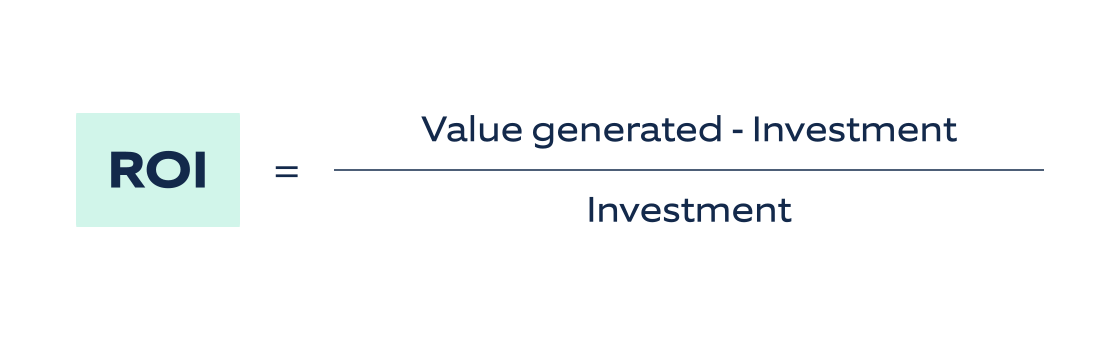
What it shows is that value generated is never a fixed number. It is what one use is worth, multiplied by how many times it gets used in practice. For people, adoption is the multiplier that turns potential value into real value. To say it bluntly: “A mediocre solution that is used by many beats a brilliant solution that is used by only a few.”
To illustrate this with another example: here at Nagarro in our consulting engagements we have observed a significant increase in Change Management efforts for AI initiatives vs. other typical initiatives such as Cloud Transformation. While it typically takes about 10%-15% of total effort for Change Management to be effective, this percentage jumps significantly to 25% and more for AI initiatives.
No matter how you look at it, the name of the game is adoption. And this is where our Pendulum of AI Adoption comes into play.
The Pendulum of AI Adoption
I have teased you enough, here it is in its full beauty: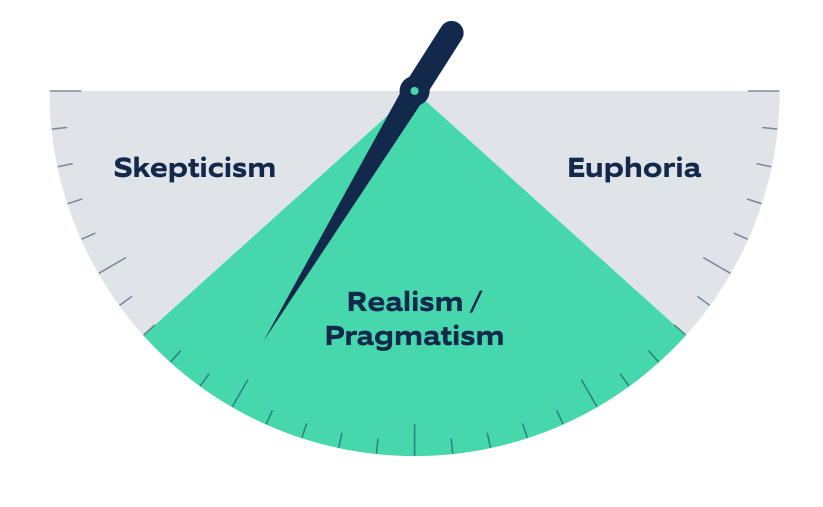
Figure 2
What does the pendulum visualize? Both on a personal and on the organizational level you can quickly and easily assess where people stand with their attitude towards AI.
The three areas can broadly be described as follows:
- Euphoria is the state where people blindly believe in following AI whilst any kind of critical thinking or reflection is missing. The positive effect that comes along with that is extremely high adoption due to absolutely trusting the new ways of working. However, the sheer absence of any corrective measures / thinking will lead to lack of quality and further improvements. A lack of coordination and guiding principles across multiple AI initiatives can also create chaos, leading to fragmented efforts and a lack of strategic alignment.
- Skepticism on the opposite end of the pendulum means that people are not at all trusting AI both in principle and in particular. On the one hand it is good to be critical and strive for a workable solution with high-quality outcomes. But people might fall into the trap that they will double check anything that the AI does. Thus, any potential productivity gains fall flat to say the least. In such a skeptical environment adoption and innovation towards more and better use cases in general will be hard to achieve.
- Realism / Pragmatism and going towards Euphoria is where the pendulum should be. In this area people will be open-minded and even excited about the possibilities of AI, but at the same time they know the limitations and rail guards that are in place. They are also aware of where in certain processes ad human check/confirmation is needed and adds value, safety and/or quality.
Why are these three areas visualized as a pendulum?
During an AI initiative, as with any other transformation, people will be on an emotional roller coaster, and it is natural for them to shift from one area to the other. Of course, not everyone will shift from one extreme edge to the other, but on average we as Nagarro observe these kinds of shifts stronger than in classical transformations. As such, the pendulum is a useful tool to show your current status, and it works well with top management.
To give you an idea about the shift from one edge to the other, here is a concrete example of a project that I did some time ago: we automated a part of assessing the creditworthiness of companies. That means e.g., analyzing financial statements. There were hundreds of thousands of companies to assess which obviously required automation. Naturally, those cases where the credit exposure was low were the prime candidates for (nearly) full automation so that the analysts could focus on the critical cases for manual assessment. Long story short, when we launched the system, plenty of people were very skeptical about it and manually re-calculated financial ratios such as net profit margin, EBITDA, equity ratio, or current ratio. Despite various efforts, they simply did not believe in the system. After some months had passed, we started to observe a shift towards certain fatalism. During manual reviews, even if something seemed off on first sight, they would just accept any assessment from the system because “if the system says so.” Almost like the popular meme “computer says no.” In the end we managed to shift everyone back towards the realism area of the pendulum. This ultimately led to achieving both the quality and productivity gains that we originally anticipated. The people affected by the change settled into their new roles with focus on the larger cases, which added human expertise where it was needed.
How does the pendulum help you?
If you know where you are standing, you can choose the tools and methods to move into the desired area. That goes for both Change Management but also technical aspects of the AI initiative. Without going in too deep now, here are some initial thoughts on what to do.
Our Nagarro approach to AI Adoption, both technically and from the people side, focuses on the following areas:
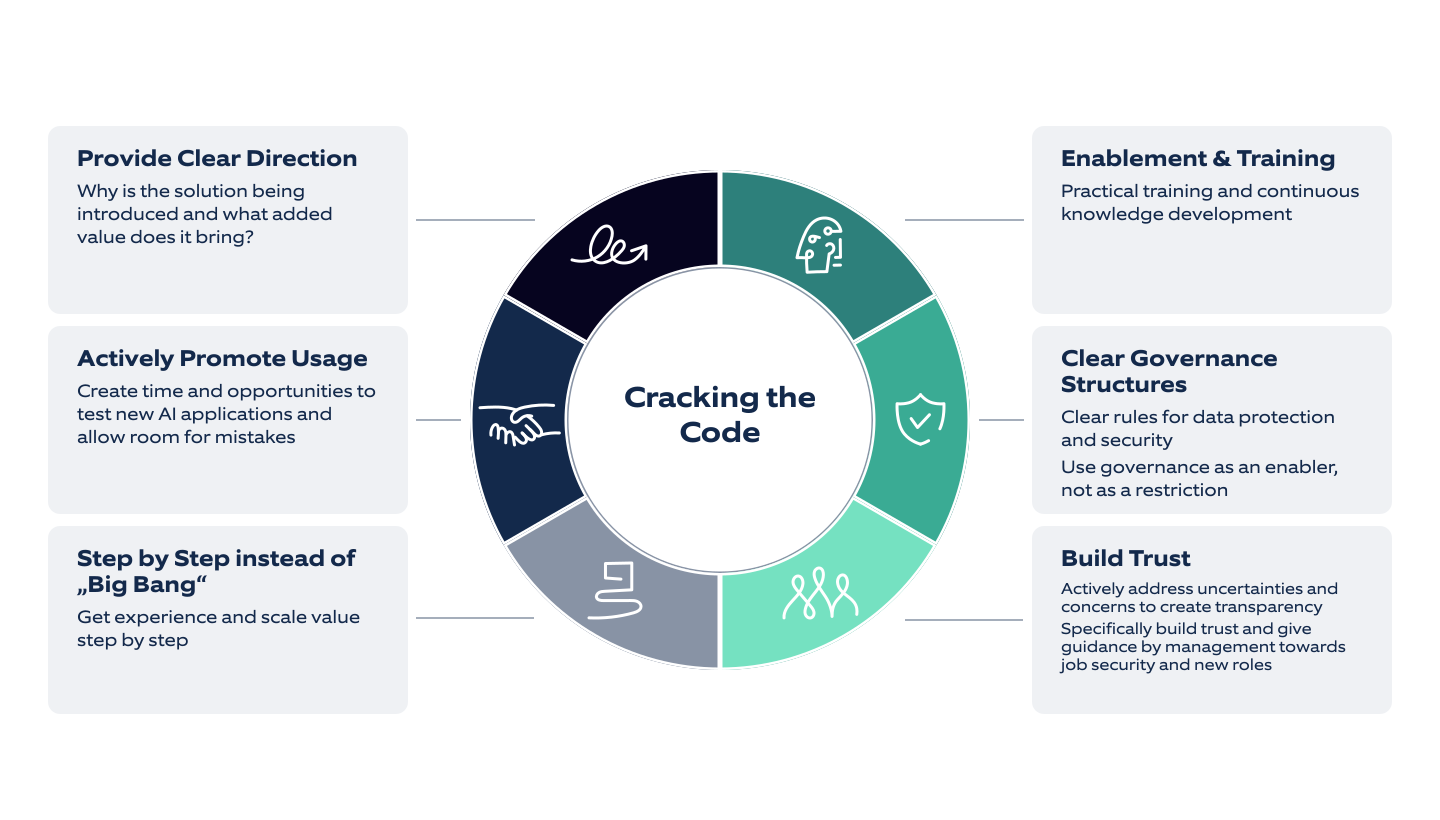 Figure 3
Do note that “normal” Change Management practices will still be carried out, I am just highlighting the AI specifics. For each area of the Pendulum of AI Adoption there is a certain subset of measures that I recommend to you:
- Euphoria: Channel the positive energy towards finding effective use and business cases. If you are establishing some lighthouse projects in some areas of the organization, do not forget to think of a way to connect them properly with the mainland so that more parts of the organization can benefit from them. Also think of rules of engagement and proper AI governance to help people understand what the limits are and gain a positively critical stance.
- Skepticism: An iterative approach is suggested here. Find one part of the organization with the least skepticism and resistance, establish one good use case, and let it run. Then show the rest of the organization how well it works and start spreading out from there. At this stage proper governance will also work well as an enabler. Very clear messages from the top management regarding the goals and vision related to AI are essential to ensuring security.
- Realism / Pragmatism: Of course, in this area there is no resting either, or more than enough to do. The activities resemble much more of the “normal” change management activities in managing resistance, communication, leadership enablement, and training. People should stay in this area with a slight tick towards Euphoria.
Conclusion: AI Transformation is not a technical Problem
The people’s side of change is a critical factor for the success of AI initiatives, if not the most crucial one. I have used a similar picture in my second blog post (see here Practical thoughts on Organizational Change Management: The next steps) and here is the AI-specific version of it:
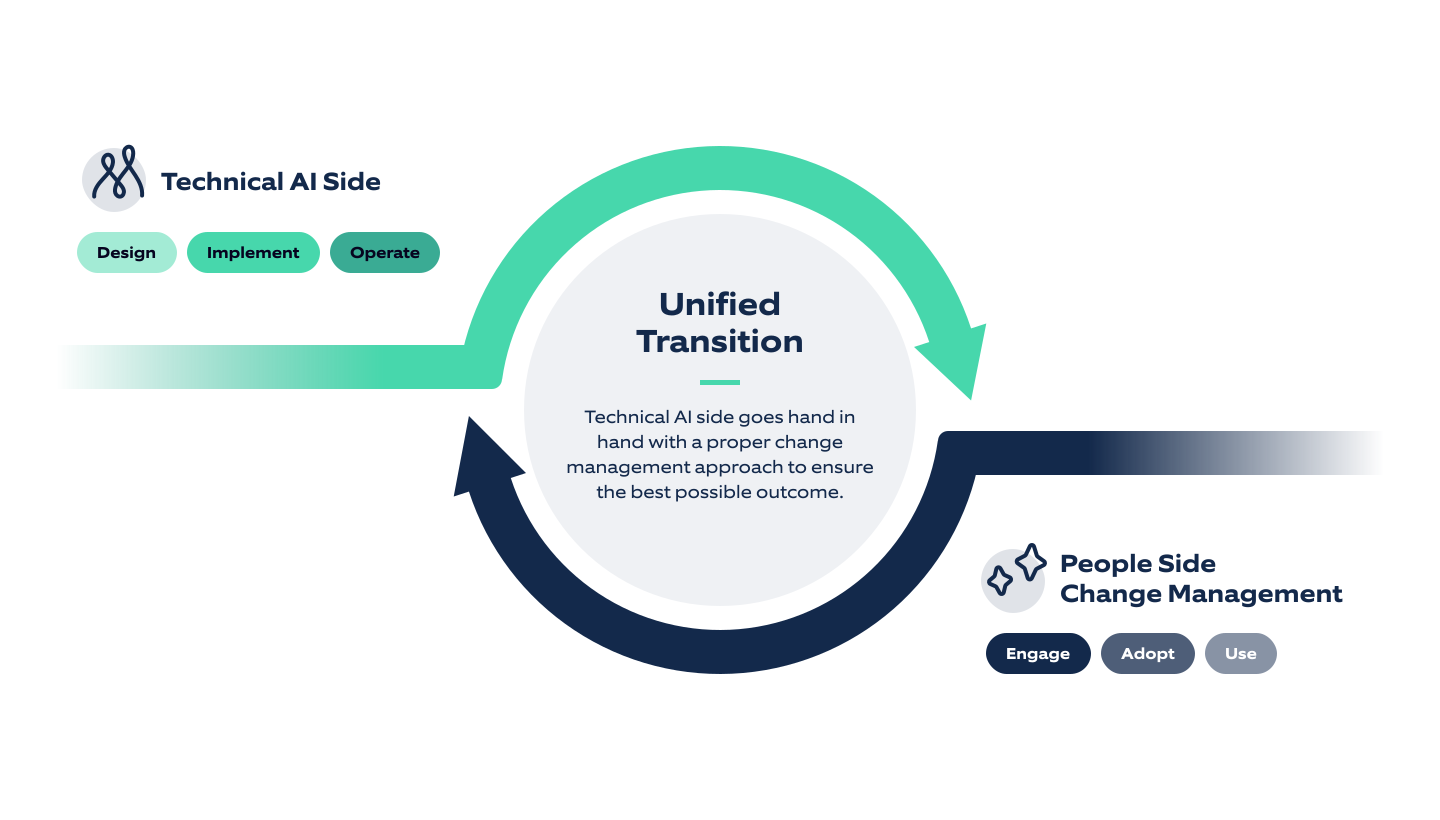
Figure 4
For artificial intelligence to work properly and to yield a solid return on invest, we also very much need human intelligence and the human heart to be aligned and ready. Due to the nature of AI initiatives, I strongly recommend an increased Change Management effort to yield the expected benefits and align the people.
AI initiatives without looking at the people side of change waste potential and jeopardize their return on invest. If this side is neglected for too long, eventually people will leave the organization due to change fatigue or a piled-up history of failed changes. And those mobile people are often the ones you would like to keep and who are expensive to replace.
Especially with costs for AI on the rise, it is a very costly mistake to focus only on the technical side. It is a mistake you do not want to make. That is why our teams for AI transformations always consist of experts from all disciplines.

