60 mins


 China
China  India
India  Japan
Japan  Philippines
  Singapore
  South Africa
  Sri Lanka
  Thailand
  Colombia
  Ecuador
  Austria
  Denmark
  Finland
  France
  Germany
  Hungary
  Norway
  Poland
  Portugal
  Romania
  Spain
Spain  Sweden
  Switzerland
  United Kingdom
  UAE
UAE  Canada
  Mexico
  United States

.svg)


Ever wondered if investing is only for experts? Many people hesitate to invest because they worry about losing money or feel they don’t understand the market well enough. They prefer to keep their money in savings accounts, fixed deposits, or gold; all safe choices, but ones that rarely help wealth grow in the long run.
Maybe they think, “I don’t know anything about stocks, bonds, or crypto markets, so how could I possibly invest?” What if investing didn’t have to feel risky or complicated? What if you could start small, learn as you go, and let technology help you grow your money automatically? What if you could turn $10 into $100, just by letting technology do the heavy lifting?
That’s where robo-advisors come in. They’re like having your own financial consultant using algorithms and data to make smart, unbiased decisions. Whether you’re a student just starting to save or a working professional looking to build long-term wealth, robo-advisors make it possible to invest with confidence.
1. The “Magic” behind robo-advisors
Think of a robo-advisor as a super-smart digital assistant that knows how to invest. It has access to global markets, analyzes data in real time, and makes calculated decisions without ever getting tired.
Here’s how it works:
- It learns about you: Robo-advisor asks about your goals, whether you’re saving for your first car, building a retirement fund, or buying a house. It then builds a personalized investment plan.
- It diversifies your money: Robo-advisor doesn’t put all your eggs in one basket. Instead, it spreads your money across stocks, bonds, real estate or tech investments. This reduces risk and improves stability.
- It uses the power of compounding: Every time your investments earn returns, those returns are reinvested automatically. Over time, that simple act creates exponential growth.
Example: How your investment could grow
Investor Profile:
- Initial investment: $10,000
- Monthly contribution: $500
- Investment horizon: 20 years
- Portfolio allocation managed by robo-advisor:
- 50% Stocks (average annual return 8%)
- 30% Bonds (average annual return 4%)
- 15% Mutual Funds (average annual return 6%)
- 5% Cryptocurrency (average annual return 15%, but higher volatility)
Step 1: Calculate expected annual returns for the portfolio
Weighted average return = (0.50 × 8%) + (0.30 × 4%) + (0.15 × 6%) + (0.05 × 15%) = 4% + 1.2% + 0.9% + 0.75% = 6.85% annual return
Step 2: Project future value of the investment
Using the future value of a series formula for monthly contributions plus initial lump sum:
Future value of initial lump sum: FV=PV×(1+r)^n
- (P = 10,000) (initial lump sum)
- (r = {6.85%}/{12} = 0.005708) (monthly interest rate)
- (n = 20 * 12 = 240) (total months)
FV1= 10,000 * (1 + 0.005708)^{240}=$37590
Future value of monthly contributions: FV = PMT x [(1+r)n - 1)]/r
- (PMT = 500) (monthly contribution)
- (r = {6.85%}/{12} = 0.005708) (monthly interest rate)
- (n = 20 * 12 = 240) (total months)
FV2=500*[(1+0.005708)^240-1)]/0.005708 = $243,480
Step 3: Projected portfolio value after 20 years:
- Future value of initial investment: $37,590
- Future value of monthly contributions: $243,480
- Total portfolio value: $281,070
Total future value FV = 37,590 + 243,480 = $281,070
What this means:
- Starting with $10,000 and adding $500 monthly, a diversified portfolio managed by a robo-advisor growing at an average of 6.85% annually could grow to over $280,000 in 20 years.
- This illustrates the power of compound interest, consistent investing, and diversification, all managed automatically by the robo-advisor.
- The robo-advisor adjusts allocations and rebalances as markets change, reducing risk and optimizing returns.
Why Robo-Advisors work so well:
- Diversification reduces risk
- Regular contributions build discipline
- Compounding accelerates growth
- Automated rebalancing optimizes your portfolio
- Access to new asset classes adds growth potential
For people who feel unsure or intimidated by the idea of investing, robo-advisors offer something priceless: a calm, data-driven way to build wealth at your own pace.
2. Why financial firms love robo-advisors
Robo-advisors aren't just for individual investors. they’re reshaping how financial firms operate. Here’s why:
- Lower costs, higher margins: Traditional financial advisors often charge around 3% annually. Robo-advisors can reduce this to about 0.25%, saving millions for firms managing large portfolios.
- Scalability: Robo-advisors allow financial firms to reach thousands, even millions, of clients across the globe. This goes far beyond serving local markets. Firms can now offer low-cost, personalized investment services to anyone with a smartphone, enabling global expansion without heavy operational overhead.
- Meeting customer expectations: Millennials and Gen Z prefer simple, digital-first experiences. Robo-advisors provide instant, customized financial guidance on the devices people already use.
- Predictable Growth: In North America alone, robo-advisors are expected to manage nearly $8 trillion by 2030. That is not just market expansion, it’s a revolution in accessibility.
The takeaway for financial firms?
By adopting robo-advisory platforms, financial firms are not just improving profits. They are opening doors for people who were once excluded from financial growth.
3. But can you trust all Robo-Advisors?
Robo-advisors are amazing, but can you trust them blindly? The answer is no, not completely.
Robo-advisors are powerful, but not all are created equal. They rely on algorithms built by humans, and while these models are designed to be smart, they can’t predict every event or market change. Sometimes unexpected events (like a pandemic or a sudden market crash) can throw a wrench into things. Think of it as a GPS for your investments. It’s highly reliable, but you still need to steer occasionally.
Do all robo-advisors give the same results? No. Each platform has its own investment philosophy and algorithm, and each one approaches investing in its own unique way.
Here’s a simple breakdown:
- Some focus on low-cost index funds for stable long-term growth.
- Others specialize in thematic investment, like green energy or technology.
- A few are built around tax efficiency to minimize liabilities.
So, how to choose the right one? Start with:
- Clarifying your goals: short-term or long-term growth? Are you saving for a house or just looking for long-term growth? Some robo-advisors are better for short-term goals, while others focus on building wealth for retirement.
- Assessing your risk tolerance: Balanced, conservative or aggressive? Some robo-advisors take higher risks in exchange for potentially higher returns, while others are more conservative. If you’re a new investor, you’ll probably want something more balanced and low risk to start.
- Reviewing your budget: Some platforms have low minimum investments (even $1), while others require more upfront cash.
Key tips for new investors
1. Start small, but start today. You don’t need large capital or expert knowledge to begin. Even small, regular contributions can grow significantly over time through compounding.
For example, Navi ELSS Tax Saver Fund, Navi Large & Mid Cap Fund, and Navi Flexi Cap Fund let investors begin their SIP journeys at this amount. It proves that you can start with what you have, not what you hope to have later.
2. Look for transparency and low fees. Choose robo-advisors that clearly explain how they manage your money and keep their costs minimal.
3. Avoid unrealistic promises. If a platform promises unusually high returns, it’s best to exercise caution.
4. Consistency is key. Building wealth is a gradual process. Stick to your plan and let intelligent automation do the heavy lifting.5. Accessibility is growing. Robo-advisors are breaking barriers that once made investing seem intimidating. With the right mindset and a little help from smart technology, anyone can embark on their investing journey with confidence.
4. How Nagarro can help bring robo-advisors to life
At Nagarro, we believe that innovation should create access. Robo-advisors are not just tools for wealth management; they are instruments of empowerment. They help people everywhere, especially those who once saw investing as out of reach, to take their first step toward financial independence.
We help financial firms design and build the technology that powers modern robo-advisory platforms. From AI-powered investment engines to elegant user interfaces, we create experiences that inspire confidence.
- AI-driven intelligence: Our systems don’t just follow the market; they learn and adapt to it.
- Effortless user experience: We design intuitive, accessible apps that make investing simple for everyone.
- End-to-end development: From strategy to deployment, we help firms build scalable, secure, and compliant platforms.
We see robo-advisors as more than just a financial tool. They represent the next step in financial inclusion, giving everyone, regardless of age, location, or income, the chance to
5. How robo-advisors are changing the world?
Robo-advisors are booming everywhere, from New York to Nairobi, Tokyo to Toronto. They’re helping people from all walks of life grow their savings without stress.
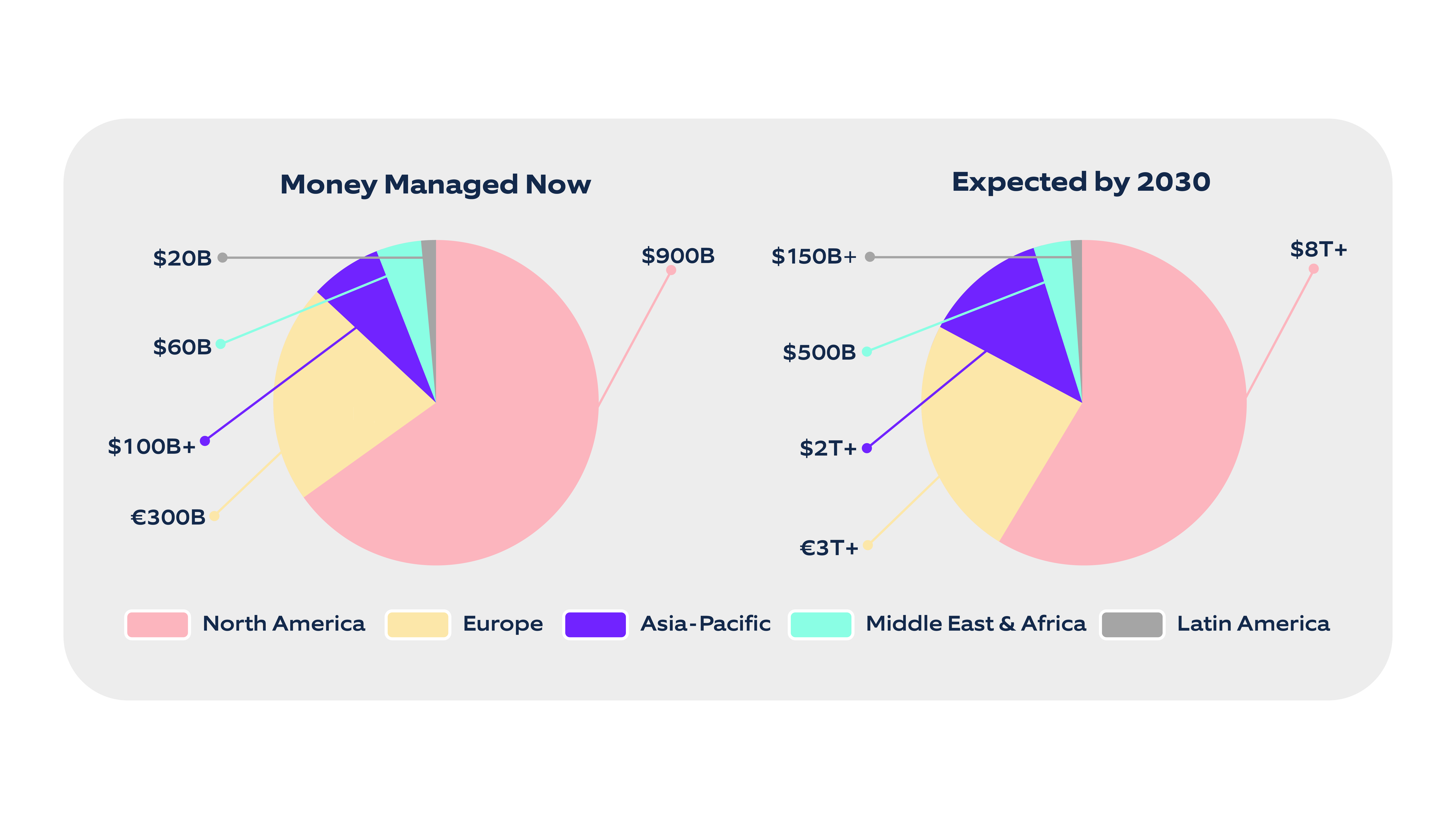
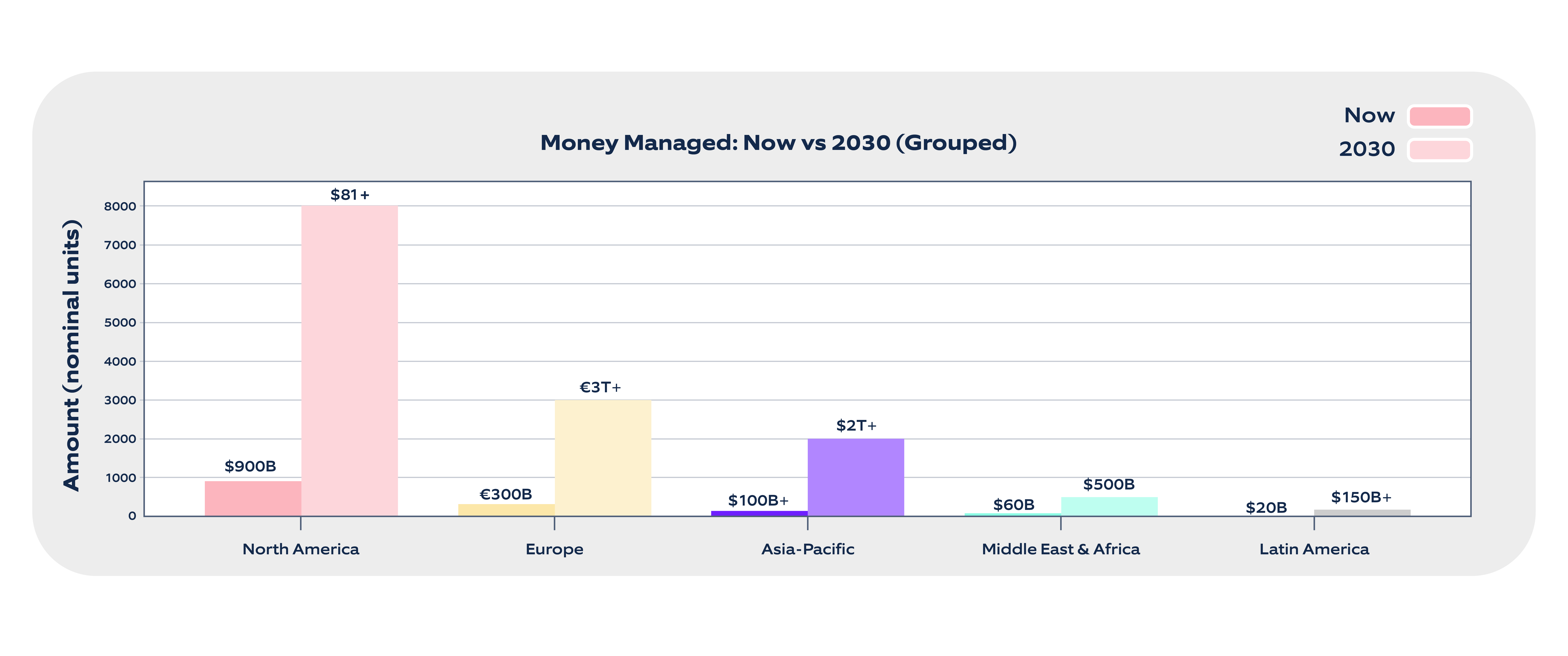
| Region | Money Managed Now | Expected Growth by 2030 | Why It Matters | Source |
|---|---|---|---|---|
| North America | $900 billion | $8 trillion+ | Easy access and low fees for all | Statista and Business Insider Intelligence, 2023 |
| Europe | €300 billion | €3 trillion+ | Focus on green and social investing | Financial Times and Deloitte, 2023 |
| Asia-Pacific | $100 billion+ | $2 trillion+ | Bringing investing to millions | McKinsey Global Wealth Report and Business Insider, 2023 |
| Middle East & Africa | $60 billion | $500 billion | Opening doors for new investors | Middle East Financial Review and PwC Fintech Insights, 2023 |
| Latin America | $20 billion | $150 billion+ | Empowering young, digital natives | Business Insider Intelligence and LAVCA Fintech Reports, 2023 |
The future of investing: What’s coming by 2030?
Imagine a future where:
- Your robo-advisor adapts instantly to global events to protect your portfolio.
- You can invest based on your personal values, such as sustainability or social impact.
- Investing feels more like a guided learning journey than a guessing game.
- Your robo-advisor helps you save, budget, and understand money better.
Conclusion
Robo-advisors are transforming the way people think about money. They make investing simple, affordable, and inclusive. They prove that wealth creation is not just for the privileged few.
For individuals, this is the time to start. You do not need expert knowledge or large sums of money. Consistent, small investments guided by smart automation can build a stronger financial future.