60 mins


 China
China  India
India  Japan
Japan  Philippines
  Singapore
  South Africa
  Sri Lanka
  Thailand
  Colombia
  Ecuador
  Austria
  Denmark
  Finland
  France
  Germany
  Hungary
  Norway
  Poland
  Portugal
  Romania
  Spain
Spain  Sweden
  Switzerland
  United Kingdom
  UAE
UAE  Canada
  Mexico
  United States

.svg)




Organizations are increasingly turning to Edge AI to enable real-time decision-making, reduce latency, improve resilience, and keep sensitive data closer to where it is generated. Yet many initiatives struggle to progress beyond successful pilots and deliver value at enterprise scale.
What’s holding them back? Operationalizing AI models across a distributed environment while maintaining performance, security, reliability and governance. This requires a platform-led approach that brings together MLOps, DevSecOps, fleet management, observability, and edge-cloud orchestration into one operating model.
In this article, we examine the engineering practices organizations need to build scalable, secure, and maintainable Edge AI platforms. (Refer to part one of this series for a practical guide to running AI at the edge.)
How to build efficient AI models for the edge
Optimize AI models for edge environments
Deploying AI models on edge devices requires careful optimization due to limited compute, memory, and power. Two of the most effective techniques are quantization and pruning.
Quantization reduces the numerical precision of model parameters (weights and activations), significantly lowering the model’s memory footprint and computational requirements. Further, Quantization Aware Training (QAT) can help improve accuracy and keep the model robust to precision loss.
Lower-precision operations execute faster, reducing inference latency and improving energy efficiency. With appropriate validation, quantization can preserve model accuracy while significantly improving efficiency.
While quantization reduces precision, pruning reduces the number of parameters by removing weights or connections that contribute little to the model’s output. This results in smaller model size, faster execution and lower memory usage.
Standardize deployment and continuous updates
Standardize Edge AI deployments with containers: Containerization is the practice of packaging an application, its dependencies, and runtime environment into a single, self-contained unit (container). Using tools such as Docker, containers package everything an application needs to run, including its code, libraries, and configuration files, ensuring consistent behavior across different environments.
Containerization bridges the complexity of heterogeneous edge environments by providing standardized, portable, and manageable deployment units, enabling organizations to scale AI workloads reliably across diverse device ecosystems.
Automate model updates with Edge MLOps: When deploying AI models on edge devices, model performance tends to degrade over time. This happens due to data drift: changes in the nature of real-world data.
In production environments, teams continuously monitor this drift. Real-time data is collected from deployed systems and used to retrain models, keeping them accurate and relevant. When a significant drop in performance is detected, the team generates and deploys an updated model.
As a result, production systems require continuous, automated model updates. This process typically includes:
-
Retraining the model using newly collected data
-
Validating inference code and checking for vulnerabilities or quality issues
-
Building and packaging models into Docker containers
-
Scanning container images for security compliance
-
Creating device-specific builds for different edge hardware
-
Deploying updates to edge devices using over-the-air (OTA) mechanisms.
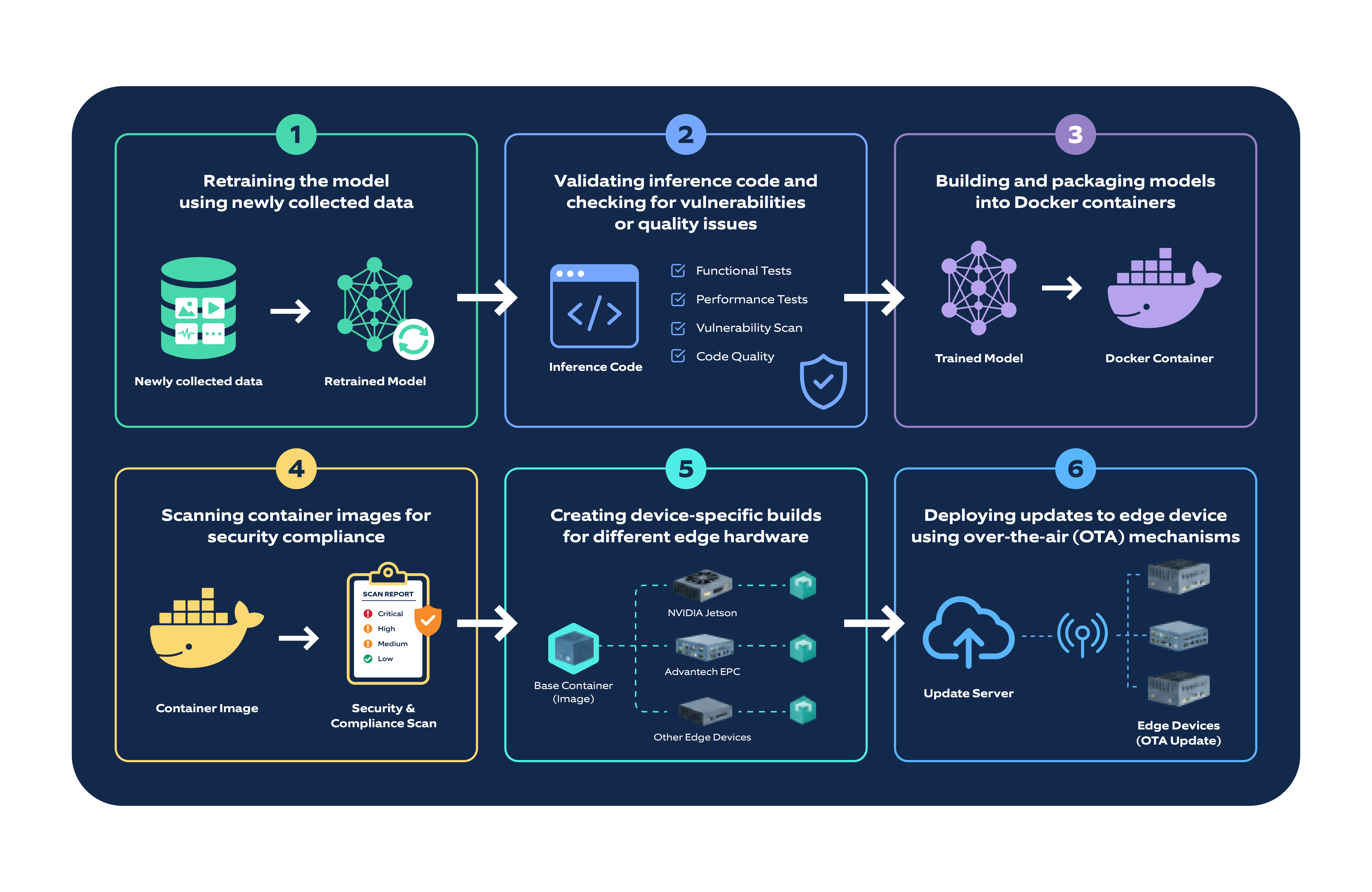
To streamline and scale this lifecycle, organizations adopt CI/CD pipelines aligned with DevSecOps practices.
End to end, this pipeline (covering performance monitoring, data collection, model retraining, validation, packaging, and deployment) forms the foundation of MLOps at the edge. It enables organizations to maintain reliable, secure, and up-to-date AI systems across distributed edge environments.
.png?width=728&height=726&name=Edge%20AI%20Part%202%20Blog%20Illustrations-02%20(1).png)
Security by design
Security by design embeds cybersecurity across the Edge AI stack to protect devices, data, applications, and users.
-
Secure boot & device identity: Ensure only trusted devices and software can run.
-
Encryption: Protect data at rest and in transit.
-
Identity & access management (IAM/RBAC): Enforce least-privilege access.
-
Secure OTA updates: Safely deploy firmware, application, and AI model updates.
-
Vulnerability management & threat monitoring: Continuously detect, patch, and respond to security risks.
-
Audit & compliance: Maintain audit trails to meet governance and regulatory requirements.
These controls enable secure, resilient, and compliant Edge AI deployments.
.png?width=837&height=649&name=Edge%20AI%20Part%202%20Blog%20Illustrations-03%20(1).png)
Operate Edge AI at scale
Manage large fleets of edge devices: As Edge AI deployments grow from a handful of devices to hundreds or thousands of sites, managing those devices becomes a significant operational challenge.
At scale, organizations need capabilities to onboard new devices, maintain an inventory of deployed assets, monitor device health, manage configurations, distribute software and AI model updates, and perform remote diagnostics. Without these capabilities, operating large Edge AI fleets quickly becomes expensive and difficult to manage.
Consider a manufacturing enterprise with 5,000 vision systems deployed across 20 factories. Without centralized edge fleet management, upgrading an inference runtime or patching a security vulnerability would require manual intervention on every device. Device management platforms automate these operations through secure OTA updates and remote diagnostics.
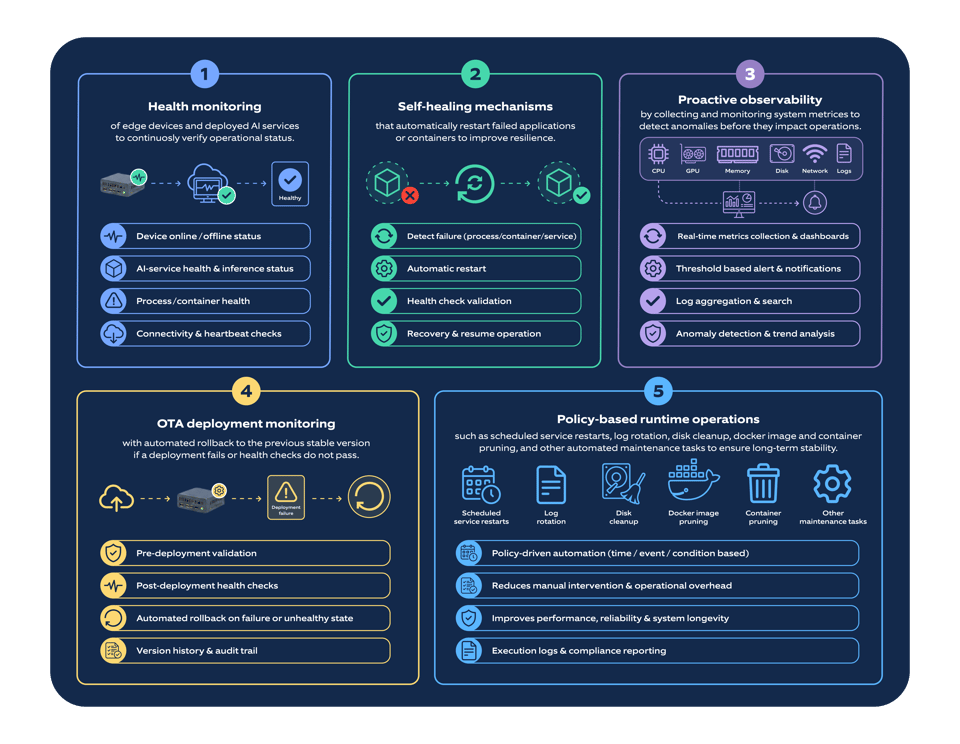
Ensure reliable Edge AI operations: Once an Edge AI application is deployed, maintaining high availability and operational reliability becomes essential. Runtime management ensures edge devices continue operating with minimal manual intervention while quickly recovering from failures.
Key capabilities include:
-
Health monitoring of edge devices and deployed AI services to continuously verify operational status.
-
Self-healing mechanisms that automatically restart failed applications or containers to improve resilience.
-
Proactive observability by collecting and monitoring system metrics such as CPU utilization, GPU utilization, memory consumption, disk usage, network connectivity, and application logs to detect anomalies before they impact operations.
-
OTA deployment monitoring with automated rollback to the previous stable version if a deployment fails or health checks fail.
-
Policy-based runtime operations such as scheduled service restarts, log rotation, disk cleanup, Docker image and container pruning, and other automated maintenance tasks to ensure long-term stability.
This runtime management layer minimizes downtime, reduces operational overhead, and enables reliable operation of large-scale Edge AI deployments in remote and distributed environments.
Monitor Edge AI performance at scale: Most Edge AI use cases involve deployments across dozens or even thousands of sites. AI models often run across large fleets of devices connected to data sources with varying quality and characteristics. As a result, model performance can vary significantly across locations.
To ensure consistent performance and realize the expected business value, continuous monitoring of edge devices and AI workloads is critical. Organizations need visibility into key metrics such as model accuracy, device health, system performance, and failure rates across the entire deployment.
Edge environments are also highly dynamic. Data sources evolve, and software components are frequently updated through over-the-air (OTA) updates. This makes remote access to device logs essential for troubleshooting device-specific issues, diagnosing failures, and maintaining high system uptime.
A platform-led approach addresses these challenges by providing built-in monitoring and logging frameworks. These frameworks enable:
-
Real-time performance monitoring across distributed edge devices
-
Centralised log collection and analysis for faster issue resolution
-
Remote debugging capabilities without physical access to devices
Together, these capabilities improve operational reliability, reduce downtime, and enable scalable management of large edge AI deployments.
%20(1).png?width=8000&height=6714&name=Edge%20AI%20Part%202%20Blog%20Illustrations-06%20(2)%20(1).png)
Build edge and cloud intelligence
Hybrid inference: While Edge AI offers significant advantages, it is not always the best choice for every workload. Some use cases require the advanced reasoning capabilities, broader knowledge, or higher accuracy of large AI models hosted in the cloud.
Hybrid inference combines the strengths of both edge and cloud AI. Time-sensitive tasks are processed locally on the edge device, while more complex requests are selectively routed to cloud-based models for deeper analysis. This approach enables organizations to balance responsiveness, cost, bandwidth consumption, and AI capability.
Consider a smart airport kiosk. A lightweight language model running on the edge can answer common passenger queries such as gate directions, flight information, nearby restaurants, or restroom locations. More sophisticated requests such as planning a multi-city journey, comparing flight options, or creating a vacation itinerary, can be escalated to a cloud-hosted large language model or agentic AI workflow. The passenger experiences a seamless interaction while the system dynamically selects the most appropriate AI resource.
Hybrid inference allows organizations to leverage the speed and reliability of Edge AI while retaining access to the advanced capabilities of powerful cloud-based models, delivering the optimal balance between performance, intelligence, and cost.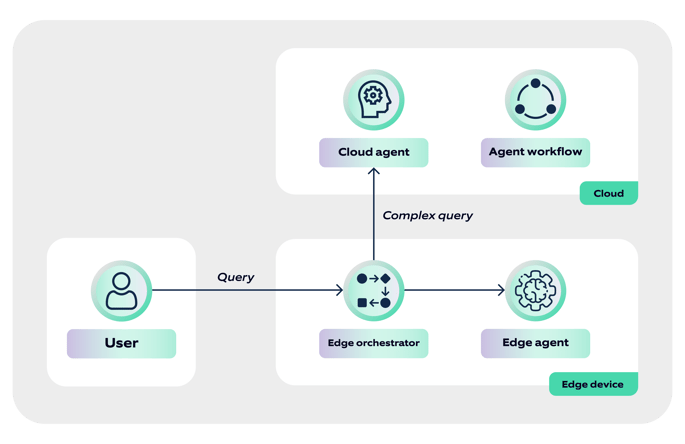
Conclusion: From experimentation to production
Edge AI can deliver significant business value by enabling real-time decision-making closer to where data is generated. However, the success of an Edge AI initiative depends on far more than an individual model's performance.
As deployments scale across distributed devices and locations, organizations must manage the complete lifecycle of their AI systems. This includes model optimization, deployment automation, security, device management, monitoring, and continuous improvement.
The organizations that realize long-term value from Edge AI are those that treat it as a platform capability rather than a collection of isolated models. A platform-led approach creates the foundation needed to deploy, operate, secure, and scale AI consistently across the enterprise.
In the next part of this series, we will explore a reference architecture for building a production-ready Edge AI platform.