60 mins


 China
China  India
India  Japan
Japan  Philippines
  Singapore
  South Africa
  Sri Lanka
  Thailand
  Colombia
  Ecuador
  Austria
  Denmark
  Finland
  France
  Germany
  Hungary
  Norway
  Poland
  Portugal
  Romania
  Spain
Spain  Sweden
  Switzerland
  United Kingdom
  UAE
UAE  Canada
  Mexico
  United States

.svg)




Salesforce has become the operating system of modern businesses. With its powerful ecosystem, Salesforce promises growth, efficiency, and intelligence. Yet, despite millions invested, many organizations fail to unlock even 50% of its potential.
Why? One word: Adoption.
Forrester Research indicates that nearly half of CRM projects, standing at 49%, ultimately struggle or fail. Strikingly, other studies show that 83% of senior executives find it hard to get staff to embrace and effectively use CRM software fully.
Technology investments rarely fail because of software. They fail because of people who do not use the software in the right way, or at all.
1. Meet Neville — The CIO at a crossroads
 Neville, the CIO of a global manufacturing firm, is worried and frustrated.
His company spends millions on Salesforce licenses every year. The board keeps asking about ROI. The sales teams still rely on Excel and manual calculations. Marketing says the data is unreliable. Service agents complain about clunky workflows.
Neville knows Salesforce should be the customer brain of the organization. Instead, it’s become an expensive muscle no one flexes.
2. The silent cost of poor adoption
.png?width=416&height=260&name=Picture5_blog%20(1).png) Ignoring adoption is not only risky; it is financially reckless. Analysts estimate that 70% of digital transformations underdeliver, costing enterprises up to 12% of annual revenue.
Ignoring adoption is not only risky; it is financially reckless. Analysts estimate that 70% of digital transformations underdeliver, costing enterprises up to 12% of annual revenue.
For Neville, poor adoption is a business liability.
Licenses sit underutilized, data is fragmented, and forecasts are wrong.
This leads to missed quotas, frustrated teams, and shadow systems that work around official processes and undermine his IT strategy.
3. AI everywhere, adoption nowhere?
If AI promises automation and simplicity, why does user adoption remain one of the biggest challenges for Salesforce leaders?
Neville believed AI would solve adoption. After all, with copilots and predictive dashboards, he assumed people would naturally want to use Salesforce.
But the reality looks different:
- Users resist change when value isn’t obvious.
- Processes were never redesigned for Salesforce, so the platform simply added administrative overhead.
- Data migrated with duplicates and gaps that eroded trust.
- Systems struggled with performance and integration issues.
- Design overwhelmed users with cluttered screens.
Neville finally realizes tech isn’t the problem, adoption is!

The reasons for low Salesforce adoption can be viewed through several lenses.
- User-related factors
Users don’t see clear value in the CRM, carry negative past experiences with digital tools, feel monitored, resist change, or are simply unsure how to use the system. This richness of features overwhelms them instead of helping them. - Process-related factors
Workflows are not mapped correctly or they do not reflect daily realities. Role-based views and customizations are missing, so everyone sees the same screens and irrelevant fields. - Data-related factors
Poor, outdated, duplicate or fragmented data across disjointed systems leads to low data trust and confusion. Users stop depending on Salesforce for decisions. - Implementation-related factors
Weak implementation, performance issues and half-integrated systems slowly erode confidence in the application. - Design and UI/UX related factors
Confusing or cluttered interface, mobile unfriendliness, complex navigation and non-intuitive designs - Change Management or Support factors
One-time training, no clarity on goals or usage measurement, lack of champions or internal role models, and no feedback mechanisms all reduce the chances of sustained adoption.
4. Adoption reality check: Where is Neville’s org on the curve?
Neville encounters Nagarro’s Salesforce Adoption Maturity Model and decides to run an honest assessment of his company.
Let’s do a quick deep dive into the model (Figure 1) first.
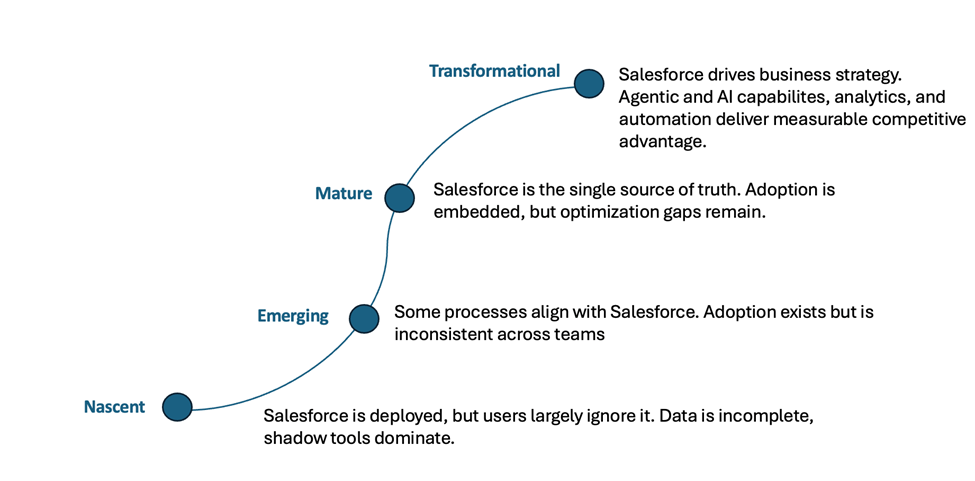
Figure 1
 After reviewing the model and looking at his organization’s behavior, Neville realizes his firm sits somewhere between “Nascent” and “Emerging.” Painfully honest, but a very necessary analysis.
This moment of clarity becomes the turning point.
5. From excuse to execution: Can this be fixed?
Good user Adoption is not a mystery. It is an engineering and behavioral challenge that can be approached systematically.
Some key enablers include:
- Assessment & Diagnostics: Identify root causes (process, data, system, people, combination).
- Clear Goals: Define what adoption means for the organization and track it. Examples include login frequency, data completeness, opportunity hygiene, and forecast accuracy.
- Executive Sponsorship: Leaders must own the dashboards and outcomes. Adoption improves when executives ask for Salesforce-driven insights.
- Continuous Enablement: Training at go-live is not enough. Enablement should be embedded into workflows with regular refreshers and contextual help.
- Support Model: A strong mix of hypercare and ongoing admin support reduces user friction quickly and builds trust in the platform.

- Assessment: Where are we today?
- Goal Definition: What does good adoption look like for us?
- Change Champions: Who will lead the adoption wave?
For Neville, the journey now starts with a clear definition of success, not with more licenses or new features.
6. Climbing the adoption ladder
Adoption isn’t a one-time fix. It’s a journey that moves through various maturity stages.
Each stage builds on the previous one, shifting from survival mode to real transformation. With the right steps, companies can move from basic usage to high-impact Salesforce adoption. 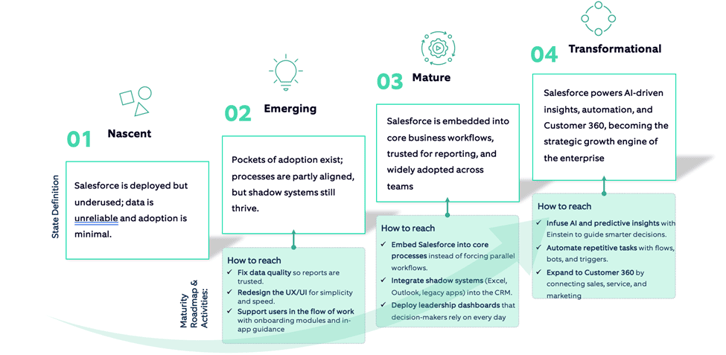
Neville aligns his plan to the maturity curve:y
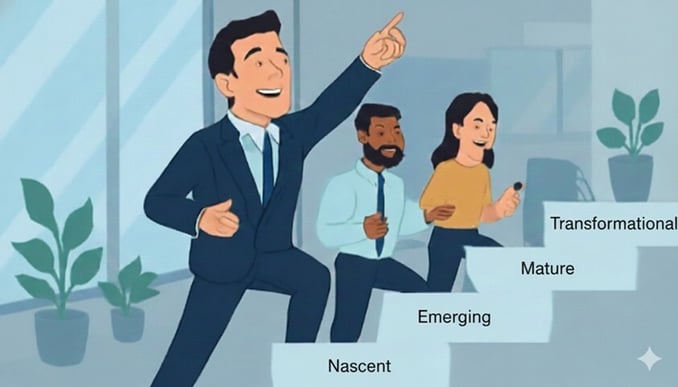
- Nascent to emerging: Focus on quick wins, targeted training, and visible executive sponsorship.
- Emerging to mature: Invest in UX redesign, process realignment, and data cleansing.
- Mature to transformational: Integrate systems, enhance analytics, and deliver dashboards that leaders and teams actually use for daily decisions.
Neville realized that progress will be step-by-step. Adoption behaves more like a ladder than one big leap.
Enter RAPID-USE
At Nagarro, we created RAPID-USE (Root-cause Analysis & Performance Improvement for Driving User Salesforce Engagement), a structured framework to identify and solve adoption challenges for Salesforce implementations.
RAPID-USE covers multiple adoption barriers through a set of focused steps:
| Adoption Barrier | Root Causes (Why it happens) | Solution (Approach) |
|---|---|---|
| R – Requirements Misalignment |
|
|
| A – Adoption Resistance (User Behavior) |
|
|
| P – Poor Data Quality |
|
|
| I – Implementation Gaps |
|
|
| D – Design & UX Failures |
|
|
| U – Untrained Users |
|
|
| S – Support Weakness |
|
|
| E – Engagement & Sustainability Gaps |
|
|
Along with technical audits, UX blueprints, data remediation, enablement toolkits, and adoption heatmaps, this framework turns adoption from a pain point into a growth engine.
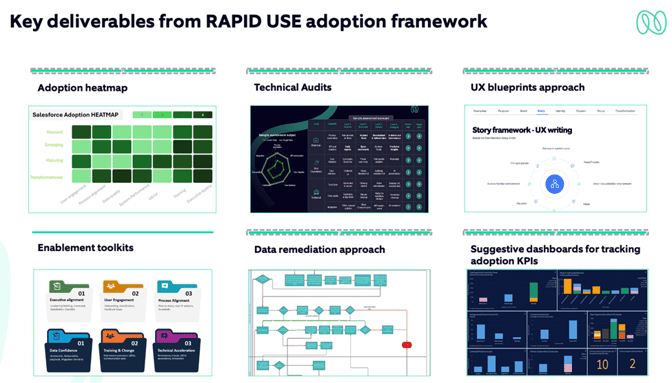
7. Neville applies RAPID-USE
 Neville decides to adopt Nagarro’s RAPID-USE framework. He used it for root-cause analysis & performance improvement for driving user salesforce engagement. It diagnoses issues across runtime performance, business alignment, UX, data, training, support, shadow systems, and executive buy-in.
For the first time, Neville has a structured, repeatable playbook instead of scattered and short-term fixes.
8. The New ROI is Adoption
 Months later, the picture looks different.
Adoption metrics climb across key roles.. Sales teams stop defaulting to Excel. Forecast accuracy improves by 25 percent. Data trust returns as duplicate and stale information is cleaned up.
Neville finally sees Salesforce shifting from a cost center to a growth engine.
His takeaway?
Technology doesn’t fail. Adoption does.
When on fixes the adoption, Salesforce starts to deliver on its full promise.
In the age of AI, the winners aren’t the organizations with the most features, but the ones whose people actively use the tools they already have.
Adoption is no longer a side conversation. It is the strategy. With the right framework, Salesforce can move from “just another tool” to the central driver of business transformation.
If you see your own organization in Neville’s story, we should talk.
Let’s come together to turn user adoption from a pain point into a growth engine and realize the true ROI of your Salesforce implementation.

%201.jpg?width=83&height=83&name=IMG-20210918-WA0023%20(2)%201.jpg)