60 mins


 China
China  India
India  Japan
Japan  Philippines
  Singapore
  South Africa
  Sri Lanka
  Thailand
  Colombia
  Ecuador
  Austria
  Denmark
  Finland
  France
  Germany
  Hungary
  Norway
  Poland
  Portugal
  Romania
  Spain
Spain  Sweden
  Switzerland
  United Kingdom
  UAE
UAE  Canada
  Mexico
  United States

.svg)




When testing teams join a new project, they are often expected to deliver quality quickly with little reliable context. Documentation is outdated, incomplete, or missing. Requirements, process flows, and functional specifications are scattered across stakeholder knowledge, old defect tickets, and a handful of automated tests.
This slows onboarding, creates inconsistent product understanding, and delays test coverage when the business needs confidence most. Traditionally, testers bridge this gap through stakeholder shadowing, repeated clarifications, and manual exploration, but that approach does not scale well, especially in legacy systems where knowledge is fragmented.
AI gives testing teams a more proactive path. Instead of waiting for refined requirements, testers can reverse-engineer from the product itself. By combining exploratory testing with AI-powered analysis, teams can uncover business rules, map workflows, identify hidden assumptions, and generate draft specifications directly from the application.
For organizations modernizing legacy systems or accelerating delivery, this is more than a testing technique. It is a way to rebuild product understanding, reduce dependency on tribal knowledge, and create a stronger foundation for quality. This article presents a practical framework for doing exactly that.
The central argument is straightforward: AI’s greatest value in undocumented systems is not faster test generation, it is faster product understanding. When a team can quickly build a shared mental model of what a system is supposed to do, every testing decision that follows becomes sharper and better directed.
What testing without clear requirements costs an organization?
Testing without clear requirements is a shot in the dark. Without clear product understanding, the feature you are prioritizing or the bug you are logging is irrelevant. This happens due to various reasons:
-
Legacy applications with little or no documentation
-
User stories with limited details
-
Features understood by only a handful of people
-
New team members trying to learn a big product
Testing without clear requirements creates problems that grow over time. Teams often build test plans based on partial product knowledge, making it difficult to prioritize the right features and scenarios. This can lead to defects being reported and later closed as intended behavior.
The challenge is not only validating the application but understanding its purpose and expected behavior. AI can help bridge this gap by accelerating product understanding and guiding testing efforts more effectively.
AI as a product discovery assistant
AI excels at analyzing large amounts of information, identifying patterns, summarizing behavior, and organizing knowledge. Rather than treating AI purely as a test generation tool, consider using it as a product discovery assistant. These capabilities are particularly useful when testers need to understand unfamiliar systems with little or no documentation.
Organizations can approach reverse-engineering of requirements in terms of three layers. Each layer uncovers deeper product understanding.
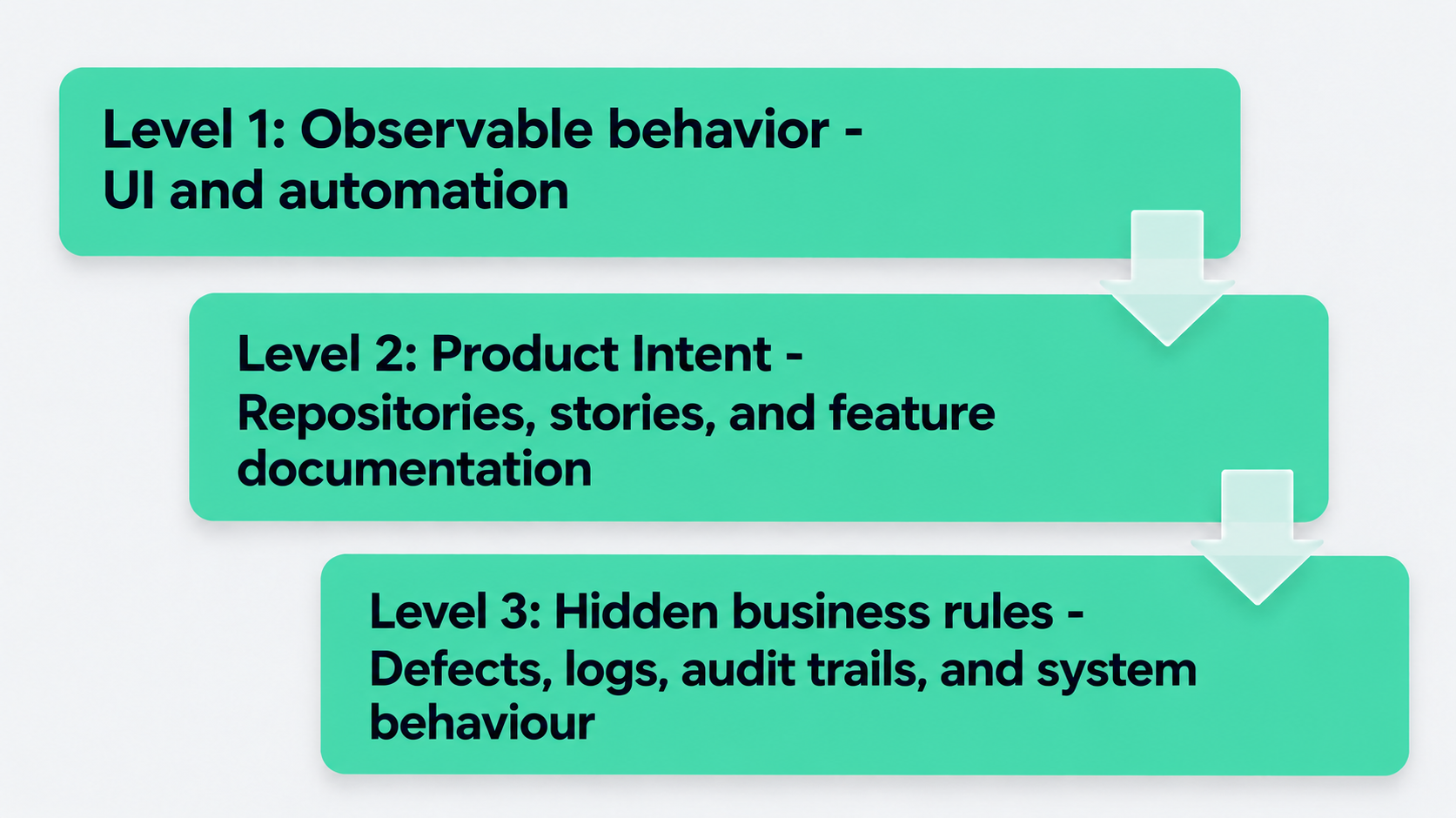
Level 1: Observable behavior - UI and automation
This layer focuses on understanding what users do and what the system visibly supports.
Starting with the user interface: The UI is often the most accessible source of product knowledge. Experienced exploratory testers learn applications by navigating screens, observing workflows, and identifying user actions.
Today, testers can go a step further by combining AI with tools such as Playwright MCP to build exploratory testing agents that can probe live applications and help create product requirement drafts and test charters.
Existing automation: Your hidden requirements repository: Existing automation tests for a product serve as a great source of system knowledge. Well-written automated tests often contain years of accumulated understanding about how a product behaves. In many organizations, automation contains more accurate and up-to-date business knowledge than formal documentation.
AI can analyze Playwright, Selenium, Cypress, or API test suites and help answer questions such as:
-
What business scenarios are being validated?
-
Which workflows are considered critical?
-
What assumptions do these tests make?
-
What business rules appear repeatedly?
A collection of hundreds of automated tests can quickly be transformed into understandable business narratives, dramatically accelerating onboarding and product learning.
Level 2: Product intent - repositories, stories, and feature documentation
Once you're past Level 1 and understand how the application behaves, ]the next step is understanding why it behaves that way. This layer has two primary aspects-
Mining product knowledge from the development repository: The development repository is one of the richest yet most underutilized sources of product knowledge. In many modern projects, the repository serves as a living history of product decisions. AI helps convert technical artifacts into business knowledge.
Beyond the source code, repositories typically contain:
- Architecture documents
- README files
- Wiki Pages
- Release notes
- Test data
- Design discussions
- Pull Requests
- Commit history
These artifacts often reveal business context that never made its way into formal requirements. For example, if you need to find how a particular module works, find the related file in the development repository, reference it to AI and ask:
-
Why was this feature introduced?
-
What business problem was it designed to solve?
-
What validations were added?
-
Which user personas are impacted?
-
What edge cases are developers explicitly handling?
Similarly, reviewing commit history often helps uncover business rules that evolved over time. If you feel that a particular functionality on a page has been working differently lately and you need to find out why, a simple prompt such as:
Analyze the pull requests that modified file “X” and summarize the business functionality introduced over the last few days.
This can provide a surprisingly accurate view of recent changes that make it behave differently and the reasoning behind it.
User stories and epics: Understanding product intent
User stories and epics provide insight into what the business intended, even when implementations have evolved significantly since they were written.
AI can analyze:
-
User stories
-
Acceptance criteria
-
Feature requests
-
Epic descriptions
-
Product backlog items
to identify:
-
Recurring business objectives
-
User personas
-
Workflow dependencies
-
High-priority business processes
-
Functional gaps between intended and actual behavior
Comparing current application behavior against historical stories often reveals undocumented changes that occurred over time. This layer helps answer not only "How does the system work?" but also "What problem was it originally trying to solve?"
Many of the latest product management tools like Jira, Azure DevOops & Rally have their own MCPs. Testers can utilize these MCPs to understand a feature better by pulling relevant data from Features & User stories.
Level 3: Hidden business rules – defects, logs, audit trails, and system behavior
This layer uncovers business rules that may not be obviously visible.
Defect History: A gold mine of business rules
Defects reveal how the system failed, and more importantly how the system was expected to behave.
Historical bug reports often contain:
-
Expected behavior
-
Actual behavior
-
Reproduction steps
-
Business impact
-
User expectations
When analyzed collectively, they expose recurring patterns. For example:
-
Certain fields may always require validation
-
Specific user roles may have access restrictions
-
Approval workflows may enforce hidden business constraints
-
Data combinations may be invalid
AI can identify themes across thousands of defect records and surface business rules that may not exist anywhere else. In many organizations, defect history becomes an unofficial requirements repository.
Learning from application logs and system behavior
Logs often contain business activity that gets ignored in the usual workflow. Many complex systems have some configuration-related process running in the background, like:
-
Approval processing
-
Workflow transitions
-
Notification triggers
-
External integrations
-
Background jobs
Feature flag changes, for instance, can silently alter application behavior in ways that are rarely documented. This knowledge is often confined to a handful of people. But using AI to analyze logs, audit trails, and event streams can help reconstruct complete business workflows.
Bringing everything together
Once all three discovery layers are analyzed, AI can synthesize information from multiple sources and generate draft specifications, including:
-
User stories
-
Functional requirements
-
Business rules
-
Process flows
-
Domain glossaries
-
System diagrams
Instead of starting from a blank page, the team begins with a well-informed hypothesis to validate with stakeholders. The result is faster onboarding, better test planning, improved exploration testing, and a deeper understanding of the product domain.
Putting this framework into practice – A walkthrough
Consider a tester who joins a project mid-flight. The product is a workflow management system used by a sales organization. No functional specifications, no process flow diagrams, and the person who built the original version left the company a year ago. Testing needs to begin immediately.
The tester starts at Level 1. They navigate the application systematically, mapping screens, user actions, and visible workflows. Separately, they feed the existing automation suite into an AI tool and ask: what business scenarios are these tests validating? The AI returns a summary describing the deal approval flows, role-based access patterns, and field-level validations that appear across multiple test files. In under an hour, the tester has a working outline of what the system appears to do which is built entirely from artifacts the team already owned.
Moving to Level 2, the tester locates the service layer for the approval module in the development repository and asks AI to extract the business logic: what validations are enforced, what states a record can move through, and what triggers each transition. They also find a handful of old epics in the backlog. AI cross-references these against the observed code behavior and surfaces a gap: the original stories describe a two-step approval process, but the current implementation appears to enforce only one. That discrepancy becomes a specific and targeted question for the product owner, which is far more productive than a vague conversation about how the feature works.
At Level 3, the tester analyzes two years of defect history. AI identifies a recurring pattern: multiple bugs were logged against the same scenario, e.g. records being approved by users who should not have had permission. Each was closed as a duplicate or resolved with a configuration change, but the underlying rule was never formally documented. That pattern becomes a business rule: approval requires role validation, and the system has a known history of edge cases around permission boundaries.
By the end of the exercise, the tester has a draft set of business rules, a prioritized list of high-risk areas, and a short list of targeted questions for the product owner. The team is no longer testing in the dark. They test with a hypothesis they can validate, refine, and build on.
Human-in-the-loop approach
AI can accelerate discovery significantly, but treat everything it surfaces as a hypothesis, not a final answer. Reverse-engineered requirements represent informed assumptions derived from observable behavior. They are a starting point for conversations, not a substitute. Before acting on any AI-generated specification, validate it with the people who carry business and domain knowledge.
AI helps generate hypotheses quickly, but humans must validate them before treating any output as definitive. In practice, this means taking discovered requirements back to product owners, business analysts, or domain experts and asking targeted questions: Does this accurately reflect how the feature is supposed to work?
Are there regulatory or policy constraints not visible in the code? Has this business rule changed since it was originally implemented? What edge cases does the system handle that are not obvious from observable behavior?
AI-powered discovery produces a well-informed first draft that earns its place only after human review.
The strongest approach combines AI-powered analysis with insights from product owners, business analysts, support teams, and domain experts.
Conclusion
By leveraging AI alongside exploratory testing techniques, testers can reverse-engineer product behavior from UIs, automation suites, feature specifications, development repositories, logs, and historical defects. The result is faster onboarding, deeper understanding, and more effective testing.
The most successful testers of the future may not be those who simply validate requirements. They may be the ones who can uncover them.