60 mins


 China
 India
 Japan
 Philippines
 Singapore
 South Africa
 Sri Lanka
 Thailand
 Colombia
 Ecuador
 Austria
 Denmark
 Finland
 France
 Germany
 Hungary
 Norway
 Poland
 Portugal
 Romania
 Spain
 Sweden
 Switzerland
 United Kingdom
 UAE
 Canada
 Mexico
 United States




This article is the third and final part of our Edge AI series. In the first article, we examined the unique challenges organizations face when moving AI from centralized cloud environments to distributed edge deployments. In the second article, we explored the best engineering practices required to address these challenges.
One lesson from these practices is that individual tools and processes aren't enough to run Edge AI at scale. While organizations may successfully establish standalone tools and processes for model training, deployment, monitoring, or device management, managing them independently often creates operational silos, increases complexity, and limits scalability. To scale reliably, organizations need a platform that connects model development, deployment, monitoring, and device operations.
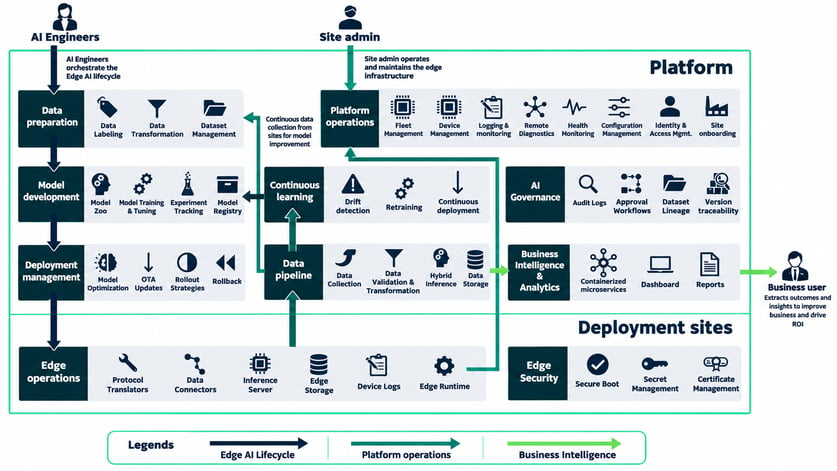
In this final article, we bring together the concepts discussed throughout the series and present a reference architecture for an Edge AI platform. The architecture illustrates how data preparation, model development, deployment, edge operations, inference, analytics, governance, security, and continuous learning can be integrated into a cohesive platform that supports the complete Edge AI lifecycle. Rather than prescribing a specific technology stack, the architecture provides a blueprint that organizations can use to design and evolve their own production-ready Edge AI platforms.
The Edge AI lifecycle
The Edge AI lifecycle goes through the stages involving preparing the data to train the model, evaluating, and deploying the model, monitoring, and collecting metrics from the deployed model and retraining the model in case of drift. A platform should provide the capability to enable and automate the complete Edge AI lifecycle to ensure operational excellence while ensuring security and cost efficiency.
The lifecycle stages are detailed below:
Data preparation
Every AI model begins with data. For each use case, one or more datasets are collected and curated to represent the scenarios the model is expected to handle. Before model training, data typically undergoes labeling, transformation, and augmentation to improve its quality, diversity, and suitability for machine learning.
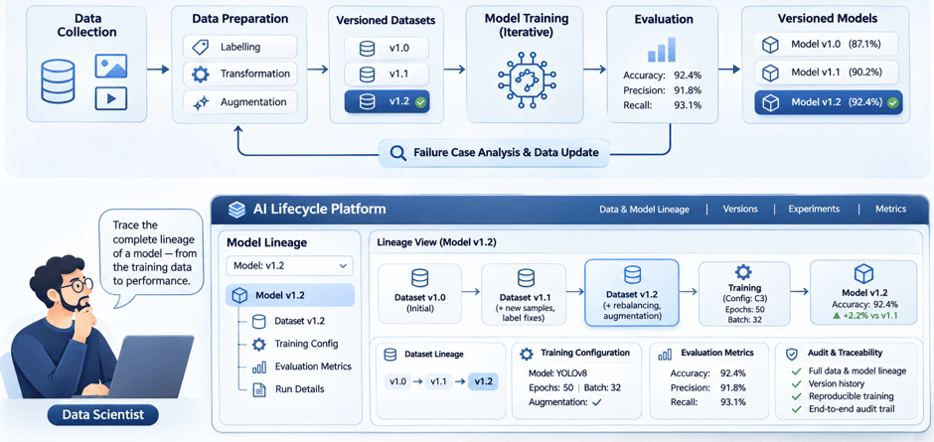
Model training is an iterative process. Each model training cycle identifies failure cases where the model performs poorly, revealing gaps in the dataset. These insights are used to collect additional samples, correct labels, or rebalance existing data, resulting in progressively improved dataset versions and model performance.
As datasets evolve, it is essential to maintain data lineage and versioning to ensure reproducibility and traceability. The platform should track dataset versions, the models trained using each dataset, training configurations, evaluation metrics, and overall model performance. This helps teams understand how dataset changes affect model accuracy and produce a reliable audit trail throughout the AI lifecycle.
Model development
Model development typically begins with a pre-trained model rather than training from scratch. For use cases such as object detection, image classification, or segmentation, transfer learning enables organizations to fine-tune existing models on domain-specific datasets, significantly reducing training time while achieving high accuracy.
An Edge AI platform should provide a model repository (or a model zoo) of validated, pre-trained models that serve as the foundation for different AI use cases. Standardizing on approved base models improves consistency, accelerates development, and simplifies maintenance across projects.
The platform should also support experiment management to enable data scientists to evaluate different training strategies. This includes tracking changes to datasets, hyperparameters, preprocessing pipelines, model architectures, and training configurations, along with the resulting evaluation metrics. Experiment tracking makes model development reproducible and helps teams identify the factors that contribute to improvements in model performance.
Before deployment, models should be validated on representative target hardware to assess inference latency, throughput, memory consumption, and resource utilization. Performance observed during development or cloud-based testing may differ significantly from actual edge deployments. The registry acts as the source of truth for approved model versions and provides the metadata, version history, and lifecycle management required for controlled deployment to edge devices.
Model deployment & platform operations
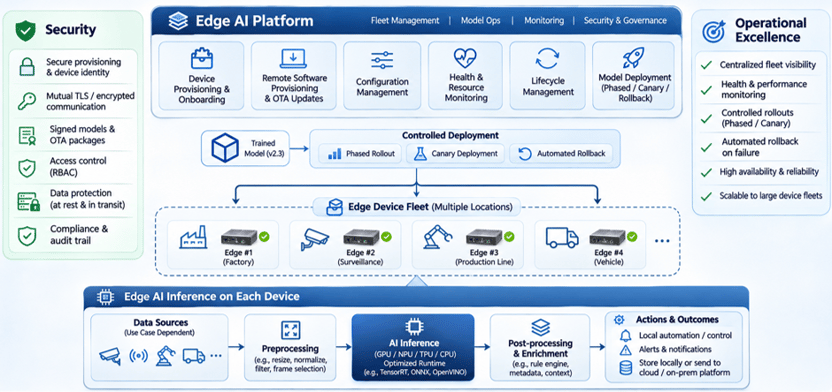
Before AI models can be deployed, edge devices must be securely provisioned and onboarded to the platform. Provisioning establishes the device's identity, enables secure communication with the platform, and registers hardware and software information such as processor architecture, available accelerators, operating system, installed runtime, and available resources. This inventory allows the platform to determine whether a device is compatible with a particular AI workload.
An Edge AI platform should provide centralized edge fleet management capabilities, including remote software provisioning, over-the-air (OTA) updates, configuration management, health monitoring, and lifecycle management of edge devices. Continuous monitoring of device health, resource utilization, connectivity, and runtime status ensures that deployments are performed only on healthy devices and that operational issues can be detected and resolved remotely.
Once a device is provisioned, healthy, and meets the deployment requirements, it becomes a candidate for AI model deployment. The platform should support controlled deployment strategies such as phased rollouts, canary deployments, and automated rollback in case of failures, enabling reliable and scalable deployment across large fleets of edge devices.
Edge AI inference
Once an AI model and its supporting software are deployed, the edge device begins collecting data, executing inference, and processing the resulting outputs. Depending on the use case, data may originate from cameras, industrial equipment, IoT sensors, vehicles, or other connected systems.
After data is collected, it undergoes preprocessing before being passed to the inference engine. AI inference is executed using frameworks or inference runtimes optimized for the underlying hardware, such as GPUs, NPUs, TPUs, or CPUs, to meet the latency and throughput requirements of the application. Following inference, the results are post-processed, enriched with contextual information if required, and used to trigger downstream actions such as local automation, alerts, or business workflows. The processed results are then stored locally or transmitted to the cloud or a centralized on-premises platform for further analytics, reporting, and long-term storage.
Data pipeline
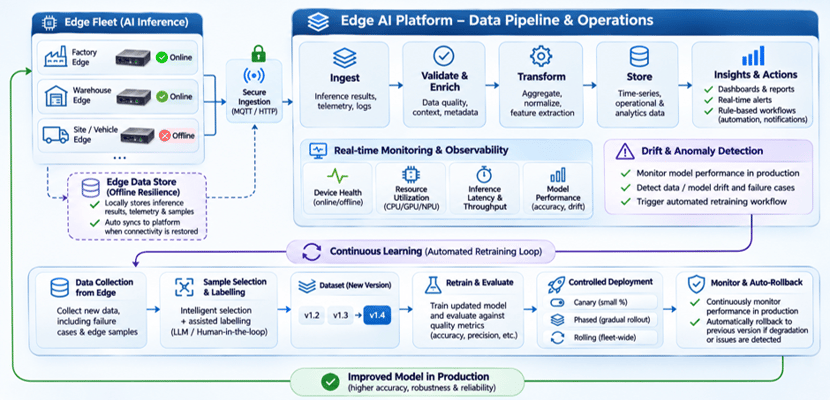
The data pipeline collects inferences from distributed edge devices across the enterprise and transforms them into actionable business insights. It ingests data from hundreds or thousands of devices, performs validation, enrichment, and transformation, and stores the processed data in suitable storage systems for analytics, visualization, and reporting.
Beyond business data, the pipeline also ingests operational telemetry from edge devices, including system logs, resource utilization, inference latency, device health, and model performance metrics. This operational data provides visibility into the health and performance of the Edge AI platform, enabling proactive monitoring, troubleshooting, and capacity planning.
The data pipeline can also integrate with rule engines, event processing systems, or alerting platforms to generate real-time notifications and automate business workflows based on inference results. In addition, the collected telemetry and inference data serve as valuable inputs for continuous learning by identifying model drift, detecting failure cases, and providing the data required for retraining and improving AI models over time.
Continuous learning
Continuous learning closes the feedback loop in the Edge AI lifecycle by continuously improving models as new data becomes available. Over time, changes in operating conditions, environments, sensor characteristics, or user behavior can lead to data drift and model performance degradation. An Edge AI platform should continuously monitor model performance and detect such drift to identify when retraining is required.
The platform should support automated data collection from edge devices, intelligent sample selection, and assisted data labeling using larger cloud-based foundation models or human-in-the-loop workflows. Newly labelled data can be incorporated into updated dataset versions, enabling the model to be retrained and evaluated against predefined quality metrics.
The platform continuously monitors the performance of the new model in production and automatically rolls back to a previous version if performance degrades or operational issues are detected. This feedback loop enables Edge AI systems to adapt as operating conditions change, without losing control over production deployments.
Conclusion
Throughout this series, we have examined the journey from understanding the challenges of Edge AI to identifying the best practices required for successful adoption. The common theme across both discussions is that sustainable Edge AI success depends not on any single technology or tool, but on the ability to manage the entire lifecycle as an integrated platform.
The reference architecture presented in this article provides a blueprint for achieving that objective. By bringing together data management, model development, deployment automation, edge fleet management, AI inference, analytics, security, governance, and continuous learning, organizations can establish a scalable and operationally resilient foundation for Edge AI.
As Edge AI deployments continue to grow in scale and business criticality, the focus must shift from deploying individual models to operating a repeatable, end-to-end AI platform. Organizations that adopt a platform-centric approach will be better positioned to accelerate innovation, reduce operational complexity, continuously improve model performance, and get more consistent value from AI at the edge.
Whether you're evaluating your first Edge AI use case or scaling a growing deployment, establishing a robust platform architecture is critical for long-term success. Explore how Nagarro helps organizations build and operate production-ready Edge AI solutions.