60 mins


 China
China  India
India  Japan
Japan  Philippines
  Singapore
  South Africa
  Sri Lanka
  Thailand
  Colombia
  Ecuador
  Austria
  Denmark
  Finland
  France
  Germany
  Hungary
  Norway
  Poland
  Portugal
  Romania
  Spain
Spain  Sweden
  Switzerland
  United Kingdom
  UAE
UAE  Canada
  Mexico
  United States

.svg)


.png)
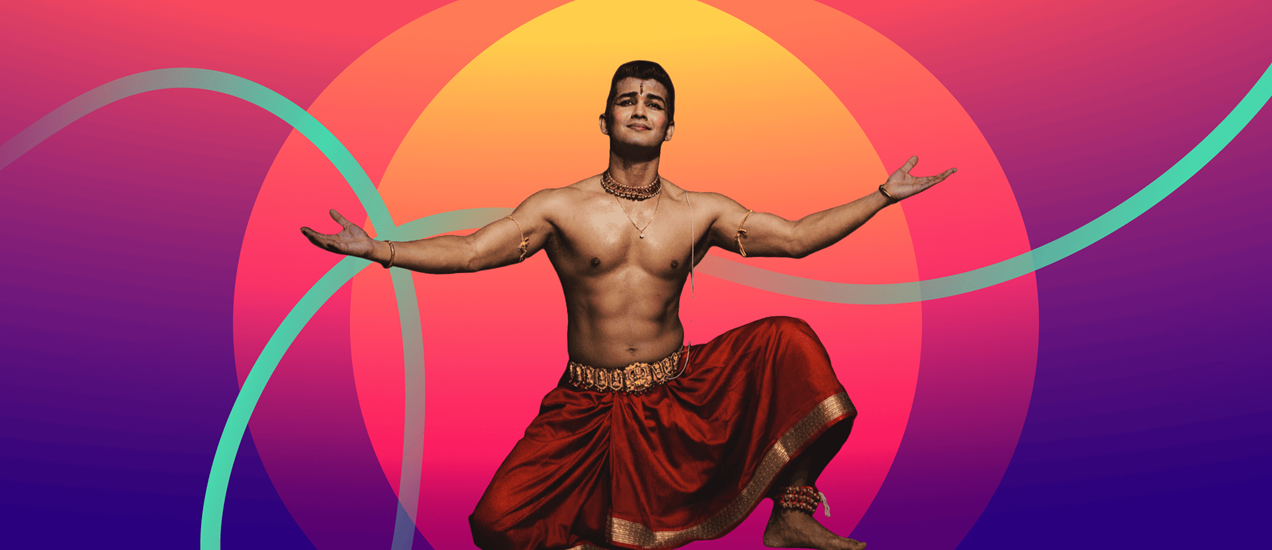
In this edition of Nagarrians at Play, we meet Vishwadeep Rao, Practice Lead-Sustainability at Nagarro, whose connection with Bharatanatyam has shaped rhythm, routine, and discipline.
Vishwadeep Rao was six when dance first became part of everyday life. While most kids were picking up hobbies one by one, he was already learning an art form that demanded patience, discipline, expression, and years of practice.
Guided by his father and guru, K. Ramamurthy Rao, what started as training slowly became a way of life. The rehearsals got longer, the stages got bigger, and somewhere along the way, dance stopped being just something he did after school.
Today, Vishwadeep has performed on more than 500 stages across India and around the world. There’s so much happening in every move, the expressions, the pauses, the sharpness, the control. Nothing feels random. Even the smallest glance tells a story. Years of practice show up everywhere, quietly but clearly.
That’s the beauty of this art form. One moment is all structure and precision. The next is emotion, storytelling, and expression taking over completely.
Over the years, his dedication to the craft has also earned recognition, including a scholarship from the Ministry of Culture, Government of India. But beyond the awards and performances, the years of practice seem to have shaped something bigger, the way he approaches work, discipline, and life itself.
We caught up with Vishwadeep to talk about practice, performance, and how some childhood passions quietly stay with you for life. Let’s step behind the scenes.
Hello, Vishwadeep. Your passion is spectacular. People see the performance. But what does living with this art form look like day to day?
Vishwadeep: For me, it started very naturally. My father is a Bharatanatyam acharya (teacher), so some of my earliest memories are of sitting quietly in a corner and watching classes, rehearsals, and performances. Dance was always around me. I didn’t really “start” learning one day. It slowly became part of everyday life.
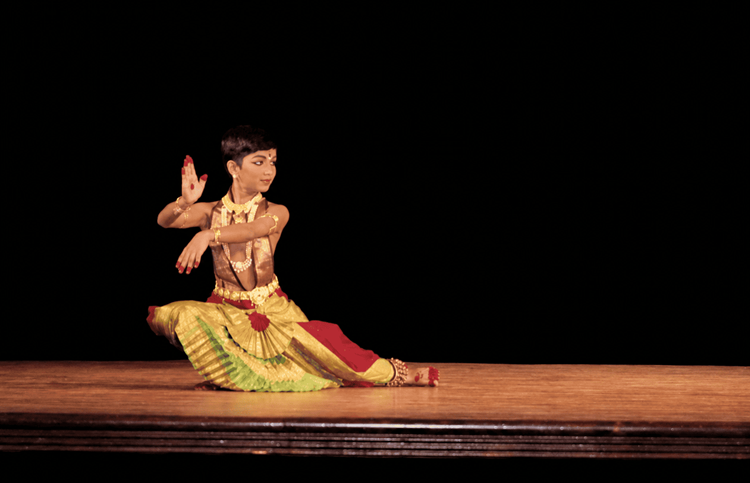 Vishwadeep performing at a Bharatanatyam national-level dance competition at the age of 11.
That’s what people don’t always see. Beyond the stage, this art form demands consistency and discipline every day.
What's always fascinated me about Bharatanatyam is the balance it asks for. On one side, there’s structure, precision, posture, timing. You spend hours repeating footwork, correcting the smallest details, and aligning every movement perfectly to rhythm.
Then comes abhinaya. That’s when emotion, storytelling, and character take over. Suddenly, it’s not just about technique anymore. A single expression, glance, or movement can completely change the meaning of a performance.
That contrast is what makes the art form so special to me. It’s deeply disciplined, but never rigid. Technical, yet full of feeling at the same time and all fluidic.
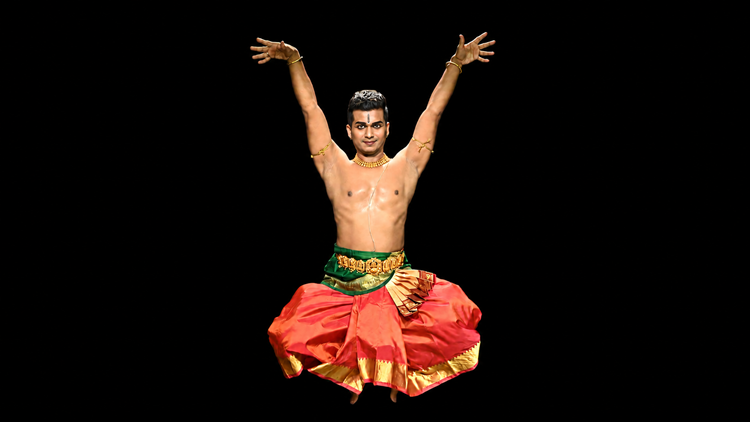
Vishwadeep captured in a powerful moment of Shiva Tandav, embodying the intensity, rhythm, and divine energy of the cosmic dance.
Growing up around it meant seeing both sides closely, the long hours of practice behind closed doors, and then the magic that unfolds once the performance begins. Even today, that balance stays with me.
After living with it for so many years, it no longer feels separate from daily life. The discipline, patience, and focus slowly become part of how you approach everything else too.
Was there a moment when dance started feeling personal to you?
Vishwadeep: Today, Bharatanatyam can feel “female-coded” because most visible modern performers are women and because themes like “nayika bhava” (emotional state of a heroine) are central to its repertoire.
But things shifted when I started watching male Bharatanatyam performers on stage. Until then, I had mostly seen the art form through a certain lens.
Watching men perform with so much strength, grace, and presence changed something for me. For the first time, I could actually see myself in it, not just as a student learning steps, but as a performer with a voice of my own.
That’s when the connection became more personal. It stopped being just about technique and became about expression, presence, and storytelling.
From there, my relationship with dance naturally deepened. I wasn’t trying to imitate anymore. I was exploring, understanding the form in my own way, and slowly finding my place within it.
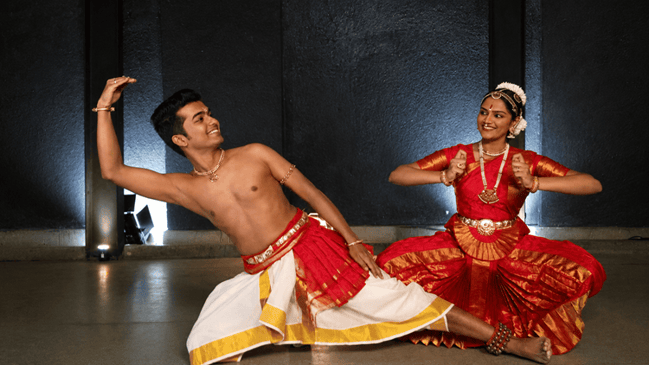
Vishwadeep with his IndianRaga Fellowship co-dancer, portraying a graceful Vishnu and Lakshmi pose through classical dance
Bharatanatyam is about precision, discipline, and adaptability. Do those qualities show up in the way you work too?
Vishwadeep: Absolutely. Bharatanatyam teaches you discipline in very real ways. Even something as basic as araimandi, the half sitting posture, takes strength, balance, and consistency. You hold that posture for long periods while staying precise with every movement and expression. Over time, you realize progress only comes through patience, repetition, and attention to detail.
That mindset naturally shows up in my work too. I tend to be structured, methodical and detail oriented, but dance has also taught me how to adapt quickly. Performances don’t always go exactly as rehearsed, and you learn how to recover calmly in the moment without losing flow. Quite so with client conversations at work.
Another big lesson for me has been empathy. In Bharatanatyam, you don’t just perform a character, you try to understand their emotions and perspective from within.
I think that ability to step into different points of view has helped me a lot while working with people and collaborating across teams.
In many ways, the art form trains both the body and the mind. The resilience, focus, and patience you build there slowly become part of how you handle everything else too.
Looking back, your path has been anything but predictable. How did one chapter lead to another?
Vishwadeep: Honestly, none of it was planned that way. Looking back now, it does feel like one chapter slowly led to another.
Professionally, I started out as an oil and gas engineer, working on commissioning control systems in offshore and high-risk environments. There were moments where safety became very real. I’ve experienced gas leaks on offshore platforms that required immediate evacuation. Situations like that stay with you and give you a very direct understanding of the industry and its complexities.
Over time, I felt the need to widen my perspective, which led me to pursue an MBA at ISB Hyderabad. That shift eventually brought me into the sustainability space. In many ways, it feels like coming full circle. I’m still connected to the same industry, but now the conversations are about carbon emissions, sustainability, diversity, and responsible business practices.
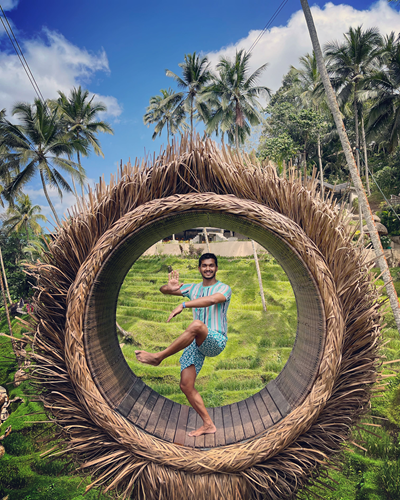 Vishwadeep strikes the iconic pose of Nataraj — the Lord of Eternal Dance — amid the lush beauty of Bali, Indonesia.
Dance was always running parallel to all of this. While I’ve mostly kept it separate from work, there are subtle overlaps. Bharatanatyam often explores themes around ethics, human values, and society, and I think that naturally shaped the way I look at larger issues and responsibility. That would feel like a meaningful way to bring both parts of my journey together.
One idea I’m really excited about someday is creating a dance production around climate change, using storytelling and performance to talk about the environmental challenges we’re facing today.
Do you see parts of the dancer in the way you work today?
Vishwadeep: Definitely. More than I probably realized at first. Bharatanatyam teaches you how to work within structure while still leaving room for creativity. There’s a strong grammar to the art form, technique, rhythm, discipline, but within that, you’re constantly interpreting and expressing things in your own way. I think I approach work very similarly, especially in sustainability and ESG, where frameworks exist, but real impact often comes from how thoughtfully you apply them.
Precision is another big one. In dance, every movement, expression, and beat matters. That attention to detail naturally carries into the way I work, whether it’s building sustainability strategies, looking at ESG metrics, or working with clients.
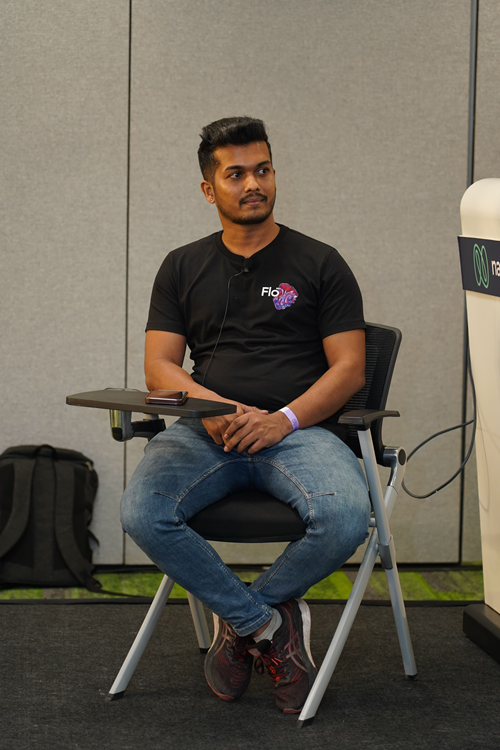
Vishwadeep moderating a panel discussion on AI and sustainability for Flo 2024 in Nagarro’s Gurgaon hive.
But honestly, the biggest crossover is probably storytelling. Sustainability can easily become a conversation full of data and technical terms. Dance teaches you how to connect with people emotionally, hold attention, and communicate something meaningful. I think that’s helped me a lot in making complex ideas feel more human and relatable.
In Bharatanatyam, you constantly step into different characters and emotions. Over time, that teaches you empathy and the ability to see situations from multiple viewpoints, which is incredibly valuable while collaborating and working across teams.
People often notice the expressions and movements in Bharatanatyam first. But how important is rhythm in holding everything together?
Vishwadeep: It’s almost impossible to watch dance without feeling rhythm. It’s something very instinctive. You see a child naturally moving to music, that’s rhythm. You walk into a room with music playing and immediately start tapping your foot, that’s rhythm too.
While the rhythmic patterns in Bharatanatyam can get incredibly complex, the experience of rhythm itself feels very natural and accessible to people.
What audiences may not always realize is how structured that layer actually is. Behind something that looks effortless, there’s a lot of precision, mathematical thinking, and years of training. A dancer isn’t just moving to music, they’re constantly in conversation with it, responding to it, and sometimes even leading it.
That’s what makes it so fascinating to me. Rhythm in Bharatanatyam feels immediate, you connect with it instantly. But at the same time, it’s something you can spend a lifetime understanding more deeply.
After performing across so many stages and audiences, is there one performance you still think about often?
Vishwadeep: Every performance leaves something behind. No two stages ever feel the same. Sometimes you’re performing in an intimate space with a small audience, other times in front of thousands. Some audiences understand every nuance of Bharatanatyam, while for others it may be their first experience with the art form. As a performer, you learn to adapt constantly, your energy, your expression, even the way you communicate a piece.
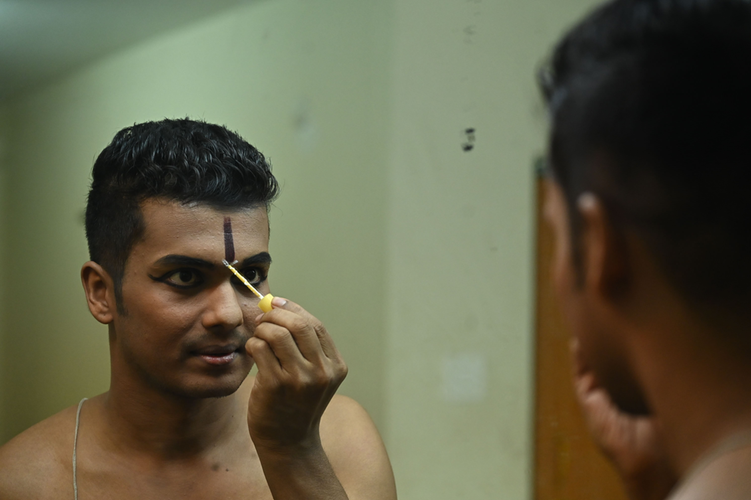 Vishwadeep, preparing before going on stage, in the quiet ritual of makeup, where life transforms into art
But one performance that has really stayed with me was when I performed Priye Charusheele, one of Jayadeva’s Ashtapadis. It’s an emotional piece about the separation of Krishna and Radha, and I’ve always felt deeply connected to it.
After the performance, an elderly woman came up to me and held my hands tightly. She was emotional and told me she had been completely carried away by the performance, almost transported into another world for those few minutes.
I still think about that moment. It reminded me that dance goes far beyond technique or perfection. At its best, it becomes a shared emotional experience between the performer and the audience.
Over the years, experiences like this have taught me that connection doesn’t really depend on how much someone knows about the art form. What matters is honesty in the performance and the ability to make people feel something real.
When someone finishes reading this conversation, what’s one thing you hope stays with them?
Vishwadeep: Probably the importance of staying with something, even through the awkward or difficult phases.
I still remember one of my earliest performances when I was around seven or eight. The next day, there was a newspaper review, and instead of talking about the performance itself, it mentioned how awkwardly I ran off stage at the end of a dance piece. At that age, it really stayed with me.
Looking back now, that moment feels almost funny, but at the time, it could have easily discouraged me.
Over the years, I’ve realized that growth in any field, especially something as demanding as Bharatanatyam, is never smooth or perfect. There will always be criticism, self-doubt, uncomfortable moments, and performances that don’t go the way you imagined.
But that’s not really the part that defines you. What matters more is continuing to show up, learning from it, and slowly growing through the process.
Today, after performing on hundreds of stages, I see that early review very differently. It wasn’t a setback. It was just one small moment in a much longer journey. And if Bharatanatyam has taught me anything, it is this: every stage, every critique, every silence, and every applause become part of the dancer’s growth. The journey continues; with more humility, more depth, and more devotion to the art.
NagarriansAtPlay is a series that showcases Nagarrians following their passions. In this series, we bring to you some of our remarkable colleagues who have made it big globally in their respective fields and have inspired many to follow their dreams.