60 mins


 China
China  India
India  Japan
Japan  Philippines
  Singapore
  South Africa
  Sri Lanka
  Thailand
  Colombia
  Ecuador
  Austria
  Denmark
  Finland
  France
  Germany
  Hungary
  Norway
  Poland
  Portugal
  Romania
  Spain
Spain  Sweden
  Switzerland
  United Kingdom
  UAE
UAE  Canada
  Mexico
  United States

.svg)




Boardrooms across the globe face a persistent agility crisis: the pressing need to launch dynamic, personalized products to compte with nimble market entrants, clashing violently with the reality of the systems that run the business.
This is the "Legacy Paradox": decades-old mainframes and rigid core systems provide unmatched reliability and transaction capability are now the primary bottleneck to innovation.
Traditionally organizations have dealt with this with a data-first modernization strategy that entails a high-risk, multi-year ‘Big Bang’ effort to migrate data to the cloud before rewriting applications. But this often leads to operational paralysis, massive budget overruns and distributed spaghetti code that severs critical business context from the data.
An often overlooked but critical consequence of this approach is severe ‘context loss.’ The legacy code that contains decades of knowledge on business rules, compliance exceptions and routing logic that aren’t documented anywhere else. Simply migrating data severs the connection between the data and the business intent, failing to create a foundation for modern AI-driven development.
There is a more pragmatic path forward that avoids risky rewrites while still delivering speed and flexibility. An orchestration‑first approach modernizes how business processes run across legacy systems without replacing them upfront.
This blog outlines why traditional modernization efforts fall short, introduces orchestration‑first as a practical alternative, and shows how financial services and insurance organizations can unlock near‑term business value while modernizing responsibly over time.
Ground realities: The daily struggle with rigid systems
The challenge isn't abstract; it’s a daily operational grind. Here is what we see on the ground:
-
Global banking complexity: Fragmented, cross-border data silos in large banks limit their ability to run accurate, real-time AI models.
-
Insurance sector rigidity: Legacy insurance core slows insurers down, turning simple product launches into year‑long efforts.
-
Investment services dependency: Legacy mainframes power investment firms but limit access to data needed for modern trader and client experiences.
These examples highlight that a simple "lift-and-shift" to the cloud doesn't solve the fundamental business problem: liberating processes from rigid, outdated architectures.
A holistic approach: The "Orchestration-first" strategy
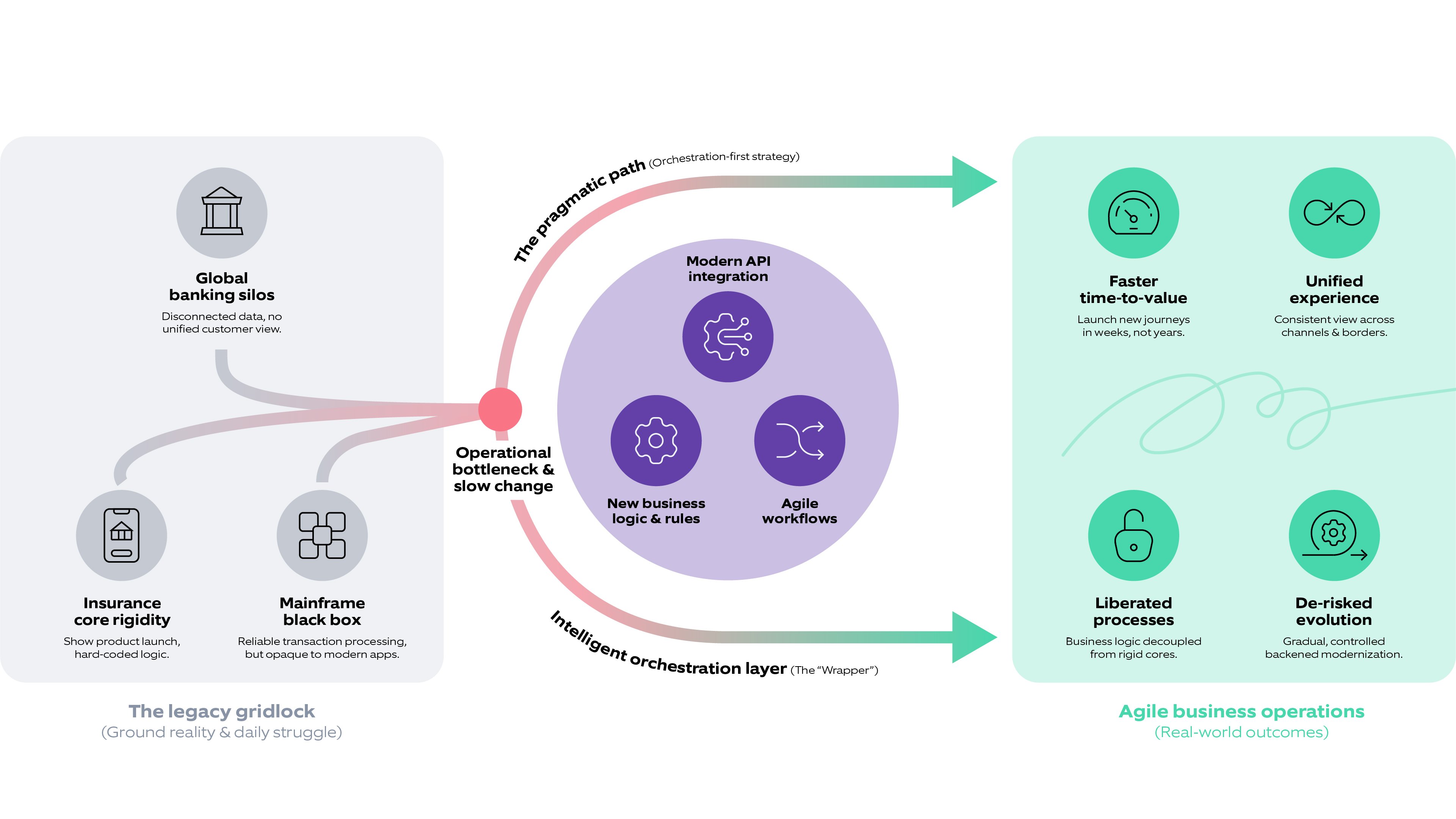 Instead, organizations can adopt a more pragmatic approach that delivers immediate business value without the unacceptable risk of a "Big Bang" migration. We call this an Orchestration-first strategy.
Orchestration-first strategy accepts legacy core as a stable system of record and deploys a modern intelligent orchestration layer as a ‘sidecar’ around it.
What does this really mean?
-
New channels (mobile apps, partner portals, agents) connect to this modern layer, not the brittle legacy core.
-
All new business logic, rules, and customer workflows are built in this agile layer.
-
The orchestration layer becomes the home for Enterprise AI. It hosts Gen AI copilots for employees, runs Predictable AI models for real-time risk scoring, and manages AI Agents that autonomously handle tasks.
-
The legacy system is treated as a ledger, accessed via APIs only for final record-keeping.
This shifts the immediate focus from migrating code to liberating process.
-
For a bank, it means you can launch a new onboarding journey in weeks by building it in the orchestration layer or deploy Gen AI customer service agents immediately in the orchestration layer to handle queries, bypassing the core banking bottleneck.
-
For an insurer, it means you can implement complex new claims routing rules in the wrapper as well as use Predictable AI in the wrapper to automate claims triage, while the mainframe continues to reliably process the payments.
The methodology: A step-by-step path to process modernization
To execute this responsibly, we suggest a methodology designed to manage risk at every step.
Phase 1: Automated discovery (The "As-Is" Blueprint)
Use advance Gen AI models to ingest unstructured artifacts like ancient PDF manuals and COBOL code. The AI extracts hidden business rules and reconstructs process flows, generating an "As-Is" blueprint in days, not months. This provides a factual, clear starting point.
Phase 2: The agile wrapper
Deploy the orchestration layer to handle new capabilities like a streamlined loan approval workflow delivering immediate value to the business.
Phase 3: Gradual hollowing out
Once processes are running smoothly in the new layer, start a controlled, piece-by-piece migration of backend logic. Replace the hard-coded ‘pricing subroutine’ on the mainframe by a modern flexible service. Route the traffic incrementally, allowing for a de-risked, gradual evolution towards a modern architecture.
Addressing real-world concerns: Cost, cutover, and operations
A pragmatic, two-platform strategy raises valid and practical concerns that must be addressed from a consultative angle. Here’s how organizations can tackle them:
Cost vs. opportunity
Adding an orchestration layer adds licensing and infrastructure cost, but this must be balanced against the significant opportunity cost.
By launching products in months, not years, you generate revenue in the first year to fund the multi-year hollowing out process. Furthermore, logic moved to the cloud is often cheaper to run, resulting in MIPS reduction and cutting-down legacy footprint.
Cutover strategy
Teams fear a single, risky cutover date. An orchestration‑first approach removes that risk. The orchestration layer controls traffic and gradually shifts transactions to the new system, moving from 1% to 100% based on proven results. Teams can further reduce risk by modernizing specific products or regions first while keeping the rest on the core.
Operational complexity
Unified observability for a hybrid stack. Running hybrid systems requires strong observability. Modern platforms like Pega, Camunda, or Appian provide unified visibility with built‑in process intelligence and end‑to‑end tracing. This reduces mean time to resolution because teams can track an entire transaction across the hybrid stack, from mobile app to mainframe, on a single dashboard.
Conclusion: The Nagarro perspective
Modernization is not an event; it's a journey. The era of the risky "Big Bang" rewrite is fading. Nagarro’s approach is rooted in the reality of your business. We focus on engineering business fluidity through practical, proven strategies. By combining smart discovery tools with a pragmatic orchestration-first approach, we help you break the legacy gridlock—giving you the speed to win today while securing the time to modernize responsibly for tomorrow.