60 mins


 China
China  India
India  Japan
Japan  Philippines
  Singapore
  South Africa
  Sri Lanka
  Thailand
  Colombia
  Ecuador
  Austria
  Denmark
  Finland
  France
  Germany
  Hungary
  Norway
  Poland
  Portugal
  Romania
  Spain
Spain  Sweden
  Switzerland
  United Kingdom
  UAE
UAE  Canada
  Mexico
  United States

.svg)




After concluding my three-part blog series focused on the principles, practices, and real-world successes of Change Management, I thought it was time to take a different approach. Instead of another educational piece or success story, I am doing the polar opposite now: provoking your thoughts with a hot but substantiated take.
Hear me out on this: you are applying double standards when it comes to Change Management vs. Project Management and Return on Invest (ROI) and it is not in your best interest.
The missing link: Project Management and ROI
But before we dive into Change Management, let us start with Project Management first. In a normal world, a typical simplified process to start a project goes as follows:

Somewhere before the project gets approved, you collect all the arguments for the project and associated risks / conflicts to establish a solid foundation for decision-making.
There are two kinds of arguments for doing a project:
1. Doing it will bring a benefit
2. Not doing it will lead to damages
And this is where it gets tricky or rather, where already a lot of projects take an early exit from the highway towards an ROI calculation and tracking.
Having seen literal hundreds of projects in large multinational corporations as well as mid-size companies, there is a big chunk of them that are simply “must do”. Examples are complying with some new regulations due to legal changes or upgrading software that is end of life. If you are in the finance sector and still sit on COBOL programs and DB2 databases, you know what I am talking about. Or even more broadly everyone that has done a S4/HANA migration.
For these “must do” projects there is not much of a need for an ROI to be calculated, because that is not the argument for or against it. More clearly: if it doesn’t work out, there is no reason to worry about ROI anymore. Of course, you can always argue that there are different degrees of how much to spend e.g. on complying with a regulatory requirement, but these considerations typically do not revolve around an ROI in the sense that I am discussing here.
Let us now look at those projects that you do because they yield a benefit. Those are the prime examples where a proper ROI calculation will convince the sponsors to fund your project, right? Right? Well, yes, but also: no. Yes, in the sense that a nice ROI is a very concise and tangible argument, no in the sense that the difficulty here is to come up with an ROI calculation that will not make your CFO cry.
As a reminder, ROI is calculated as:
ROI in % = Gain from Investment / Cost of Investment × 100
Or in case you want to see how long it takes for the investment to pay off; it can be calculated e.g. per year:
ROI in years = Cost of Investment / Yearly gain from Investment
Estimating the cost of investment should not be a big hurdle to do: you should know the estimated costs of the project you are planning and further associated running costs. However, the gain is the crucial part here. There are these rare gems of projects e.g. “we replace this server with a different one” or “we move to a different venue”. You know the investment and you can estimate the gain pretty accurately.
In many other cases, though, you might as well roll some dice instead of calculating an ROI because the gain is not quantifiable at all or quantifying it properly is very difficult to do. This goes especially for those projects that aim at process improvement or automation, be it with AI or by other means. The main gain is from “better” processes, but what does that really mean? In the end, the process cost, i.e. the cost of one instance of the process is reduced. But for how many processes do we really know the actual cost? Let us be real here: even large corporations don’t always know their process costs in such detail that it allows for a proper ROI calculation.
I will give you a concrete example: when working at an insurance company, I was responsible for a program that aimed at automating a certain process and improving its quality. When calculating the ROI I used the claims ratio (which is part of the overall cost ratio for an insurer) as a proxy to measure / quantify the quality of the process. So, the ROI was calculated based on a predicted decrease in claims ratio by 2%age points. That overall made for a very good case as it saved us millions. When, e.g. in Italy the claims ratio was 55% I would have always argued that without our program it would have been at least 57%. But of course, there is no real causality between the program and the claims ratio. It was definitely a factor, but one amongst many. While all the calculations were made in good faith, there was no chance to prove any of this.
-Having said all this, you will better understand why I am personally very skeptical about ROI on project or program level. Very often it is not done at all or when it is done, it is not necessarily reliable – which can be even worse. We are often fooling ourselves when it comes to ROI for projects.
The double standard: Change Management and ROI
Looking at Change Management, it is actually the opposite. The biggest issue is not that there are no KPIs or no data available, instead it is the reputation. People, deciders especially, often consider it a “soft” topic that is not measurable and thus, not worth investing into.
Unsurprisingly I fundamentally disagree with this point of view, especially in the context that I gave with the ROI situation related to projects. I even find it a very dangerous perspective. And here is why.
If we apply the same line of thinking, there are also two ways how to justify investing into Change Management:
1. It will bring a benefit.
2. Not doing it will lead to damages.
The first one can universally be argued with all the studies that are around:
-
For every Dollar spent, 6,5 Dollars ROI (ChangeFirst 2022)
-
7x better results with exceptional Change Management (Prosci 2024)
-
74% of low change-fatigued employees intend to stay at the company (Gartner 2022)
-
AI specific: 75% adoption rate with Change Management vs. 15% without (BCG AI at Work Report 2025)
While these studies are of course very general, you can also just look at the history of projects at your organization:
-
Have you had projects where after going live it felt like nothing really changed?
-
Was there a backlash or a drop in productivity even?
-
Do you notice that people get fatigued from all the various initiatives going on at the same time?
These are all factors that heavily imply that you are not getting the best out of your projects because you are not properly doing Change Management. So, for the next one, invest in Change Management so that it will give the results you want to yield. In this context, Change Management should be seen as the enabler that will help realize the anticipated benefits of the project.
This is a very important point and really a main point of confusion or something that is often neglected / overlooked: the big difference between Project Management and Change Management is that Project Management is about Project Management success: time, budget, quality. Change Management is about realizing the expected results.
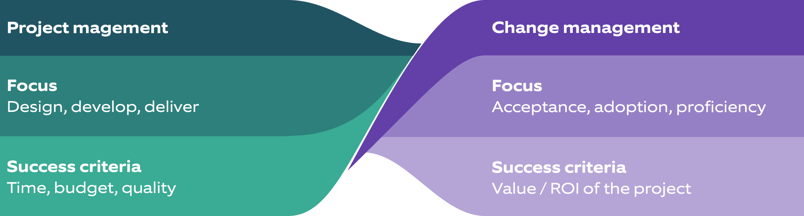
The second one, not doing Change Management will lead to damages, can be argued the same way. If there is a must-do project and you cut short (or leave out entirely) the Change Management part, then there is a very tangible risk that the expected result may not materialize. In other words: the very reason for the must-do project is endangered!
Again, Change Management here acts as the enabler to realize the project’s success and secure its desired outcomes. Without it, you jeopardize the success of the project.
And there are very real KPIs that can be used to measure the effectiveness of the Change Management. Just look at the three main areas:
-
Speed of Adoption
-
Total Utilization
-
Proficiency
You will be able to define KPIs for each of these within the context of your project very easily and then you have all the data you need to measure your positive Change Management impact.
Conclusion: Change Management has tangible ROI and KPIs!
I believe that very different standards are applied to Change Management and KPIs as towards Project Management. There is more than enough actual data available to prove otherwise.
And there is additionally the often-overlooked relationship between Project Management and Change Management: one is about Project Management success, the other is about actual results.
There are plenty of studies that confirm the positive effect of Change Management, especially within the context of AI projects. And there should be enough history of projects within your organization from which you can conclude that without Change Management very often results are not achieved as planned. And you always have tangible KPIs that help you measure the impact of Change Management.
You do not have to make Change Management all about the numbers, it is about the people after all, but you can hard-proof its impact.