60 mins


 China
China  India
India  Japan
Japan  Philippines
  Singapore
  South Africa
  Sri Lanka
  Thailand
  Colombia
  Ecuador
  Austria
  Denmark
  Finland
  France
  Germany
  Hungary
  Norway
  Poland
  Portugal
  Romania
  Spain
Spain  Sweden
  Switzerland
  United Kingdom
  UAE
UAE  Canada
  Mexico
  United States

.svg)



Quick take: Most operators can already detect the signals: slowing deposits, changing gameplay, support friction. The gap isn’t detection. It’s shared context, governed orchestration, and acting while the moment still matters. That’s where Nagarro’s Mosaic OS comes in: an agentic operating layer that connects enterprise knowledge, AI models, agents, and business systems so intelligence can move from data to decision to action.
The hidden problem behind AI adoption in iGaming
Talk to enough iGaming operators and the same pattern shows up in different forms.
Some are well into AI already, with models in production, agents in pilots, and roadmaps full of new use cases. Others are halfway there, with a couple of promising deployments and a long backlog of ideas waiting on budget or an owner. And some are still on the sidelines, trying to sort what is useful from what is just noise.
Different starting points, same underlying issue. The problem usually isn’t a shortage of AI. It is that the intelligence inside the business doesn’t move as one system. And in iGaming, where a single high-value player can be worth more than a hundred casual ones, that disconnect gets expensive fast.
A familiar player scenario
Picture a player who has deposited every Friday night for months. Then the pattern shifts. Deposits slow, and payments catches it straight away. That is the one thing payments is good at.
But payments only sees the money. It doesn’t see that the player stopped opening the slots they used to play every week. It doesn’t see the losing streak from last month. It doesn’t see the support ticket that was unanswered for three days.
So the operator does what a lot of operators still do. It fires off a generic win-back: a “we miss you” email, some free spins, maybe a bonus. And most of the time it lands flat, not because the signal was wrong, but because the response had no context.
That is the part teams underestimate. Spotting the signal is the easy part, and most operators can already do it. The hard part is knowing what the signal means, deciding what to do about it, and acting while it still matters.
Where disconnected intelligence breaks down
This usually fails in three places. And it starts with a simple structural fact: every system holds a different view of the same player.
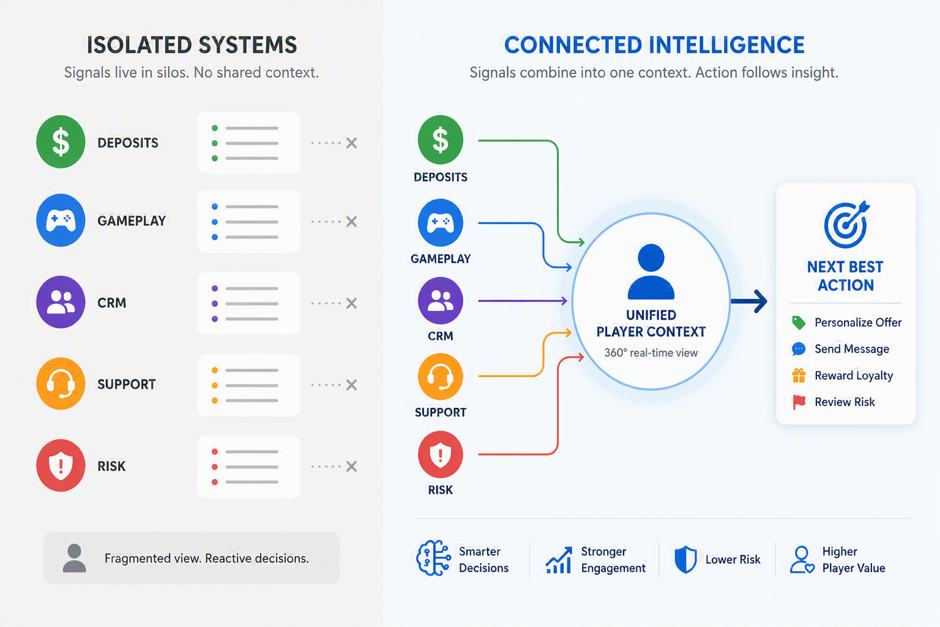
Five systems, five fragments. Each view is useful on its own, but none of them adds up to a complete picture of the player.
-
Every system sees a fragment, not the player. Payments sees deposits. Product sees sessions and game choices. CRM sees opens and clicks. Support sees complaints. Risk sees anomalies. Each view is useful, yet none is enough on its own. A drop in deposits might mean a player is losing interest, or playing smaller stakes, or having a bad support experience, or hitting a responsible-gambling threshold and deliberately stepping back. One signal isn’t an insight. It is just a clue.
-
Even when the business spots a change, it often can’t explain it. This is where a lot of AI projects quietly disappoint. They find patterns, score accounts, and raise flags, then leave teams guessing. Without connecting the change to what actually happened across gameplay, support, payments, and campaign history, you are working from half a story.
-
The action arrives too late. A signal gets raised in one tool. It lands in a dashboard, a report, or a queue. Another team picks it up later, in another system. The response goes out a day late, or three days late, or after the player has already gone. That is not an AI failure. It is an operating model failure.
And it doesn’t only show up in churn. It shows up when acquisition pays to bring in players that retention data already flags as short-lived. It shows up when a bonus goes out that risk would have blocked, or when compliance and personalization work from different slices of reality. Every team is doing its job. Their work just doesn’t join up.
In a sector where bonus abuse now accounts for most of the fraud, and where a collusion ring will deliberately smear its activity across devices, accounts, and time windows, a missing joined-up view isn’t a minor inefficiency. It is precisely the kind of gap fraudsters are built to exploit.
Why adding another model isn’t enough
Faced with this, a lot of operators reach for the obvious fix and add another model.
But another model won't reconnect disconnected decisions. It just gives you one more isolated output in one more isolated workflow. If you already have AI in play, the next real gain usually isn’t a cleverer model. It is connecting the intelligence you already have, so data, decisions, and actions stop running in separate lanes.
If you are midway through the journey, this matters even more. Every disconnected use case you bolt on now becomes an integration problem later, and those problems compound. And if you haven’t really started, that is not necessarily a disadvantage. In some ways it is the cleanest place to begin. You can skip the mistake plenty of enterprises made over the last two years: building isolated AI on top of disconnected operations and calling it transformation.
The contrast looks like this:
| Disconnected AI | Connected intelligence |
|---|---|
| Signals stay locked inside individual tools. | Signals are connected into shared business context. |
| Models raise alerts; teams still interpret them by hand. | Decisions are made with richer context and a clear next step. |
| Actions wait on handoffs across teams and systems. | Actions are orchestrated across workflows while the moment is still live. |
| Outcomes get reviewed later, in reports. | Every outcome feeds back to improve the next decision. |
A better starting point: fix the friction first
The smarter move is simpler than a platform-wide overhaul. Start where the friction is already costing money. Early churn is one candidate. Player support is another. Bonus abuse is another. Pick one. Then connect the handful of signals and systems that actually matter there. Prove the value in a contained pilot. Then build outward from that foundation.
That is the real shift is not adding more AI, but changing how intelligence moves through the business. Instead of isolated models, the focus moves to connecting data, decisions, and actions into one continuous flow, where signals come together, decisions happen in context, and actions follow immediately, while they still matter.
That is the idea behind Nagarro’s Mosaic OS. It is not another standalone AI tool or model. It is the contextual intelligence layer that helps connect enterprise data, policies, business logic, real-time signals, agents, models, and systems into a shared operating context, so decisions and actions stay coordinated across the business.
What this looks like in practice
In practice, three things matter more than anything else.
-
A shared operational context, so every team, system, model, and agent works from the same understanding of enterprise data, rules, priorities, and live signals.
-
Modular orchestration, so agents and systems can coordinate tasks across the tools you already use instead of waiting on manual handoffs between functions.
-
Governance and learning built in, so policies and guardrails are applied as autonomy scales, while outcomes feed back into the system to improve the next decision.
That is the difference between AI that looks impressive in a demo and AI that changes how the business runs. And in iGaming it cuts both ways. The same connected setup that helps you keep a valuable player is what helps you catch a player drifting the wrong way, toward harm or fraud, and step in earlier.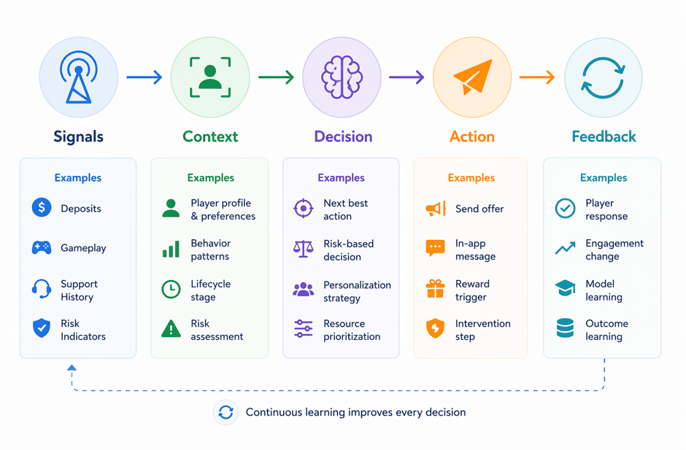
The real question for operators
So, the real question isn’t whether your business has started using AI. It is whether the intelligence already inside it, in the data, the systems, the teams, and the workflows, can actually move together.
If it can’t, more AI won’t fix that. It will just scale the disorder. And for most operators, that is the thing to fix first.
If you are looking at how AI can create real operational impact, the starting point may be connecting the intelligence you already have. Nagarro’s Mosaic OS can help you work out where shared context is missing, what needs to be orchestrated, and how to turn enterprise intelligence into coordinated action. Learn more on Nagarro’s Mosaic OS page.