60 mins


 China
China  India
India  Japan
Japan  Philippines
  Singapore
  South Africa
  Sri Lanka
  Thailand
  Colombia
  Ecuador
  Austria
  Denmark
  Finland
  France
  Germany
  Hungary
  Norway
  Poland
  Portugal
  Romania
  Spain
Spain  Sweden
  Switzerland
  United Kingdom
  UAE
UAE  Canada
  Mexico
  United States

.svg)




AI is changing how we create technical content. But the real question is: are we using it wisely?
Artificial intelligence has moved beyond experimentation. It is now a part of daily workflows of enterprises.
-
According to McKinsey's 2025 State of AI report, nearly 80% of enterprises use AI in at least one business function.
-
Gartner predicts that by 2028, more than 60% of enterprise content will be created or significantly enhanced using generative AI.
-
Studies from Microsoft and LinkedIn's Work Trend Index show that employees are increasingly relying on AI to draft documents, summarize information, and accelerate routine work.
Why is everyone discussing AI, and why are enterprises adopting it? Is AI really helping teams or is it just another passing technology trend? Can AI be trusted to produce accurate technical documentation? Is it safe to use AI-generated content without expert review?
The questions and concerns about the impact and reliability of adopting AI for work are endless. But the truth is that AI is already part of our workflows, and it depends solely on how it is used. AI can help us create technical content (documents and e-learning videos) faster, but speed shouldn’t come at the expense of trust.
This blog is not yet another dissection about the known advantages and disadvantages of AI. Instead, it explores a practical framework for successful human-AI collaboration. Here, we will try to understand the HUMAN strategy. This strategy explains how human and AI can collaborate to create an impactful technical content.
Human expertise vs. AI
AI is transforming the way technical content is being generated. While AI offers speed, automation, and efficiency in generating drafts, summaries, and visuals, human involvement brings critical thinking, emotional understanding, and contextual accuracy to the content. In fields like technical writing and e-learning videos, human input is essential to further clarity and audience engagement.
Imagine a new user is being onboarded to a product for the first time. Generally, enterprises rely on user manuals, guides, and e-learning videos for a smooth transition.
Here, AI can help accelerate the onboarding process by summarizing the key information shared in the technical content and making it easier to quickly scan for the new user. However, effective onboarding still depends on the information created and validated by humans. AI cannot independently determine whether a procedure reflects the latest product release, or whether an instruction aligns with company policies. Those responsibilities still belong to subject matter experts and technical communicators.
In other words, AI improves efficiency, while humans ensure effectiveness.
The following table highlights the respective strengths of humans and AI in developing such knowledge-based resources:
Human strength |
AI strength |
| Audience understanding | Fast content generation |
| Logical flow validation | Instant summarization |
| Accuracy validation | Grammar correction |
| Emotional intelligence connection | Template creation |
| Decision making | Repetitive task automation |
| Contextual awareness | Flexible and responsive |
Clearly, the best approach is not “Human vs AI”, but “Human with AI”. While AI helps to increase the efficiency, humans guide the content creation and make the final decisions.
The HUMAN strategy
The HUMAN strategy is a customized set of five principles for effectively using AI for the technical documentation and e-learning videos creation process. It provides five practical principles for balancing efficiency with quality.
| Harness your expertise | Let AI be your supportive tool, not a replacement of your knowledge and intelligence. To make your content empathetic, use your judgement for accuracy and decision-making. |
| Understand your audience | AI can generate content based on pattern, but humans provide the necessary guidance to the AI-generated content. Clear instructions and human review ensure that the technical content is reliable and relevant for the intended audience. |
| Make it correct | Users trust content that is accurate, relevant, and grounded in real-world experience. Technical writers understand product features and user needs, enabling them to refine AI-generated content into information that is more trustworthy, useful, and relatable. |
| Aim for better | AI should be used to enhance content and not simply accelerate its creation. With AI helping to automate the routine tasks, humans can focus their expertise and creativity, to deliver meaningful content to the audience. |
| Never skip reviews | While AI can create content quickly, human review is essential to spot mistakes and ensure the final output is dependable. Before the final version is published, it is a technical writer’s responsibility to verify its accuracy and facts. |
The collaboration of these five essential principles with AI usage, helps to generate a smarter way to create technical content that is empathetic, innovative, and authentic.
Putting the HUMAN strategy into practice
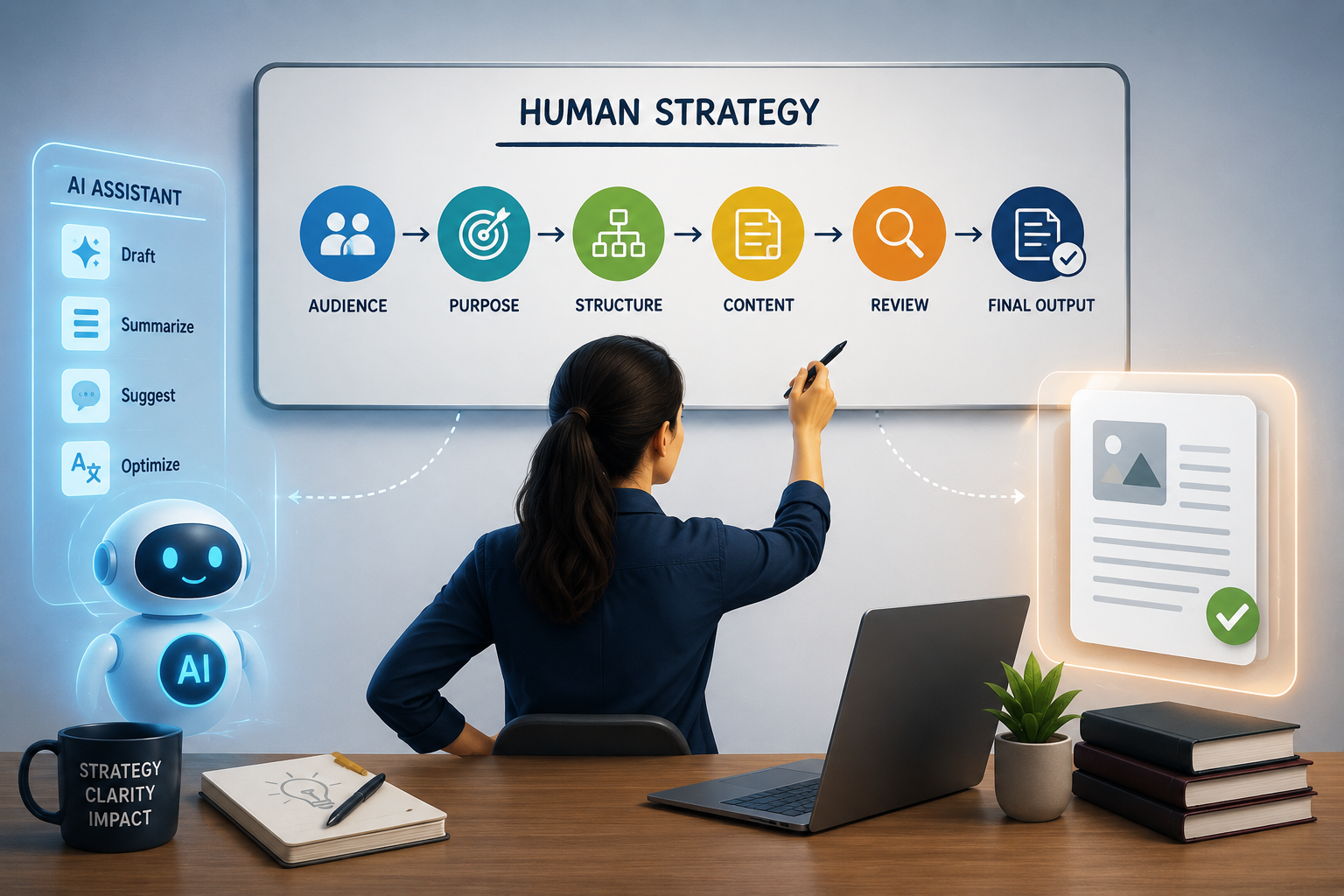
The HUMAN framework works best when AI is integrated throughout the content lifecycle rather than used as a one-time writing tool. For example:
-
Planning: AI helps brainstorm topics, create outlines, and identify knowledge gaps.
-
Drafting: AI generates first drafts, summaries, FAQs, and learning scripts.
-
Reviewing: Subject matter experts validate technical accuracy and business relevance.
-
Refining: Writers improve readability, structure, and consistency.
-
Publishing: Final human approval ensures quality, compliance, and trust.
This collaborative workflow combines AI's speed with human judgment, producing documentation that is both efficient and dependable.
Conclusion
Artificial intelligence has undoubtedly revolutionized the way technical content is generated. It has enabled professionals to work faster and more effectively by automating repetitive tasks to improve productivity through intelligent tools and features. However, AI is not foolproof, and relying entirely on AI tools can cause several unforeseen challenges. AI-generated content may become repetitive, often disregarding human emotions and real-world understanding, and may contain inaccuracies or generic information.
Rather than viewing AI as a replacement for human expertise, it should be observed as a powerful assistant that enhances the technical content creation process through:
-
Structuring information
-
Creating first drafts
-
Generating summaries
-
Designing the e-learning videos
-
Ideating
-
Outlining information
And humans can focus on bringing critical thinking, emotional connection, contextual understanding, and authenticity.
The future of technical content creation lies in combining the strengths of humans and AI, and not in choosing between them. Enterprises and professionals who learn to balance AI with human creativity and validation, will be better equipped to produce meaningful, accurate, and impactful content in the widespread AI era.
Perhaps, it’s time to rethink the question we have been asking all along. It’s not ‘AI or Humans?’ We should be asking ‘how AI and humans together can achieve what neither could accomplish alone?’