60 mins


 China
China  India
India  Japan
Japan  Philippines
  Singapore
  South Africa
  Sri Lanka
  Thailand
  Colombia
  Ecuador
  Austria
  Denmark
  Finland
  France
  Germany
  Hungary
  Norway
  Poland
  Portugal
  Romania
  Spain
Spain  Sweden
  Switzerland
  United Kingdom
  UAE
UAE  Canada
  Mexico
  United States

.svg)




Modern business organizations today operate across cloud platforms, hybrid infrastructures, distributed applications, and microservices architectures. Together, they dramatically increase the volume of security data demanding daily analysis.
Security Operations Centers (SOCs) process millions of logs, alerts, and vulnerability reports, while compliance teams must ensure adherence to regulations such as ISO 27001, SOC 2, GDPR, HIPAA, and PCI DSS.
Organizations today commonly align with standards such as ISO 27001, SOC 2, and PCI DSS, while also complying with regulations including GDPR, HIPAA, and FDA requirements. Security Operations Centers (SOCs) process millions of logs, alerts, and vulnerability reports.
Traditional approaches relying solely on manual investigation and rule-based monitoring are no longer sufficient. This is where Generative AI is emerging as a powerful capability.
Generative AI introduces a new paradigm by enabling systems to analyze, summarize, and generate actionable insights from data. However, true enterprise-scale impact emerges when Gen AI is combined with Agentic AI, where multiple intelligent agents collaborate to autonomously execute complex workflows.
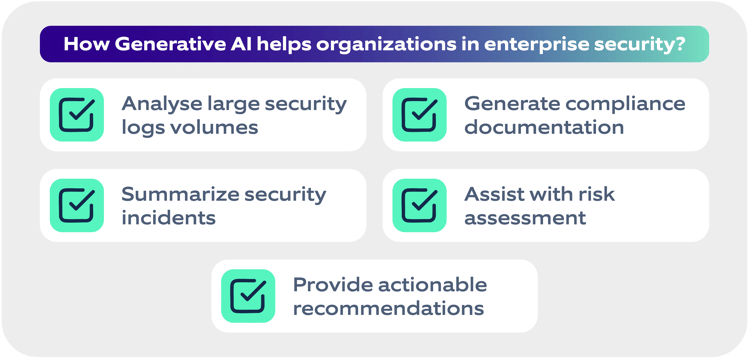 However, adopting Generative AI in enterprise environments requires careful governance, strong security controls, and responsible implementation strategies.
This article explores how organizations can leverage Generative AI to enhance enterprise security and compliance while maintaining trust and regulatory alignment.
Why is enterprise security & compliance becoming more complex?
Before we dive into how Gen AI can enable security and compliance, let’s understand why enterprises need stronger data security measures in today’s tech landscape.
-
Cloud adoption: Organizations now run workloads across multiple cloud providers and on-premises infrastructure.
-
Distributed applications: Microservices architectures generate massive telemetry data across services.
-
Remote workforce: Access patterns have become highly distributed.
-
Regulatory pressure: Organizations must comply with standards such as
- ISO 27001
- SOC 2
- GDPR
- HIPAA
Security teams, therefore, must monitor:
- Network traffic
- Application logs
- User activity
- Vulnerability reports
- Compliance evidence
The sheer volume of information makes manual analysis impractical.
This creates a need for intelligent automation—not just tools, but systems capable of understanding context, making decisions, and executing actions.
How Generative AI helps in the security operations?
In security operations, Generative AI can help:
- Interpret security logs
- Generate incident reports
- Explain vulnerabilities
- Recommend mitigation strategies
- Assist compliance teams with documentation
Instead of replacing security analysts, Generative AI acts as an intelligent assistant that accelerates investigation and decision-making.
Generative AI meets Agentic AI in security
The combination of Generative AI with agentic AI in security enables:
- Log summarization
- Incident explanation
- Compliance documentation generation
- Threat intelligence interpretation
Agentic AI takes this further by introducing:
- Autonomous agents for specific tasks
- Workflow orchestration
- Decision-making capabilities
- Continuous learning loops
The combination enables end-to-end intelligent security operations, where AI not only analyzes but also acts.
Introducing ATLAS: An agentic AI platform for enterprise transformation
To operationalize this vision, organizations are moving toward platforms built on agentic architectures. One such platform is ATLAS, developed by Nagarro.
What is ATLAS?
ATLAS is an autonomous transformation engine designed to solve infrastructure challenges that slow down enterprise cloud journeys.
It is built on a multi-agent architecture with 85+ specialized AI agents that discover, analyze, recommend, and execute, all while keeping humans in control at critical decision points.
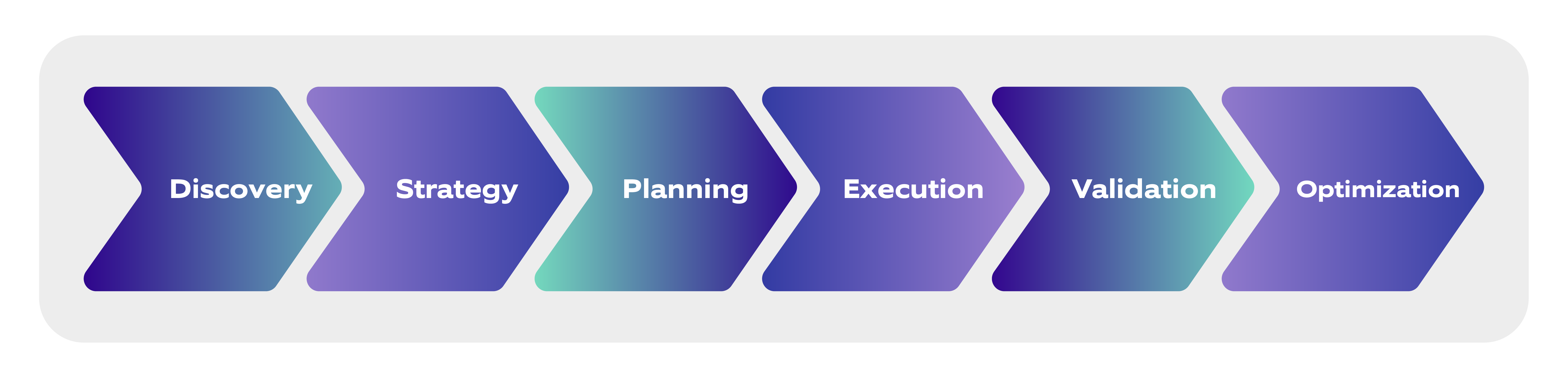
It operates across a complete 6-phase modernization lifecycle, each powered by specialized agents delivering autonomous intelligence, and supports multiple domains including migration, legacy modernization, cost optimization, FinOps, AIOps, Platform Engineering, Security and compliance.
You can learn more about ATLAS here.
Security & Compliance with ATLAS
Security assessment (Comprehensive Security Posture Evaluation)
ATLAS deploys specialized agents to:
- Discover infrastructure assets
- Analyze configurations
- Identify vulnerabilities
- Map risks across environments
How Gen AI enhances this
Generative AI not only improves human-readable outputs but also provides the intelligence layer that powers the agentic workflow itself. It enables agents to
- Interpret security findings contextually
- Correlate vulnerabilities with business impact
- Prioritize risks intelligently
- Recommend remediation strategies
- Generate executive and audit-ready reports
By combining reasoning, contextual understanding, and natural language generation, Gen AI helps transform raw security data into actionable insights for both autonomous agents and enterprise stakeholders.
For example: "Public-facing API endpoints lack authentication controls, exposing sensitive data. Risk severity: High. Immediate remediation recommended."
Compliance remediation (Addressing compliance gaps and violations)
| ATLAS agents | Gen AI contribution | Enterprise benefit |
|
|
|
Security implementation (Implementing security controls and tools)
| ATLAS enables automated implementation of | Agentic workflow | Gen AI role |
|
|
|
Reference architecture for AI-powered security monitoring
Below is a simplified architecture showing how Generative AI can integrate with enterprise security systems.
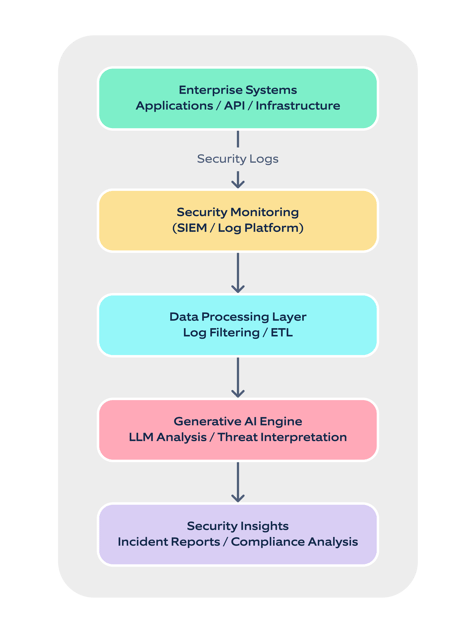
In modern cloud environments, this architecture could involve:
- Security log platforms (SIEM)
- Data pipelines
- AI inference services
- Monitoring dashboards
The AI layer acts as an intelligence engine that interprets security data.
Enterprise use cases
AI-Powered SOC Transformation
A global enterprise using ATLAS can transform its SOC operations.
| Before | After (powered by ATLAS) | Outcome |
|
|
|
Example: Continuous compliance automation
ATLAS enables organizations to move from periodic compliance audits to continuous compliance monitoring.
| Capabilities | Outcome |
|
|
What are the security risks of using Generative AI in security?
Despite its benefits, Generative AI introduces new security challenges.
-
Prompt injection: Attackers may attempt to manipulate AI responses through malicious prompts.
-
Data leakage: Sensitive enterprise data could be exposed if AI systems are not properly configured.
-
Model misuse: Unauthorized access to AI systems could allow malicious activity.
-
Inaccurate outputs: AI-generated insights must always be validated by security professionals.
Organizations must therefore treat AI systems as critical enterprise infrastructure requiring strong security controls.
Best practices for secure implementation
Organizations adopting Generative AI for security operations can follow several best practices.
-
Implement strong access controls: Only authorized personnel should be able to interact with AI systems.
-
Protect sensitive data: Ensure encryption and data masking for security logs.
-
Monitor AI outputs: Audit and monitor AI responses should for accuracy.
-
Use secure architecture: Integrate AI systems with existing security monitoring tools.
-
Maintain human oversight: Validate AI recommendations before acting.
Future of AI-driven enterprise security
Generative AI is expected to become a core component of enterprise security platforms. Future capabilities may include:
- Autonomous threat investigation
- AI-powered vulnerability management
- Continuous compliance monitoring
- Intelligent incident response
Rather than replacing security professionals, AI will augment human expertise and improve decision-making speed.
Conclusion
Generative AI is redefining how enterprises approach security and compliance. When combined with Agentic AI, it enables systems that can analyze, decide, and act autonomously.
Through platforms like ATLAS, organizations can:
- Strengthen security posture
- Automate compliance processes
- Reduce operational overhead
- Improve response times
Nagarro is at the forefront of this transformation, building agentic AI-driven platforms that go beyond traditional automation to deliver intelligent, scalable, and enterprise-ready solutions.
The shift is clear: from reactive security to intelligent, autonomous, AI-driven security ecosystems.