60 mins


 China
China  India
India  Japan
Japan  Philippines
  Singapore
  South Africa
  Sri Lanka
  Thailand
  Colombia
  Ecuador
  Austria
  Denmark
  Finland
  France
  Germany
  Hungary
  Norway
  Poland
  Portugal
  Romania
  Spain
Spain  Sweden
  Switzerland
  United Kingdom
  UAE
UAE  Canada
  Mexico
  United States

.svg)




Last week, memes flooded social media after Sam Altman and Dario Amodei appeared extremely uncomfortable when forced to hold hands at the AI Summit in New Delhi. The on-camera moment triggered discussion on their well-known rivalry.
But if you look at that picture of the who’s who of the AI world holding hands with Modi, there is another oddity. One that demands attention much more than the Altman-Amodei rivalry. If you haven’t figured it out yet, it’s the fact that there is not a single woman in that frame.
Imagine a young schoolgirl looking at that image and wondering: where are the women? These moments are not just photo ops or headlines. They become reference points. They quietly shape who feels seen in the future of technology.
That imbalance operates on three levels.
-
First, there is the visibility gap in leadership.
-
Second, there is the pipeline-and-retention problem that limits how many women even reach those positions.
-
And third, there is the growing risk that women, while underrepresented in the field of building AI, may be disproportionately exposed to its disruption.
In this blog, I talk to four women leaders at Nagarro to uncover their observations on what’s limiting women in AI and the way forward. This builds on an earlier exploration of how AI systems can either hinder or foster diversity, examining the relationship between algorithmic design and social bias.
I. The visibility gap in AI leadership
The numbers reflect the imbalance at the top.
Stanford’s AI Index Report 2025 (Stanford Human-Centred AI), using LinkedIn’s AI talent dataset, finds that women make up 30.54% of global AI talent, compared to 69.46% for men. The same report notes that AI skill penetration is lower among women than among men in nearly every country measured.
In the corporate world as well, the ratio of women in entry-level roles to those in senior leadership positions is skewed. A 2025 report by Girls Who Code and the MetLife Foundation, Navigating the Tech Workforce in the Age of AI, estimates that women and nonbinary professionals make up 28% of the tech workforce and hold only 15% of executive roles.
%201.jpg?width=250&height=250&name=Image%20(11)%201.jpg) Anamika Mukhopadhyay , Global Lead - Emerging and Special Tech Testing Practice at Nagarro, believes that many women enter the space, but not as many reach the top. “I am constantly checking the latest developments in AI to stay updated,” she says. “But running a team and a household at the same time leaves much less room to upskill. I do not have the luxury to spend a weekend on a certification.”
Anamika Mukhopadhyay , Global Lead - Emerging and Special Tech Testing Practice at Nagarro, believes that many women enter the space, but not as many reach the top. “I am constantly checking the latest developments in AI to stay updated,” she says. “But running a team and a household at the same time leaves much less room to upskill. I do not have the luxury to spend a weekend on a certification.”
The leadership gap, therefore, is not just about representation. It is about velocity. In a field evolving as rapidly as AI, those who can continuously upskill and experiment tend to accelerate faster.
The business case for gender diversity in AI
Organizations should be interested in this conversation not just for moral reasons, but also for business reasons. How?
AI models are trained on data. Data reflects behavior. And behavior reflects lived experiences.
If lived experience is skewed in the rooms where products and data models are made, blind spots multiply. Women are not a niche segment; they are half the market as employees, decision-makers, and stakeholders.
If they are meaningfully represented in leadership and technical teams building the data models and products, companies risk losing out on them as customers as well.
II. The pipeline and retention problem
So why aren’t enough women making it to AI leadership positions?
Part of the answer lies much earlier.
According to UNESCO, women make up only 35% of STEM graduates worldwide, a figure that has remained largely unchanged for a decade.
The drop-off continues into the research ecosystem, where much of AI is conceived and crafted. UNESCO’s 2025 UIS data release on SDG 9.5 reports that in 2022, women were just 31.1% of researchers globally, up only slightly from 29.4% in 2012.
A decade of minimal progress signals that retention and progression remain persistent structural hurdles. And sometimes the reasons are deeply structural, not abstract.
In a 2024 UNDP Indonesia feature story, Enabling Women in STEM, Reversing Gender Gap in Energy Sector, electrical engineer Aulia Nadira described her university experience: “I noticed that none of my lecturers at the time were women, and there were no female teaching assistants or laboratory supervisors.”
She was one of just five women in a cohort of 47 students. The message wasn’t spoken, but it was clear. You are the exception here. That sense of exception often carries into the workplace.

Ashwini Jadhav Jandial, a Senior Director at Nagarro who is building beauty and fashion retail technology solutions, observes a visible difference in how AI is adopted. “Men use AI very confidently. For women, there can be hesitation. Managing change at work becomes another responsibility,” she says.
In a field that rewards visible experimentation, that hesitation has consequences. Studies suggest impostor syndrome is more prevalent among women than men, and when combined with the rapid pace of AI adoption, it can intensify self-doubt. Ashwini notes that some women worry about being judged for experimenting with AI tools, particularly in environments where confidence is often mistaken for competence.
The Girls Who Code + MetLife Foundation 2025 study reinforces this psychological layer. One participant observed, “It’s definitely hard to feel like you have a safe space to try new things or grow your skills.”
In an era where AI rewards experimentation and constant learning, psychological safety becomes more than just a basic need; it becomes a career accelerator.
Across these conversations, a pattern emerges. It is not a lack of capability. It is a shortage of time, structured opportunity, and institutional support that compounds over time.
This is how the gender gap in AI quietly widens, not through the absence of talent, but through the absence of structural support.
III. The automation and power imbalance
Despite sustained global campaigns to increase women’s representation in tech, we are still far behind. And the stakes are rising.
According to UN Women and UN DESA’s Gender Snapshot 2025, 27.6% of women’s employment is potentially exposed to generative AI, compared to 21.1% of men’s employment. Employed women are nearly twice as likely as men to be in jobs at high risk of automation (4.7% versus 2.4%).
So, women remain underrepresented among those building AI, yet disproportionately exposed to its disruption.
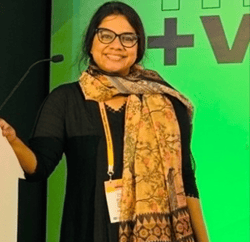 Ranjana Karunakaran, Diversity Lead at Nagarro, observes that technology often holds a mirror to society. The biases that exist in our institutions, workplaces, and cultural norms inevitably find their way into the systems we build.
But the relationship does not stop there.
AI does not function like a static mirror. It functions more like an amplifier. What exists in the data is not only reflected back but also scaled.
When datasets reflect skewed realities and decision-making teams lack diversity, those biases can become embedded in models that operate at scale. Once deployed, those models influence hiring decisions, credit scoring, healthcare prioritization, and customer engagement, reshaping the very society that produced the original imbalance.

Ruchi Sharma, Associate Director at Nagarro and AI and Big Data mentor recognized by NITI Aayog, says that in the AI era, leadership decisions carry amplified consequences by setting direction, accountability, and guardrails for technologies that increasingly shape business outcomes and societal trust.
“Gender-diverse leadership teams bring broader risk awareness, stronger stakeholder empathy, and more balanced decision-making, improving how priorities are set and how responsibly AI systems are deployed at scale,” she adds.
In that sense, AI does not simply reflect society. It can amplify it.
IV. Correcting the course
The gap is structural. But so are the solutions, and change is already underway.
Microsoft, for instance, has embedded Responsible AI frameworks into its product governance architecture rather than treating bias as an afterthought.
How do they ensure that? By having dedicated leadership roles in Responsible AI, formal review processes before deployment, and internal accountability mechanisms that ensure questions around fairness, risk, and unintended harm are raised early rather than retrofitted later.
At the core, they are shifting diversity from symbolism to system design that acknowledges that AI systems operate at scale and thus require structured guardrails, not just goodwill.
At Nagarro, initiatives like the Glass Window program are intentionally designed to nurture women into leadership roles, ensuring that diverse perspectives are not only represented but also empowered to influence strategy and outcomes.
Ranjana Karunakaran argues that bridging the gender gap in AI requires more than encouragement. “One big reason why women are missing out on AI is the upskill gap and skilling barriers,” she says. “There are fewer structured upskilling opportunities, and time constraints make it harder for women to participate.”
This is how diversity moves beyond intent and becomes impact: by shaping who leads, how decisions are made, and ultimately, how AI creates value for businesses and societies.
But getting more women a seat on the Data and AI table requires much more than a single organization-level framework. It requires sustained action across the pipeline and within organizations. That includes structured AI upskilling pathways, sponsorship programs that move beyond mentorship, transparent promotion criteria, flexible learning access for women balancing caregiving responsibilities, and measurable accountability at leadership levels.
It also requires widening the circle of who gets to experiment. In an industry where skill currency evolves rapidly, psychological safety and access to time are competitive advantages.