60 mins


 China
China  India
India  Japan
Japan  Philippines
  Singapore
  South Africa
  Sri Lanka
  Thailand
  Colombia
  Ecuador
  Austria
  Denmark
  Finland
  France
  Germany
  Hungary
  Norway
  Poland
  Portugal
  Romania
  Spain
Spain  Sweden
  Switzerland
  United Kingdom
  UAE
UAE  Canada
  Mexico
  United States

.svg)


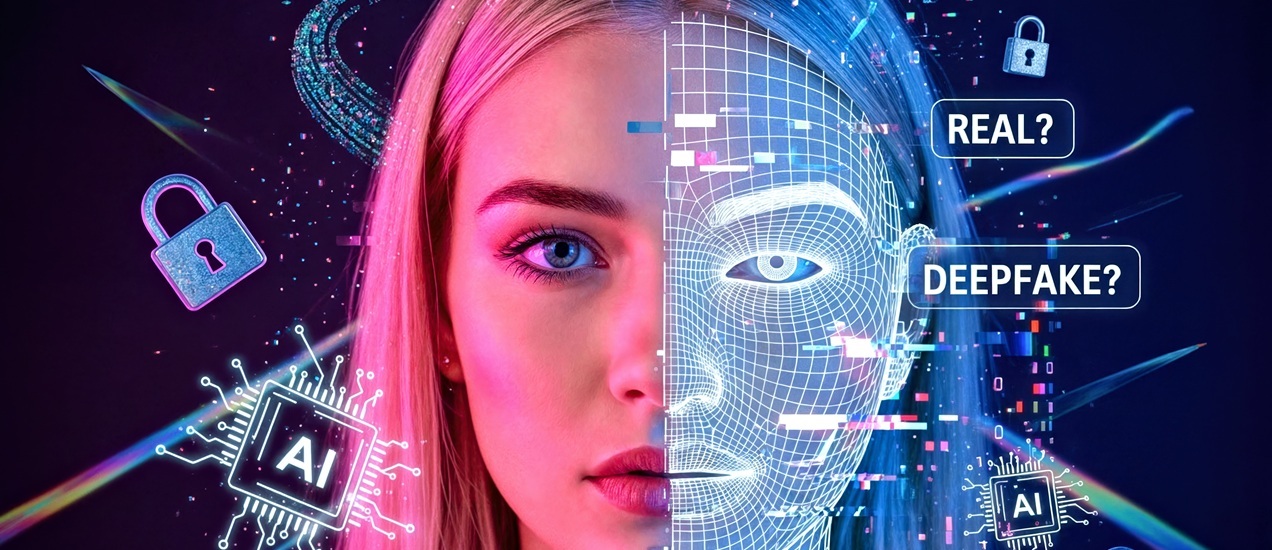
Artificial Intelligence is rewriting the rules of how we create, share, and trust digital content. Every scroll, every video, every voice clip we encounter today carries a silent question: Is this real?
One of the most prominent reasons for this uncertainty is deepfake technology. What once felt like a futuristic concept is now very much part of today’s digital reality showing up in videos, images and even voices that feel unsettlingly real.
As deepfakes become easier to create and harder to detect, they are raising important questions about trust, authenticity, and responsibility in the digital world. This blog unpacks how deepfakes work, where they’re being used, and why their rapid rise matters – not just for technologists but also for anyone navigating the digital world.
What are deepfakes and why do they matter?
At a basic level, deepfakes are AI-generated or AI-manipulated images, videos, or audio that closely imitate real people or events. Using advanced machine-learning techniques, these systems learn how a person looks, speaks, or moves and then recreate those traits in new content.
They matter because they blur the line between what is real and what is fabricated. In a world where so much information is consumed digitally, this shift has serious implications for how we trust content, verify sources, and make decisions.
How AI advancements are fuelling deepfake growth
The rapid growth of deepfakes is closely tied to recent advances in Generative AI. Powerful models, faster hardware, and widely available AI tools have made it possible for almost anyone to experiment with deepfake creation. What once required deep technical expertise can now be done with minimal effort and cost.
Open-source AI models, user-friendly applications, and cloud computing platforms have significantly lowered the barrier to entry. Today, with just a few images, short video clips, or even small audio samples, AI systems can generate highly realistic faces, voices, and videos in a matter of minutes. Many of these tools are easily accessible online, which means the technology is no longer limited to researchers or large organizations.
Another factor accelerating this growth is the improvement in AI training techniques. Modern generative models can learn complex patterns in human expressions, speech, and movements. As a result, the outputs they produce look increasingly natural and convincing, making it much harder for people to distinguish between authentic and AI-generated content.
At the same time, the popularity of social media and digital content platforms has created an environment where manipulated media can spread rapidly. A single convincing deepfake video or audio clip can reach thousands or even millions of viewers within hours.
As AI continues to evolve, deepfakes are becoming more realistic, more convincing, and more widespread. This makes it increasingly important for individuals and organizations to understand the technology, its potential benefits, and the risks that come with it.
Where deepfakes are being used today
Deepfakes are often discussed in a negative context, but the technology itself is neutral. In fact, it is already being used in several positive and creative ways:
-
In films and media for visual effects and voice dubbing
-
In education and training through realistic simulations
-
In accessibility solutions, such as recreating voices
-
In creative and artistic storytelling
When used responsibly, deepfake technology can enhance experiences and open up new creative possibilities.
Key risks and ethical concerns
At the same time, the risks associated with deepfakes cannot be ignored. They can be used to spread false information, impersonate individuals, manipulate opinions, or invade personal privacy. Even a single convincing deepfake can damage reputations or undermine public trust.
In one widely reported case, scammers used AI-powered voice cloning to impersonate a company executive and instructed a senior finance leader to authorize urgent fund transfers. Believing the request to be legitimate, the organization ended up losing millions of dollars. The attack did not rely on sophisticated hacking techniques, but on trust, urgency, and the realism of the cloned voice. (Source: https://www.brside.com/blog/deepfake-ceo-fraud-50m-voice-cloning-threat-cfos).
In another case, attackers simulated an entire video meeting using deepfake technology, where multiple participants appeared to be known colleagues. During the call, instructions were given to transfer a large sum of money, which the employee followed, assuming the meeting was genuine. Only later was it discovered that the entire interaction had been fabricated using AI. (Sources: https://www.ndtv.com/world-news/cfo-cloned-200-crores-stolen-hong-kong-company-falls-victim-to-deepfake-5003629)
Beyond financial fraud, deepfakes also pose a broader societal risk. They can be used at scale to create misleading narratives, influence public opinion, or erode trust in digital media. When people begin to question the authenticity of everything they see or hear, it creates a deeper challenge, not just of misinformation, but of general distrust.
These examples highlight important ethical concerns around consent, misuse, and accountability especially when identities, authority, and trust are exploited. As deepfake technology becomes more advanced and accessible, maintaining digital trust will require not only stronger detection mechanisms but also robust processes, awareness, and organizational readiness.
Detection challenges and trust issues
One of the biggest challenges with deepfakes is in identifying them. Our eyes and ears are no longer reliable indicators of authenticity. While detection tools are improving, they are still playing catch-up with rapidly advancing generation techniques.
This creates a broader issue: trust in digital content is becoming fragile and verifying authenticity is becoming increasingly complex.
How to stay informed and prepared
Staying safe in the age of deepfakes starts with awareness. Being cautious about sensational or emotionally charged content, verifying information through multiple sources, and understanding how AI-generated media works can go a long way. Technology can help, but informed human judgment remains just as important.
The future of deepfakes and digital trust
Deepfakes are not going away. With continuous technological evolution and maturity, we can expect more realistic content, stronger detection mechanisms, and clearer regulations. Ultimately, the future will depend on how responsibly this technology is used and how seriously digital trust is taken.
Building awareness, encouraging ethical use, and investing in trust-focused solutions will be key to navigating the next phase of the digital age.
Identifying deepfakes: Why awareness alone is not enough
While technology plays a role in detecting deepfakes, people remain one of the most targeted and vulnerable entry points. Many deepfake attacks today don’t rely on sophisticated videos alone. They exploit urgency, authority, and emotion. A cloned executive voice asking for an urgent fund transfer or a convincing video call requesting sensitive information can easily bypass traditional security controls if humans are unprepared. This is why identifying deepfakes is not just a technical challenge - it’s a human one.
Training through realistic deepfake simulations
To address this gap, organizations are increasingly turning to deepfake simulation and social engineering training platforms offered by third-party providers such as Hoxhunt, Breacher.ai, and similar solutions. These platforms simulate realistic AI-driven attacks like voice calls, videos, and messages to safely test how employees respond in high-pressure situations.
Instead of learning through theory alone, employees experience:
-
Urgent requests that mimic real-world scenarios
-
AI-generated voices or messages impersonating leadership
-
Time-sensitive decision-making under stress
This hands-on exposure helps employees recognize subtle red flags that are easy to miss in traditional training.
Why simulations are becoming essential for every organization
Deepfake simulations help employees move beyond awareness to real-world readiness by exposing them to realistic, high-pressure scenarios. They reveal behavioural gaps and verification weaknesses before attackers can exploit them. By practicing how to pause, validate, and respond, organizations significantly reduce the risk of AI-driven fraud, data loss, and social engineering attacks.
In an era where AI-generated deception is becoming increasingly convincing, regular deepfake simulation exercises are no longer optional as they are a critical layer of defence.
Impact on virtual interviews
Deepfakes are also raising concerns in virtual hiring processes. AI-generated video or voice manipulation can allow candidates to impersonate others or receive real-time assistance during interviews. This is pushing organizations to rethink remote interview validation, introducing stronger identity checks, live coding assessments, and AI-assisted monitoring to ensure authenticity and fairness.
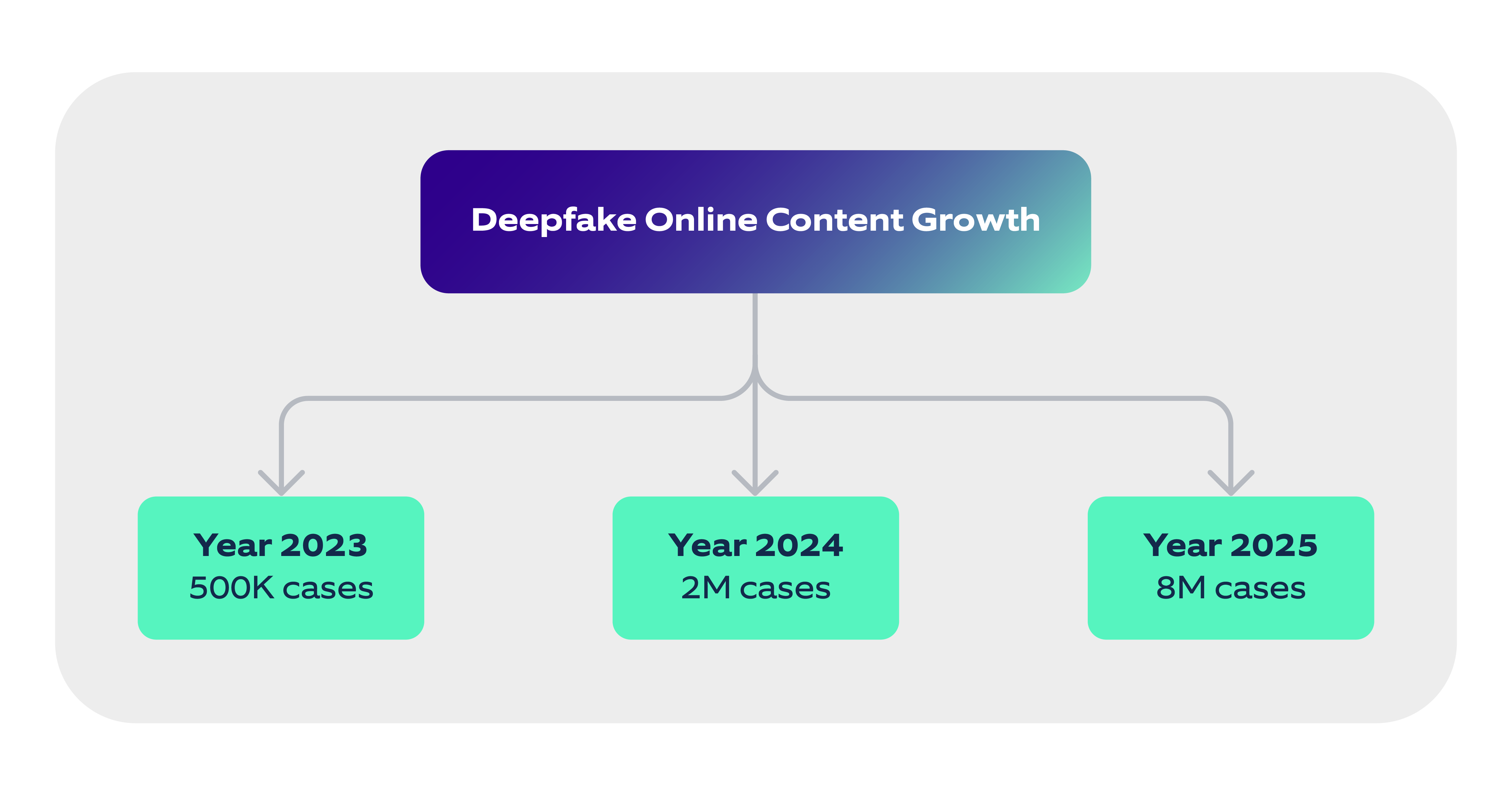 A worrying trend: Exponential growth of online deepfake content
Source: https://deepstrike.io/blog/deepfake-statistics-2025
How deepfakes are impacting test automation
Complexities in testing media-heavy features
Applications using video, voice, or facial recognition must now be validated against AI-generated or manipulated inputs, not just normal user behaviour.
Expanding scope of security testing
Systems need to be tested for their ability to detect spoofed audio, fake video streams, and AI-generated identities.
Test data integrity matters more than ever
AI-generated media can unintentionally enter test environments, which can affect accuracy, if it’s not controlled and labelled properly.
Automation must go beyond functional validation
It’s no longer only about verifying features; it’s about validating authenticity and trust boundaries.
Testers need AI awareness
Modern QA teams must understand how deepfakes work, how they can be misused, and how to simulate such scenarios in controlled environments.
AI is also strengthening testing
The same AI advancements behind deepfakes are also enabling smarter automation, such as in visual testing, anomaly detection, and intelligent test maintenance.
Conclusion
Deepfakes are no longer a futuristic threat but a present-day reality now. They are shaping how we communicate, trust, and make decisions. As AI-generated content becomes more seamless, organizations and individuals must reassess how they verify identity, protect information, and respond to digital manipulation.
Technology will continue to evolve, but so will misuse. The real challenge is not just to detect deepfakes but to build a culture of digital scepticism and preparedness. By combining smarter tools, stronger processes, and practical human training (including deepfake simulations), we can navigate and overcome this challenge successfully.
Eventually, the future of digital trust will not be defined by deepfakes themselves but by how intelligently and ethically we choose to respond to them.