



 60 mins


 China
 India
 Japan
 Philippines
 Singapore
 South Africa
 Sri Lanka
 Thailand
 Colombia
 Ecuador
 Austria
 Denmark
 Finland
 France
 Germany
 Hungary
 Norway
 Poland
 Portugal
 Romania
 Spain
 Sweden
 Switzerland
 United Kingdom
 UAE
 Canada
 Mexico
 United States



The UAE is rapidly moving from AI experimentation toward enterprise-scale adoption. As organizations embed Generative AI into customer journeys, operations and regulated processes, the challenge is no longer simply whether AI can generate an answer, but whether AI can participate in real business processes with the required governance, accountability, security and human oversight.
This becomes especially important in banking, where even a simple customer request can trigger activities across digital identity, credit assessment, document verification, core banking, APIs, and operational teams. AI may understand the intent or recommend an action, but the enterprise still needs to control what happens next, which rule applies, who needs to act, and how exceptions are handled.
The next phase of enterprise AI therefore requires more than intelligence alone.
“Intelligence without orchestration remains an answer. Intelligence with orchestration becomes a business process”
The missing layer between generative AI and enterprise execution
Generative AI can interpret information and suggest possible actions. Retrieval Augmented Generation (RAG) is an approach that enhances AI generated responses by retrieving relevant information from external knowledge sources, such as enterprise policies, requirements, and historical decisions. Knowledge Augmented Generation (KAG), as applied in this architecture, extends this approach by incorporating relationships between business rules, systems, dependencies and past decisions to provide richer contextual understanding.
While RAG and KAG strengthen the knowledge available to AI, they do not independently manage the sequence of activities, human approvals, business rules and exceptions required to execute an enterprise process.
Bridging this gap between AI intelligence and enterprise execution requires a layer that connects trusted knowledge, reasoning and governed orchestration.
That is the foundation of Governed Product Intelligence.
Introducing MEYON: A Governed Product Intelligence Platform
MEYON (Model-Enabled Enterprise Yield and Orchestration Network) is a Product Intelligence platform designed to bring enterprise knowledge, AI reasoning, and process orchestration together in one governed architecture.
MEYON is built to help enterprises move from fragmented information and isolated AI outputs toward connected, reusable product intelligence. It brings together business context, rules, decisions, system knowledge, historical outcomes and operational learnings so that AI can reason with a richer understanding of the product and its environment.
At its core, MEYON combines enterprise knowledge, AI reasoning and process orchestration to transform contextual intelligence into governed business workflows. Within this architecture, RAG retrieves relevant enterprise knowledge, KAG connects relationships across business rules, systems and historical decisions, and AI uses this context to generate insights and recommendations. Camunda serves as the orchestration engine, coordinating how AI capabilities, human decisions and enterprise systems interact through structured workflows while maintaining process control, traceability and governance.
From Enterprise Signals to Governed Product Decisions
In large organizations, product decisions rarely start from a single requirement. They emerge from multiple signals such as customer feedback, regulatory change, operational pain points, production issues, market opportunities, and technology transformation.
The challenge is that these signals are often spread across teams, tools and knowledge sources. Before an opportunity can become part of a roadmap, teams need to understand its context, identify what already exists, assess dependencies and impact, compare possible options, and involve the right stakeholders.
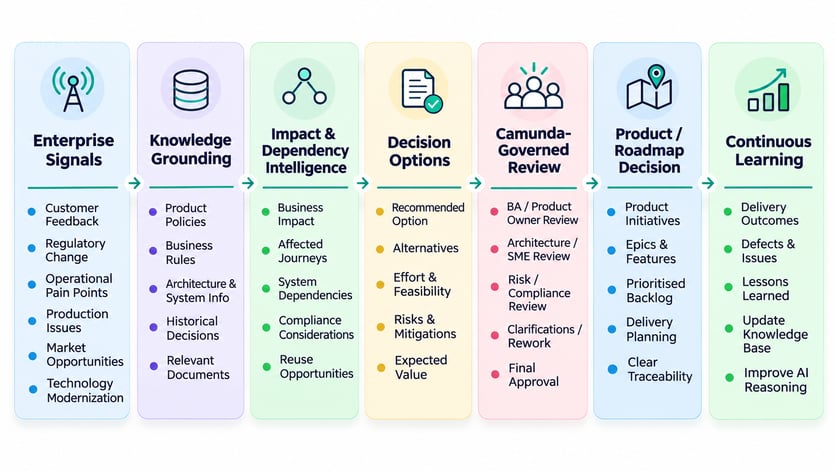
MEYON brings these activities into a connected flow:
What Makes MEYON Different?
AI is already becoming part of modern product management platforms.
Product discovery itself is not new. Platforms such as Jira Product Discovery, Productboard and Aha! already help product teams capture ideas, analyze insights, prioritize opportunities, and build roadmaps.
MEYON is designed around a different problem.
Its core capability is Governed Product Intelligence, building intelligence around how an enterprise understands, evaluates, and governs a product decision.
A typical AI-enabled product platform may support a journey such as:
Capture > Analyze > Prioritize > Roadmap
MEYON is not intended to replace established product planning or delivery platforms. It is designed to add an enterprise intelligence and governance layer around product decision-making—bringing together trusted knowledge, AI reasoning, evidence, and orchestration before decisions move into roadmap and delivery.
Ground Knowledge > Connect Context > Reason > Assess Impact > Generate Options > Govern Decisions > Learn
The difference becomes important as enterprise complexity increases.
When a new opportunity enters MEYON, the objective is not simply to summarize the idea or generate a recommendation.
RAG can retrieve relevant policies, requirements, architecture information and historical decisions.
KAG can connect relationships across business rules, journeys, systems, APIs, previous decisions, and historical outcomes.
AI reasoning can identify potential impact, dependencies, risks, conflicts, and opportunities for reuse.
Instead of producing only one AI-generated answer, MEYON can bring forward decision options supported by enterprise context and evidence.
Camunda then governs how those options move through the organization, coordinating the appropriate stakeholders, AI capabilities, and systems while managing review, clarification, approval, exceptions, and traceability. Camunda explicitly positions agentic orchestration around coordinating AI agents, people and systems while keeping deterministic process controls and auditability around AI-driven work.
The organization retains final product or roadmap decision-making.
The approved decision, its rationale, dependencies, and eventual delivery outcomes can then become reusable knowledge within MEYON, creating stronger context for the next decision.
Most Product AI helps teams decide what to build. MEYON is designed to help enterprises understand why it should be considered, what it impacts, what evidence supports it, who needs to be involved, and how that decision should be governed.
From Pain Points to Governed Product Decisions
In one of the digital home finance transformation initiatives Nagarro has worked on for a leading UAE bank, the end-to-end applicant verification and credit readiness journey emerged as a recurring area of operational complexity.
The challenge did not come from a single requirement. It emerged through multiple enterprise signals:
- Customer Feedback: Verification takes time, and customers have limited visibility into what is happening.
- Operations Feedback: Teams repeatedly compare customer-submitted documents with information already captured in the application.
- Production Issues: Validation gaps, document mismatches and integration dependencies can delay processing.
- Product & Technology Inputs: existing rules, system constraints and historical implementation decisions influence what can realistically be changed.
This is where MEYON's Product Intelligence journey begins.
Step 1: Understanding the Pain Point
MEYON first brings together signals from different sources and identifies the underlying product problem.
For example:
Customer signal:
“Document verification is taking too long.”
Operational signal:
“Staff repeatedly compare income documents against customer-entered information.”
Technology signal:
“Validation depends on multiple systems and existing business rules.”
MEYON synthesizes these signals into a clearer product problem:
How can applicant verification and credit readiness become faster, more accurate and more transparent while reducing repetitive manual checks and maintaining the required risk and control standards?
The important point is that MEYON starts with the problem, not with a predetermined solution.
Step 2: Finding the Right Enterprise Context (RAG)
Once the problem is summarized, RAG retrieves knowledge that may help explain it.
This could include:
KYC & Identity Rules | Document Authenticity | Income Validation | Credit / DBR Rules | Historical Defects | Architecture Decisions | Data Validations | Operational Procedures
The current product problem (q) is converted into a vector representation:
q = E(Product Problem)
Enterprise knowledge (di) is represented in the same way:
di = E(Enterprise Knowledge)
MEYON then uses cosine similarity to understand which information is most relevant:
S(q,di) = q · di / (||q|| × ||di||)
For illustration, assuming the current product problem and an existing enterprise knowledge item are represented as:
q = [0.8, 0.6, 0.3], d1 = [0.9, 0.5, 0.4]
S(q,d1) = [(0.8 × 0.9) + (0.6 × 0.5) + (0.3 × 0.4)] / [√(0.8² + 0.6² + 0.3²) × √(0.9² + 0.5² + 0.4²)]
S(q,d1) ≈ 0.989 or 98.9%
This indicates a very high semantic similarity between the current problem and the retrieved enterprise knowledge.
A retrieval result could then look like:
| Knowledge Source | Similarity S(q,di) |
|---|---|
| KYC & Identity Validation Rules | 0.94 |
| Income Validation Requirements | 0.95 |
| Document Authenticity Checks | 0.90 |
| Customer Service Process | 0.52 |
| Credit / DBR Assessment Rules | 0.88 |
S(q,di) = semantic similarity between the problem and knowledge item.
Across these sources, an illustrative RAG confidence can be derived as:
Rg = (0.94 + 0.95 + 0.90 + 0.52 + 0.88) / 5
Rg = 0.838 or 83.8%
RAG therefore answers:
“What does the enterprise already know about this problem?”
But similarity alone does not explain how these pieces of information are connected.
Step 3: Understanding Relationships (KAG)
A document may appear highly relevant but could be outdated, superseded by another decision, or dependent on a business rule that changed later.
KAG allows MEYON to understand the relationships behind the retrieved knowledge.
For the document verification use case, the knowledge graph could connect as
Business Rule > System > API > Defect > Previous Decision.
Instead of considering only semantic similarity, KAG can evaluate the strength of related knowledge using a weighted graph score.
The idea is simple: stronger and closer relationships contribute more to the graph relevance score, while distant relationships contribute progressively less.
A simplified graph relevance model can be represented as:
G = ∑(wi × e−λdi), for i = 1 to n
- G = overall graph relevance score
- wi = importance of the relationship
- di = graph distance from the current opportunity
- λ = decay factor
- n = number of connected knowledge items considered
For illustration, assume:
λ = 0.5
The contribution of each connected knowledge item is calculated as:
| Connected Knowledge | Relationship | Weight | Graph distance | Contribution |
|---|---|---|---|---|
| KYC & Identity Validation Rules | Direct validation dependency | 0.94 | 1 | 0.57 |
| Income Validation Requirements | Direct financial validation | 0.95 | 1 | 0.58 |
| Document Authenticity Checks | Direct verification dependency | 0.90 | 1 | 0.55 |
| Customer Service Process | Indirect process reference | 0.52 | 3 | 0.12 |
| Credit / DBR Assessment Rules | Connected credit dependency | 0.88 | 2 | 0.32 |
Therefore:
Graw = 0.57 + 0.58 + 0.55 + 0.12 + 0.32
Graw = 2.14
Because this is a raw graph score, it is normalized before being used by the Evidence Engine.
Using the same relationship weights with all items at direct graph distance gives an illustrative maximum:
Gmax = 2.54
Gnorm = 2.14 / 2.54
Gnorm = 0.84
The key idea is that RAG identifies how relevant the knowledge is, while KAG further considers how closely that knowledge is connected to the current product problem.
For example, Customer Service has a similarity score of 0.52, but because it is also several relationships away from the core verification problem, its contribution is reduced further to approximately 0.12.
RAG therefore tells MEYON:
“I found something similar.”
KAG helps MEYON move toward:
“I understand how that information is connected to the problem.”
Step 4: AI Reasoning: Generating Solution Options
The Reasoning Engine now receives more than the original pain point.
It receives:
Pain Points + Retrieved Knowledge + Business Rules + Dependencies + Historical Defects + Previous Decisions + System Context
Using this grounded context, the reasoning engine can generate multiple possible approaches.
For the document-verification problem, MEYON might generate:
Option A: AI-assisted document pre-validation
Use AI to identify document mismatches and potential validation issues before operational review.
Option B: Enhanced rule-based validation
Strengthen existing deterministic validation rules and automate additional checks without introducing AI into the decision itself.
Option C: Operational process optimization
Retain the existing validation approach but remove repetitive manual steps and improve staff visibility.
At this stage, MEYON has generated possible solutions.
It has not decided which one to implement.
Step 5: Evidence Engine: How Strongly Is Each Option Supported?
The Evidence Engine evaluates how strongly the enterprise knowledge supports each recommendation.
For example, let's take a simplified Decision confidence model as:
Cd = αRg + βG + γA
Where:
- Cd = overall decision confidence score
- Rg = RAG / retrieval confidence
- G = KAG / graph confidence
- A = authority of the underlying knowledge source
- (α, β, γ) = weighting factors assigned to each component
For illustration, assume the weighting factors are:
α = 0.40, β = 0.35, γ = 0.25
and the measured confidence values are (For Option A - AI-Assisted Document Pre-validation, let’s assume)
Rg = 0.838, G = 0.84, A = 0.95
using the Evidence Confidence formula:
Cd = (0.40 × 0.838) + (0.35 × 0.84) + (0.25 × 0.95)
Cd = 0.867 or 86.7%
The same calculation can be applied to each proposed option:
| Solution Options | Evidence Confidence | MEYON Interpretation |
|---|---|---|
| AI-Assisted Pre-validation | 86.7% | Strong supporting evidence exists across RAG, KAG, and trusted enterprise sources |
| Enhanced Rule-Based Validation | 78.4% | Relevant evidence exists, but some dependencies or assumptions remain unclear |
| Operational Process Optimization | 61.2% | Enterprise evidence is incomplete, conflicting, or insufficient |
MEYON is therefore not saying:
“AI is definitely the correct solution.”
It is saying:
“Based on the enterprise knowledge currently available, AI-assisted pre-validation has the strongest supporting evidence among the options evaluated.”
Step 6: Camunda: Governing What Happens Next
The highest scoring recommendation still does not automatically become a roadmap decision.
Camunda orchestrates the governance process:
- Product Review
- Business / SME Validation
- Architecture Review
- Risk / Compliance Review where required
- Clarification / Rework
- Approve / Reject / Defer
The final decision remains with the organization.
Once a decision is approved, its rationale, supporting evidence, and eventual delivery outcomes can be stored back into MEYON's knowledge foundation.
The next time a similar pain point appears, MEYON starts with the organization’s previous learning rather than starting from zero.
Enterprise signals identify the problem. RAG retrieves what the organization knows. KAG connects that knowledge. AI reasoning generates possible solutions. The Evidence Engine measures how strongly each option is supported. Camunda governs the final decision process.
This is how MEYON turns fragmented enterprise pain points into connected, evidence-backed, and governed Product Intelligence.
From AI Reasoning to Governed Execution
In MEYON, the AI layer can recommend what should happen next, while Camunda controls how that recommendation moves through people, systems, decisions, approvals and exceptions.
This creates a clear separation of responsibilities:
- MEYON Intelligence: Understands context, reasons over enterprise knowledge and generates decision options.
- Camunda: Orchestrates the process, human participation, decisions, exceptions and governance.
- Enterprise Systems: Execute the required business or technology actions.
- Knowledge Foundation: Retains approved decisions, product artefacts and historical outcomes for future reuse.
MEYON Solution Architecture
Below the MEYON solution architecture,
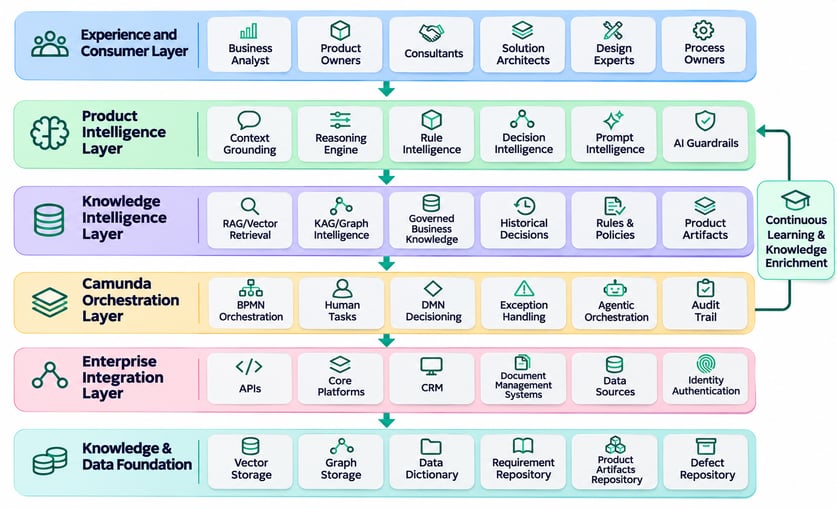
The Product Intelligence and Knowledge Intelligence layers provide reasoning and context, while the Camunda Orchestration & Governance Layer acts as the control plane connecting intelligence with people and enterprise systems.
This separation allows MEYON to combine the flexibility of Generative AI with the predictability required in enterprise environments. AI can reason where judgement and context are required, while deterministic orchestration maintains process state, governance and accountability.
As approved decisions, defects and delivery outcomes are generated, they can be fed back into MEYON's knowledge foundation, creating a continuous learning loop and stronger context for future product decisions.
AI recommends. Camunda orchestrates. Humans govern. Enterprise knowledge continuously improves.
Business analysis as the first product Intelligence Use Case
MEYON is more than an architectural concept. To demonstrate how Governed Product Intelligence can work in practice, I have developed its first working use case around Business Analysis and product discovery.
Business Analysis was chosen deliberately because it sits at the intersection of business intent, customer experience, enterprise knowledge, rules, systems, architecture, and delivery. It provides an ideal environment to demonstrate how fragmented information can be converted into connected and reusable intelligence.
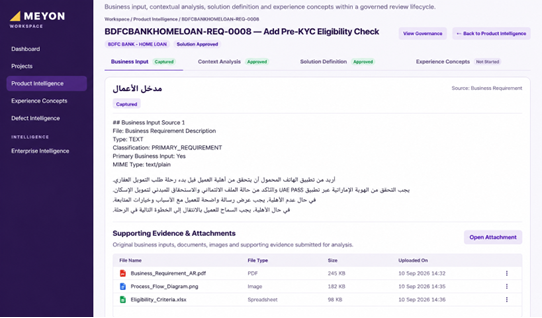
A product opportunity can enter MEYON in English or Arabic, together with supporting documents and project context. From there, MEYON grounds the request against enterprise knowledge, identifies related capabilities and decisions, analyses dependencies and business rules, highlights gaps and risks, and builds a structured understanding of the change.
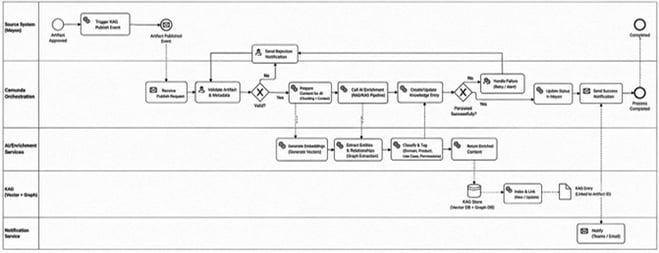
The experience is orchestrated through Camunda, allowing AI reasoning, knowledge retrieval, human review, clarification and approval to operate as one governed lifecycle rather than a collection of independent AI prompts.
The multilingual capability is particularly relevant for enterprise environments in the UAE. The same governed intelligence model can accept Arabic business input and generate Arabic-facing analysis or early experience concepts without requiring a separate product workflow.
For suitable scenarios, activities that normally require several rounds of discovery, knowledge search, analysis and initial experience shaping can be brought together within minutes through an orchestrated AI workflow.
A working view of MEYON
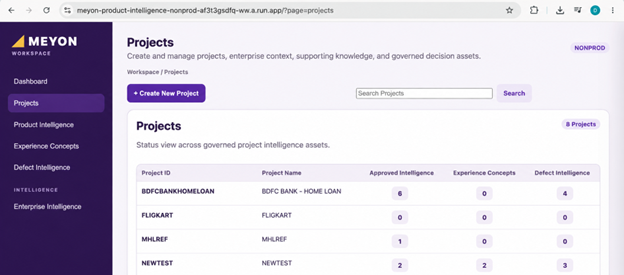
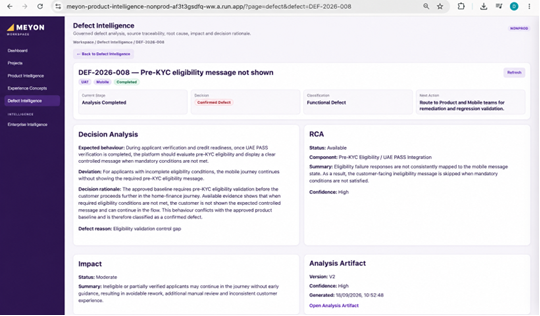
The screen below shows how MEYON brings projects, product intelligence, experience concepts, defect intelligence and enterprise knowledge into a single governed workspace. The objective is not to manage isolated artefacts, but to provide a connected view of how product decisions, analysis and learnings evolve across the lifecycle.
Conclusion
Bringing Generative AI, enterprise knowledge and Camunda process orchestration together opens a new set of possibilities for organizations looking to move beyond isolated AI experiments. AI can provide reasoning and context, while Camunda provides the orchestration, governance and human control required to turn that intelligence into reliable enterprise processes.
For financial institutions and other complex enterprises, this creates an opportunity to build solutions where AI recommendations, business rules, human decisions and enterprise systems operate within one governed workflow—with the transparency and traceability required for enterprise adoption.
Nagarro’s experience across process orchestration, AI engineering, product consulting, data, cloud and enterprise integration provides a strong foundation for exploring this next generation of intelligent workflows. By combining these capabilities, organizations can move from using AI as a standalone assistant to building connected, governed, and reusable intelligence across the enterprise.
The next evolution of enterprise AI is not simply about generating better answers. It is about orchestrating intelligence into real business outcomes.

