60 mins


 China
China  India
India  Japan
Japan  Philippines
  Singapore
  South Africa
  Sri Lanka
  Thailand
  Colombia
  Ecuador
  Austria
  Denmark
  Finland
  France
  Germany
  Hungary
  Norway
  Poland
  Portugal
  Romania
  Spain
Spain  Sweden
  Switzerland
  United Kingdom
  UAE
UAE  Canada
  Mexico
  United States

.svg)




Healthcare providers are rich in data and vision, yet weak in operational flow. In this article, we discuss how Intelligent Business Process Management (iBPM) and Process Orchestration is bridging the gap between digital promise and clinical reality.
The healthcare industry has a paradox: Hospitals poured billions into EHRs expecting them to solve “integration,” but EHRs were built for data continuity, not operational harmony. So today, hospitals are rich in data but still poor in workflow cohesion.
The current healthcare environment
CIOs and clinical leaders are facing a "silent integration crisis." They have advanced predictive AI models sitting unused on dashboards because the path from insight to action isn’t yet automated.
Having worked with leading healthcare companies globally, we witness trained nurses acting as "human routers," swivel-chairing between spreadsheets, vendor portals, and fax machines to coordinate basic care transitions.
This is the core barrier holding health systems back: the inability to deliver true “Systemness.” Every department has data. Every team has tools. But none of it adds up to a seamless, end-to-end operational rhythm. Health systems aren’t suffering from a data shortage. They’re suffering from a coordination shortage. That’s why the last thing they need is yet another platform. What they need is an intelligent orchestration layer that can thread everything together. Enter Intelligent Business Process Management (iBPM).
The great disconnect: Why EHRs aren't enough
Modern EHRs like Epic and Cerner are incredible Systems of Record. They are the single source of truth for clinical data. However, they were never designed to manage the fluid, complex, cross-departmental logistics that define a modern patient journey.
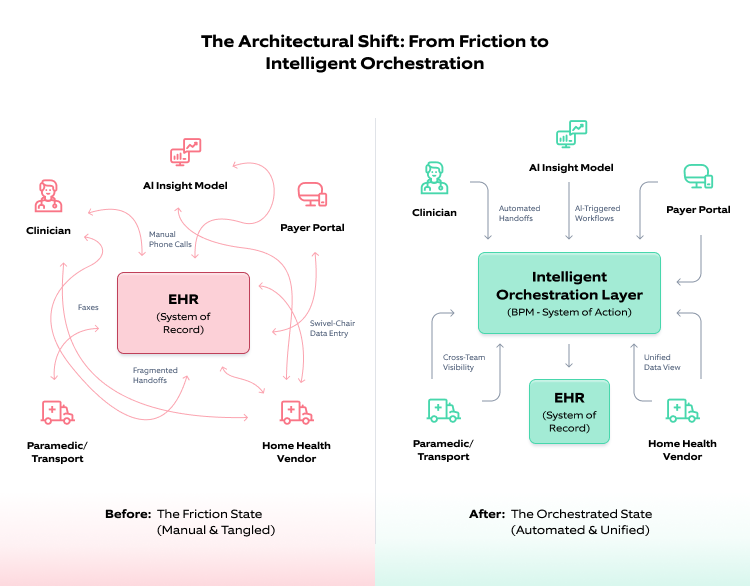
The real work of healthcare often happens in the "white space" between the EHR's data points. It's the phone calls to insurance companies for prior authorization, the coordination of paramedics for a "Hospital at Home" admission, and the manual chase for post-acute bed placement.
This is the "Systemness Gap"—a chasm of manual tasks that burns out clinicians, delays patient care, and leaks revenue. The infographic below evisualizes this fundamental architectural shift from a state of manual friction to one of intelligent orchestration.
The role of the "Action Layer" in modern architecture
To answer that question, we need to look at how the healthcare IT landscape has evolved. For decades, health systems followed an “EHR first” strategy that resulted in massive, monolithic systems. This approach solved data fragmentation, but it also created rigid processes. Whenever a hospital wanted to launch a new care model, such as a Hospital at Home program, it had to wait through costly, months-long custom development cycles inside the EHR.
The Action Layer introduces a “Composable Business” philosophy. By separating process logic from clinical data, hospitals can innovate at the speed of a startup. iBPM acts as a high-speed sidecar to the EHR, allowing clinical teams to design, test, and deploy new workflows in weeks rather than years. This agility is not just a technical improvement; it has become a clinical necessity as care models rapidly shift from inpatient environments to residential settings.
iBPM: The "System of Action"
Successful transformation initiatives generally don't try to replace the EHR. Instead, they build an agile "System of Action" on top of it. iBPM platforms serve as this layer, orchestrating people, legacy systems, and AI agents into a unified workflow.
We see this orchestration driving value across these critical transformation pillars:
-
Operationalizing the "Agentic" AI future: Moving beyond passive dashboards. iBPM gives AI "arms and legs," allowing predictive models to trigger autonomous workflows (like auto-drafting referrals) rather than just flagging human to-dos.
-
Mastering complex care logistics: Extending "Systemness" beyond the hospital walls by orchestrating the hard supply chain of Home Hospital—coordinating drones, DME vendors, and remote monitoring setups in real-time.
-
Clinician empowerment: Combating burnout by automating administrative "off time" tasks and simplifying documentation.
-
Revenue cycle resilience: Shifting from retroactive denial management to "Zero-Touch" autonomous prior authorization at the point of care.
The value of systemnessFor healthcare leaders, the value of this approach is transformative across the C-suite:
|
The governance guardrail: Ensuring safety in the "Agentic" era
While the leap toward autonomous execution is transformative, it must be governed by a rigorous "Human-in-the-Loop" framework. We don't advocate for removing clinicians from the process; we advocate for elevating them. The iBPM layer serves as a critical governance guardrail, ensuring that every autonomous action taken by an AI agent, whether it’s drafting a referral or dispatching a drone, it is transparent, auditable, and subject to final clinical approval.
In a traditional manual environment, the "audit trail" is often buried in fragmented sticky notes or unrecorded phone calls. An orchestrated iBPM approach logs every micro-decision. This provides a robust foundation for regulatory compliance, including HIPAA and Joint Commission standards, by offering a verifiable record of "Who, What, and Why" for every step of the patient journey.
By embedding these safety protocols directly into the workflow, hospitals can scale their innovation without compromising their primary mandate: patient safety.
Real-world spotlight: Mastering complex transitions
Whether it's discharging a patient to a skilled nursing facility or admitting an acute patient into their own home, these are logistical nightmares that the EHR cannot manage alone.
Using iBPM, we help clients transform these manual slogs into intelligent, parallel operations.
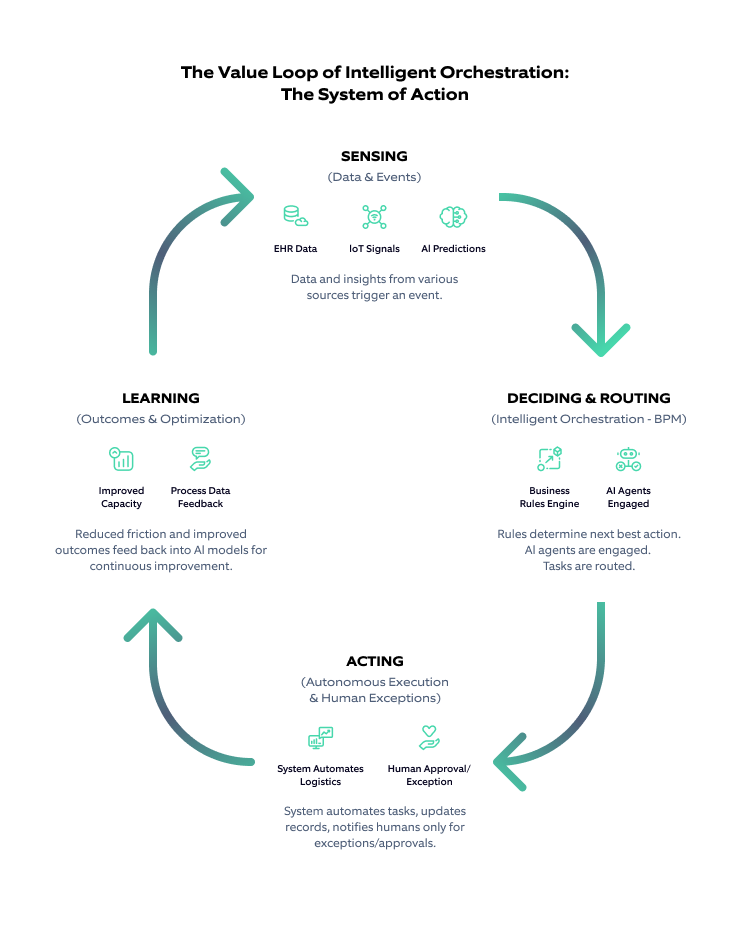
The Intelligent Orchestrator in action: Instead of a linear, human-dependent process, the iBPM brain concurrently manages critical paths:
-
Automated financial clearance: "Agentic AI" bots log into payer portals, submit clinical evidence, and secure prior authorization without human intervention, eliminating hours of phone tag.
-
Intelligent logistics command: Simultaneously, the system orchestrates the physical world. For a Home Hospital admission, it dispatches paramedics, orders oxygen delivery, and syncs telehealth kits, treating the patient's home like a virtual hospital ward.
The result is a significantly reduced Length of Stay (LOS) and the ability to scale new care models, such as Hospital at Home, without linearly scaling administrative headcount. This creates a continuous value loop that senses processes and turns data into action.
Conclusion: The pragmatic path forward
A fully integrated, AI-enabled health system demands layering intelligence and orchestration on top of what you already have.
At Nagarro, we believe that the future of healthcare isn't just about having more data; it's about having the intelligence to act on it. By embracing iBPM as the orchestration layer for "Systemness," providers can finally bridge the gap between their digital investments and the clinical reality.
We recommend starting with "Lighthouse Projects", targeting high-friction areas like complex discharges, home hospital logistics, or prior authorization automation to prove value quickly before scaling.