60 mins


 China
 India
 Japan
 Philippines
 Singapore
 South Africa
 Sri Lanka
 Thailand
 Colombia
 Ecuador
 Austria
 Denmark
 Finland
 France
 Germany
 Hungary
 Norway
 Poland
 Portugal
 Romania
 Spain
 Sweden
 Switzerland
 United Kingdom
 UAE
 Canada
 Mexico
 United States



At some point in the last two years, someone in your organization approved an AI budget. The business case looked compelling. The pilot looked promising. The vendor looked credible. Now ask yourself: can you prove it delivered? Not in impressions or anecdotes. In hard numbers, against a defined baseline, with measurable improvement, at a scale that justifies the investment.
KPMG's 2026 Global Tech Report found that 74% of companies report AI is generating value. While only 24% can prove it with tangible ROI. The rest are running on belief.
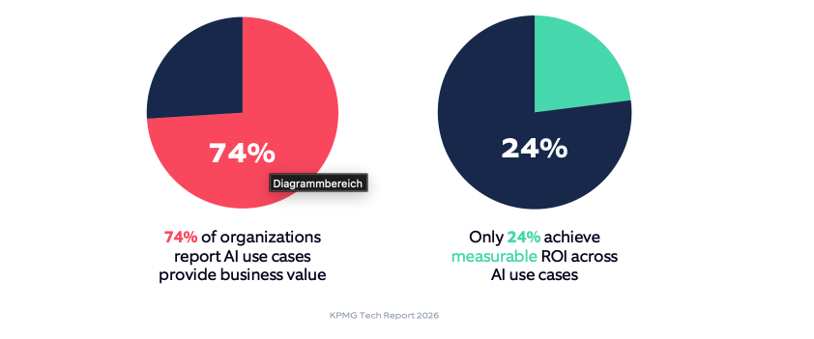
Figure 1
If you can't answer this with confidence, you're not alone. The problem with enterprise AI is often not that the technology fails. It's that organizations declare success when something goes live and stop asking whether it is being used or creating measurable value.
AI initiatives without adoption are costly failures. The investment gets made, the solution gets built, but if people aren't using it, all you have is a cost center with a good story. For leadership teams accountable for results, that isn't enough.
So what separates 24% from everyone else?
It's not a bigger budget. It's not a better model. And it's not more sophisticated agents.
The problem is rarely the technology itself. It's everything that surrounds it. AI makes it dangerously easy to confuse motion with progress. A working demo takes days. Real adoption takes months. Teams are incentivized to celebrate go-live. And organizations, exhausted from the build, are primed to agree.
Most AI initiatives lack three things: a clear definition of success before they start, an honest picture of where they stand today, and a plan to make sure people use what gets built.
Fix those three things, and the ROI question becomes answerable. Leave them unaddressed, and no amount of budget or technical sophistication will close the gap.
The fix
Fixing those three gaps takes six concrete principles, each addressing a different part of the problem. Together, they come back to the same idea is often discussed but less consistently applied: treat AI as a business discipline, not a technology project. That means defining success before deployment. Measuring the starting point before claiming improvement. Identifying friction before building solutions. And above all, treating adoption not as a communications task but as the primary driver of return on investment.
What follows is a practical framework built around six principles that turn AI investment into AI impact. Not six technologies, not six tools, but six ways of thinking and working that make the answer to "how do we know this is worth it?" something you can fully stand behind.
They build on each other. The challenge is turning them from principles into practice.
Define what value means to you
The first instinct in most AI initiatives is to ask "what can we build?" The right instinct is to ask "where does value come from", and "how will we know when we've created it?"
This sounds obvious. It almost never happens properly.
"AI delivers value" is not a KPI. It's a feeling. And feelings don't survive a CFO review, a budget renewal, or a board question about why costs keep rising while proof of return stays thin. Value needs to be defined before the first tool is selected, the first agent is implemented, or the first pilot is launched. Otherwise, there's no agreed standard to measure against, and no credible way to claim success when something goes live.
The goal isn't an exhaustive dashboard that tracks everything and tells you nothing. It's a small number of meaningful indicators directly tied to business objectives so leadership can quickly see whether the investment is generating the value it promised.
Think of these six dimensions as a menu. Your job is to pick from it, not work through all of it:
- Economic efficiency: process costs, personnel costs, ROI
- Productivity: throughput time, processing time, output per employee
- Quality: error rates, rework rates, first-time-right
- Customer experience: response time, satisfaction, conversion, retention
- Risk and compliance: compliance incidents, audit effort, incident rate
- Sustainability: resource consumption, energy use, material savings
The question isn't which dimensions exist. It's which one or two create the most visible gap between where you are and where you need to be.
Where is the distance between current performance and what's possible largest? Where does that gap connect most directly to what the business really cares about right now?
That's where value will be created. That's where attention, measurement, and accountability should concentrate.
Pick one. Two at most.
More KPIs don't mean more value. They mean more reporting, less accountability, and a growing inability to answer if it is working.
Establish a baseline
Once the right KPIs are defined, the next instinct is to move fast. Start building. Start automating. Start showing progress.
Resist it.
Before a single process is touched, the current state needs to be documented with precision. Not estimated. Not approximated. Measured. Without a clean, agreed-upon baseline, you have no credible way to prove anything improved. In a world where AI budgets are under increasing scrutiny, "we think it's better" is not an answer that will hold.
A baseline should capture the current state across whichever dimensions you selected. Costs, error rates, processing times, satisfaction scores. Whatever you choose to move, you need to know exactly where it started.
This step feels slow. It often gets skipped in the rush to demonstrate momentum. That's exactly why so many organizations find themselves months into an AI initiative with no defensible answer to the question they should have prepared for from day one: "compared to what?"
The baseline is not bureaucracy. It's protection for the investment, for the initiative, and for the people accountable for delivering it. Without it, success becomes a matter of opinion. With it, it becomes a matter of fact.
No baseline. No proof.
But what if it's already too late?
As you read this, you may already be mid-game. Your AI initiative is live, or close to it, and nobody captured a baseline. What now? You're not out of options. You'll just need to work a little harder.
Start by mining what already exists. Ticketing systems, ERP logs, CRM exports, time-tracking data. Your organizations may sit on more historical data than you think. It may simply never have been aggregated into a KPI. Before assuming nothing exists, check whether the raw material to reconstruct a baseline is already sitting somewhere.
If that data truly doesn't exist, go one level up or down the process chain until you find a surrogate metric. Something that was already tracked and correlates with the value you care about. You wanted cost per case, but it was never tracked, then look for number of tickets processed. You wanted an error rate reduction, but never measured it, then rework requests may do the trick. It’s not the metric you initially wanted, but it's real, and it's defensible.
If even that's unavailable, fall back on structured expert estimation. Not vague recollection, but anchored interviews with process owners. How many tickets did they handle per week, on average, before this went live? Weaker evidence, but still more defensible than operating on belief, as long as you're explicit that it's an estimate.
One additional lever, regardless of whether you can reconstruct your measures, is a comparison group. If any part of the organization hasn't adopted the tool yet, whether by accident or by design, that group can serve as your baseline instead of history. But keep in mind that the teams that haven't adopted usually differ in ways that matter. Workload, tech-savviness, and talent can all vary, and those differences may be driving the gap.
All of this works. None of it is as good as simply starting with a baseline next time.
Find the friction first
With a clear definition of value and a documented baseline, most organizations are tempted to jump straight to solution design. Which AI model fits? Which platform has the best demo? Which use case looks most impressive in a presentation?
Wrong sequence.
Before any solution is considered, the friction in existing processes needs to be honestly mapped. Not from a technology perspective, but from a human one. Where do things break down? Where do people waste time, make mistakes, wait for approvals, or work around broken systems? Where does the process quietly bleed cost and quality every single day?
This step reframes the entire initiative. AI stops being a technology hypothesis and becomes a targeted answer to a specific problem. The question is no longer where can we apply AI? It's where does friction cost us most, and can AI remove it?
And sometimes the honest answer is AI isn't the fix. At least not yet.
A bad process that gets automated is just a bad process running faster. A bottleneck that gets accelerated doesn't disappear. It moves. What looked like a processing problem turns out to be a data quality problem. What looked like a speed problem turns out to be a decision-making problem. Applying AI before fixing the underlying process doesn't remove friction. It industrializes it.
Find the friction first. Fix what needs fixing. Then ask what AI can do.
Make adoption the mission
The KPIs, the baseline and the friction mapping don't mean anything if people don't use the solution. And yet adoption is consistently the last thing organizations plan for and the first thing they underestimate.
The ROI formula for AI is not complicated:
ROI = (Value generated - Investment) / Investment
What counts as value depends on the dimension you picked earlier. But whichever dimension applies, value generated is never a fixed number. It's what one use is worth, multiplied by how many times it actually gets used. Be it by a person or a process running in the background. And for people, adoption is the multiplier that turns potential value into real value.
Which is why a mediocre solution used by everyone will outperform an excellent solution used by a few. Every time.
This is perhaps the most counterintuitive truth in enterprise AI, and the one most consistently ignored by teams who have spent months perfecting the technology and just hours thinking about the humans who are supposed to use it.
And research backs that up. BCG puts a number on it. Just 30% of AI transformation is about algorithms and technology. 70% is rethinking the people, culture and process component. Most organizations have those priorities exactly backwards.
Prosci's analysis of change projects found that initiatives with excellent change management are seven times more likely to meet their objectives than those with poor change management. BCG's 2025 AI survey adds a further data point on the role of strong leadership support. It can move AI adoption rates from 41% to 82%.z
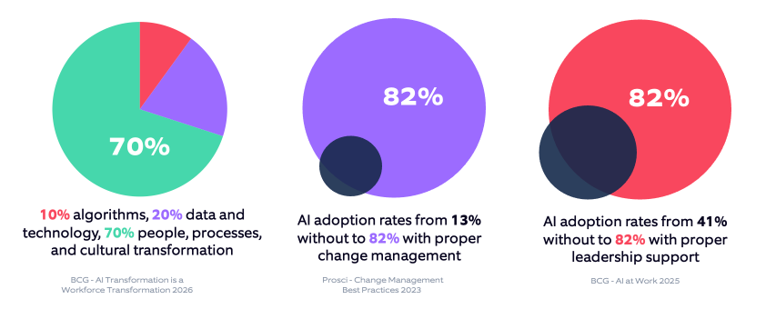
Figure 2
This shows that this isn't a technology gap or a budget gap. It's a people gap. And it cannot be closed by a better model, a slicker interface, or a company-wide email announcing that the new tool is live.
Adoption is not a communications task. It's not a training session on launch day. It is one of the primary drivers of return on investment, and it needs to be treated with the same rigor, resourcing, and accountability as the technical build itself. That means involving people before the solution is finished, not after. It means understanding resistance before it becomes rejection. It means measuring adoption rate and speed of adoption, because they are direct predictors of whether the business value defined at the beginning will ever actually materialize.
But "materialize" has a catch. Value per use often means freed-up time or capacity, not cost that disappears from a budget. Adoption guarantees the value gets realize, it doesn't guarantee that value shows up as cash. That only happens once someone decides what the freed-up capacity gets converted into.
The technology is the "easy" part. Getting people to change how they work is where AI initiatives are won or lost.
Measure what really changed
After go-live, the only question that matters is: did it work?
This sounds straightforward. In practice, it's where accountability goes to die. Teams celebrate deployment. Leadership moves on to the next initiative. And the quiet, unglamorous work of comparing new reality against baseline gets deprioritized or skipped entirely.
After implementation, the new state needs to be measured against the baseline with the same rigor applied when establishing the baseline. Not impressions. Hard numbers against the indicators defined at the outset. How much did processing time decrease? By how much did error rates drop? What process costs were reduced and by how much? Where was capacity freed up, and what is it being used for?
But not all value shows up in a spreadsheet. AI frequently generates effects that are strategically significant but harder to quantify. Greater consistency in decisions, faster response capability, higher employee satisfaction, stronger trust in outputs and processes. These matter. And because they matter, they need to be operationalized too, through quality indicators, structured surveys, SLA tracking, or standardized scoring models.
If it's worth claiming, it's worth measuring.
One more thing worth saying directly is, don't get distracted by technical KPIs. Accuracy, recall, precision, and F1 are important for model development. They are not measures of business value. An improvement in model accuracy that doesn't move the KPIs defined at the beginning has zero business value. Budget spent chasing technical performance without a line of sight to business impact is budget wasted.
Measure continuously, not just at launch
There is a moment in almost every AI initiative where the hard work of measurement quietly stops. The go-live is behind you. Adoption is climbing. The early results look promising. Attention shifts. That's exactly when measurement needs to accelerate.
AI value is not a fixed point. It moves. Usage patterns shift as teams grow more confident. Model performance drifts as data changes and edge cases accumulate. Processes evolve in ways that make yesterday's solution less relevant to today's reality. What delivered strong results in month three may be quietly underperforming by month nine. Without continuous tracking, nobody will know until the budget review forces the question.
Continuous measurement means ongoing tracking of the KPIs defined at the outset, monitoring adoption rates and usage patterns over time, regular review of quality changes, and iterative adjustment of models, prompts, and processes as performance shifts. The organizations that sustain AI value over time are not the ones that built the best solution on day one. They are the ones that kept asking whether it was still working and kept adjusting when the answer was no.
There is also a compounding effect that only becomes visible through continuous measurement. Small, iterative improvements to a widely adopted solution accumulate into significant business impact over time, but only if someone is watching. Only if the KPIs are live, the adoption data is tracked, and the accountability is real.
A pilot that gets measured once and declared a success is an expensive experiment. A solution that gets measured continuously becomes a scalable business capability.
That's the difference between AI that looked good in a presentation and AI that shows up in the results.
The question you should be asking tomorrow morning
None of these six principles requires a bigger budget or more advanced technology. What they require is a deliberate decision to treat AI as a business discipline rather than a technology project, and to hold that standard from day one through month twelve and beyond.
That decision is harder than it sounds, because the entire ecosystem around you is designed to make stopping at go-live feel like success. Technology vendors close the deal at deployment. Teams celebrate shipping. Budgets get allocated to the next initiative. The pressure to declare victory is real, and it arrives at exactly the wrong moment.
The questions that would tell you whether any of them are working are probably still unanswered. Do you have a baseline? Can you prove adoption is where it needs to be? Are the KPIs you defined in month one still being tracked in month six?
If the CFO asked today whether this investment is paying off, not in theory, but in hard numbers, could you answer?
If the honest answer is uncertain, the gap is not technical. It is organizational. And organizational gaps close when leadership decides they matter enough to close them. AI will not sort itself out. Models don't self-justify. Adoption doesn't happen by announcement. Value doesn't materialize because a solution went live. It materializes because someone in the organization took measurement seriously, took people seriously, and refused to accept belief as a substitute for evidence.
24% didn't get there by accident. They got there by asking harder questions earlier, and by being willing to act on the answers even when those answers were uncomfortable.
If you're ready to have a conversation about how to ask those questions and turn your AI investment into AI impact, reach out to betc.contact@nagarro.com.