60 mins


 China
China  India
India  Japan
Japan  Philippines
  Singapore
  South Africa
  Sri Lanka
  Thailand
  Colombia
  Ecuador
  Austria
  Denmark
  Finland
  France
  Germany
  Hungary
  Norway
  Poland
  Portugal
  Romania
  Spain
Spain  Sweden
  Switzerland
  United Kingdom
  UAE
UAE  Canada
  Mexico
  United States

.svg)




When software gains autonomy, the governance model becomes as important as the architecture itself. We are entering an era where autonomous digital actors will shape institutions as profoundly as humans do.
For decades, software systems executed instructions written by humans. When they failed, the reasons were usually understandable: a bug could be traced to a line of code, a rule, or a missing condition. Accountability, while never perfect, was conceptually clear.
But now, AI has quietly but surely unleashed a paradigm shift in this implicit contract.
Software systems no longer only recommend or predict. Increasingly, they decide and act. Agentic AI systems schedule meetings, negotiate prices, route support tickets, approve loans, trigger medical alerts, generate legal drafts, and even invoke tools and services without waiting for human confirmation. They plan, decompose goals, remember past interactions, and adapt their strategies over time. What makes this shift profound is not only technical sophistication but also autonomy.
Challenges in agentic governance:
From deterministic programs to autonomous systems
Understanding this shift requires examining how each generation of software has changed the rules of behavior, accountability, and control:
| Dimension | Traditional Software | ML Systems | Agentic AI |
| Behavior | Deterministic; same input leads to same output | Probabilistic; predictions with uncertainty | Emergent; arises from models, tools, memory & environment interactions |
| Action model | Executes fixed instructions written by humans | Recommends or predicts; human decides | Decides and acts autonomously; interprets goals, plans multi-step sequences |
| Memory & state | Stateless or explicitly managed | Model weights encode learned patterns; no runtime memory | Maintains persistent memory; adapts strategies across sessions |
| Accountability | Clear; bugs traceable to a line of code or rule | Partially traceable; model decisions are often opaque | Fragmented across chains of actions, tools, and agents |
| Governance scope | Code review, testing, deployment policies | Model cards, bias audits, fairness metrics | Orchestration logic, tool policies, inter-agent communication, execution boundaries |
This makes informal governance impossible. Without explicit controls, organizations lose the ability to predict behavior, bound risk, or reconstruct causality after failures.
Why agentic systems need governance
In agentic systems, risk no longer resides only in individual predictions. It emerges from planning errors that select harmful strategies, from tool misuse that triggers unintended actions, from memory contamination that biases future decisions, and from prompt injection and instruction hijacking. Risk also arises through cascading failures across agent networks, as well as from emergent behaviors that are not present in any single component.
Traditional governance frameworks designed for static models are not enough anymore. Governance must now encompass orchestration logic, tool policies, inter-agent communication, and execution boundaries.
Additionally, when an agent chains together ten actions across five systems, who is responsible? Without any form of explicit governance, accountability fragments beyond recovery. Agentic systems force organizations to confront responsibility at architectural scale instead of solely at the model scale.
The governance framework: Five core pillars of AI governance
While the classical pillars of AI governance remain valid, they must evolve to address autonomy, orchestration, and multimodal reasoning.
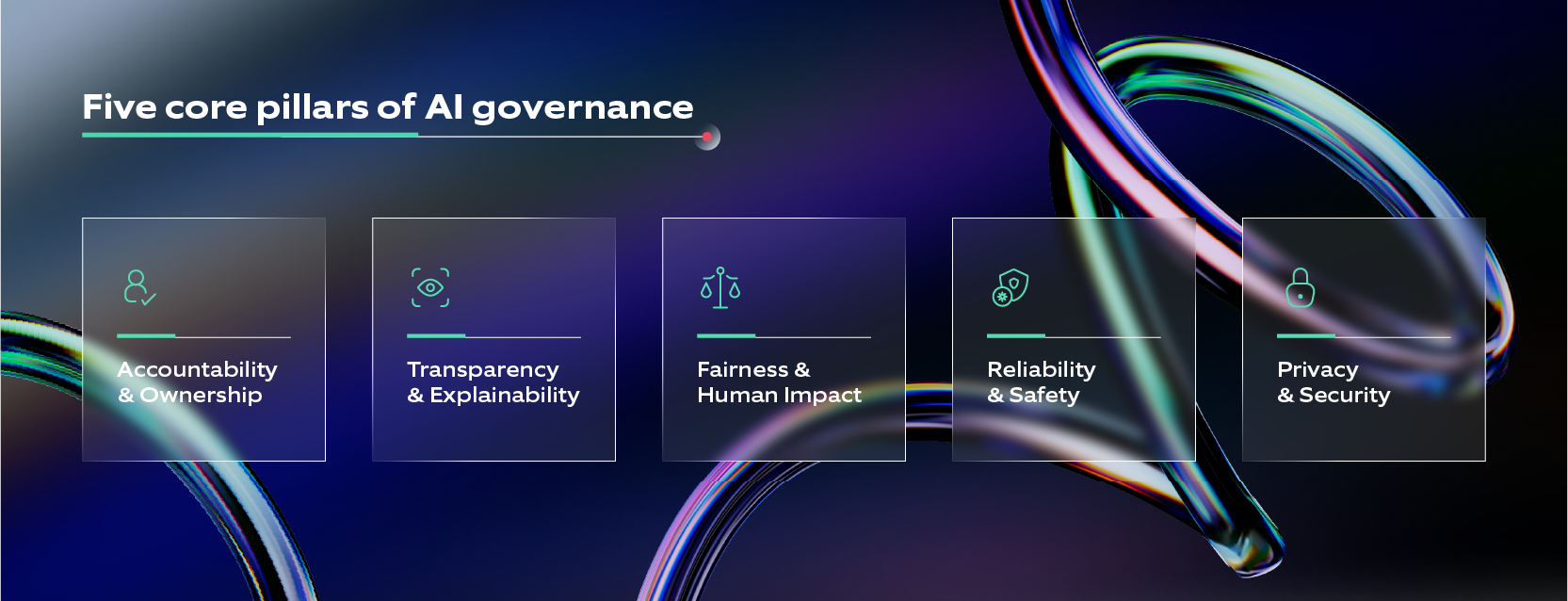
1. Accountability and ownership: Governing chains of action
In agentic systems, ownership extends beyond individual models to the behaviors they produce over time. Governance must assign responsibility across the entire chain of action: from goal definition and policy design, through planning and orchestration logic and tool selection, to memory management, persistence, execution monitoring, and rollback mechanisms.
A critical construct is action accountability. Organizations must be answerable for every action they take: Who authorized this capability? Which policy permitted this action? Which agent decided it? Which context influenced it? This requires fine-grained audit trails across reasoning steps, tool calls, and state transitions. Without instrumentation, post-incident investigation becomes impossible.
2. Transparency and explainability: Explaining decisions, plans, and trajectories
Explainability in agentic AI goes beyond single predictions. Stakeholders increasingly ask these key questions: Why was this goal selected? Why was this plan chosen? Why were these tools invoked?
These questions present a clear pattern: Governance must ensure trajectory-level explainability. This helps in the reconstruction of reasoning chains, intermediate beliefs, and planning branches. Without this visibility, it becomes difficult to sustain regulatory audits, incident investigations, safety validation, accountability attribution, and user trust.
3. Fairness and human impact: Governing long-horizon effects
Agentic systems introduce feedback loops. An agent’s decision today influences tomorrow’s data. This data re-trains tomorrow’s model, which biases tomorrow’s agent. Over time, small disparities amplify into structural inequities. Governance must evaluate fairness not only with every decision but also across trajectories and populations over time.
Human impact assessment should now account for cumulative exclusion or disadvantage, automation bias and human deskilling. It should also consider the psychological effects of interacting with agents, emerging power asymmetries between users and autonomous systems, and growing institutional dependency on opaque automation. This makes fairness a property of systems over time, rather than something that can be captured in static evaluation datasets.
4. Reliability and safety: Containing autonomous failure modes
Agentic systems fail differently as compared to traditional software. They can hallucinate plans, pursue incorrect subgoals persistently, exploit unintended loopholes, over-optimize proxy objectives, or coordinate in unforeseen ways that only amplify harm instead of containing it.
Governance must impose bounded autonomy through clear execution limits and introduce explicit human-in-the-loop checkpoints. It should also apply confidence-aware action thresholds and enable rollback-and-compensation mechanisms supported by simulation-based safety testing. In this context, safety is no longer about preventing wrong answers but about preventing wrong actions at scale.
5. Privacy and security: Governing memory, tools, and agency
Agents accumulate memory. They observe users. They integrate across systems. They act with delegated authority. This creates unprecedented privacy and security risks, including long-term profiling, memory leakage across sessions, cross-system inference attacks, prompt injection into planning logic, and tool privilege escalation.
Governance extends privacy-by-design beyond data collection and storage to encompass memory lifecycle management, and strict context isolation. It also includes robust tool permission models, precise capability scoping, and continuous red teaming to identify and mitigate emerging risks.
Testing strategies and methodologies
Testing is the practical expression of governance. In agentic AI, the principal safety mechanism is to limit autonomy, surface risks, and demonstrate that systems remain aligned with legal, ethical, and organizational expectations.
Since agentic systems learn, plan, remember, and interact continuously, testing must address not only correctness at a moment in time, but behavior across time, across contexts, and under deliberate misuse. This shift in approach reshapes not just what we test, but also how, when, and under what adversarial pressures testing must occur.
The following testing dimensions form the foundation of effective governance for agentic AI systems:
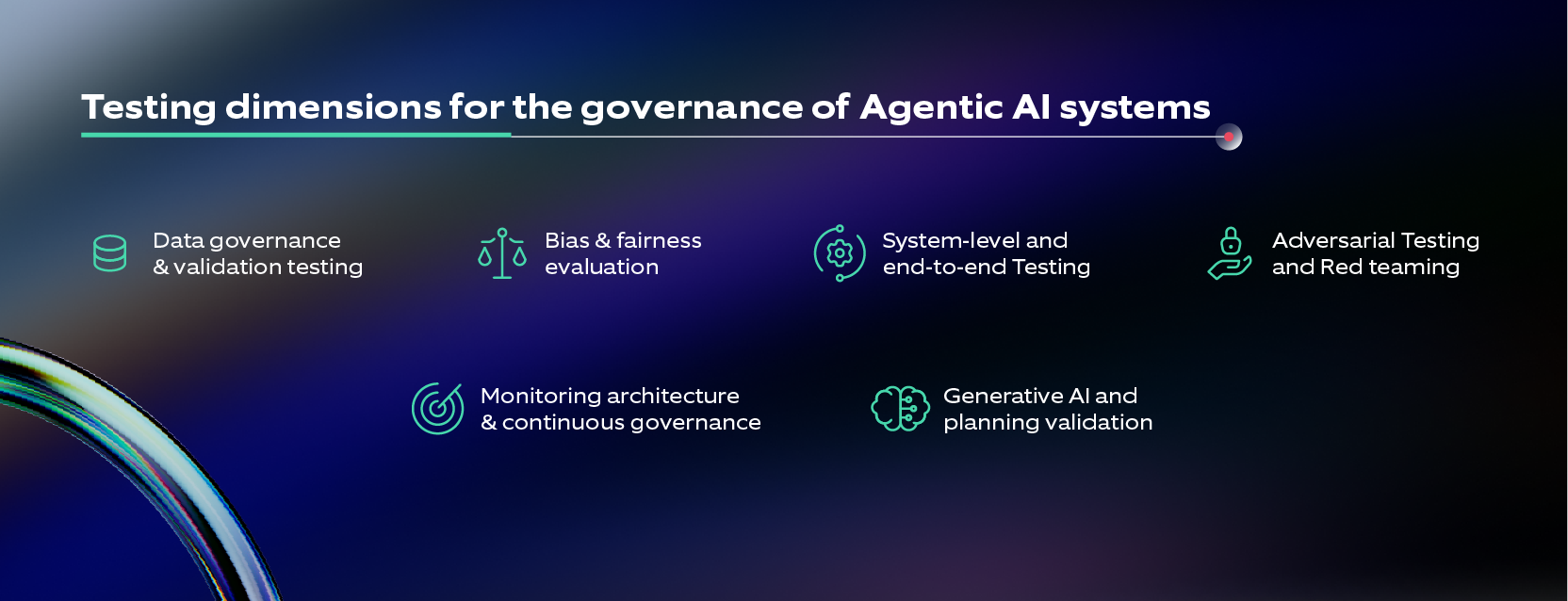
1. Data testing and governance validation
Data remains the first determinant of system behavior. Organizations must examine whether training and operational data adequately represent relevant populations, contexts, and modalities, while actively detecting proxy variables, latent bias, labeling inconsistencies, and unintended leakage between training, validation, and production streams. In systems with memory and tool integration, data governance also reaches into runtime behavior. This includes monitoring memory contamination across sessions, preventing cross-context leakage, and validating externally generated data before it re-enters the reasoning loop.
2. Bias and fairness testing to ensure governance
Bias testing evolves from snapshot measurement to continuous observation. Governance evaluates how subgroups are treated across full decision trajectories, how disparities accumulate, and how alternative plans would have altered outcomes under counterfactual conditions.
In dialog and generative agents, fairness testing examines toxicity, stereotyping, and differential refusal. Fairness becomes a property of sustained interaction, requiring ongoing measurement rather than periodic certification.
3. Adversarial testing and red teaming for governance validation
In systems that reason and act, adversarial testing is foundational. Red teams probe prompt injection, instruction hijacking, tool misuse, privilege escalation, policy bypass, data exfiltration, model inversion, and memorization.
In agentic settings, attacks increasingly target the planning process: manipulating goals, poisoning memory, inducing collusion between agents, or forcing execution beyond authorized boundaries. Continuous red teaming shifts governance from reactive incident handling to anticipatory risk discovery, exposing vulnerabilities before they manifest as operational failures or public incidents.
4. Generative AI and planning validation
Generative components require dedicated evaluation. Core concerns include hallucination, factual consistency, attribution and citation accuracy, leakage of training data, and toxic or harmful content. For generative agents, testing extends into planning behavior: detecting fabricated plans, spurious tool invocations, and overconfidence. In domains with material impact on rights, safety, or financial outcomes, automated metrics remain insufficient. This makes structured human review essential there.
5. System-level and end-to-end testing
System-level testing shifts focus from components to workflows. Scenario-based simulations explore realistic operating conditions while human-agent interaction studies examine usability, automation bias, and escalation dynamics. Governance requires explicit validation of override mechanisms, recovery procedures, rollback paths, and audit trails.
6. Monitoring architectures and continuous governance
In high-autonomy ecosystems, monitoring becomes the key element within governance. It is a continuous, adaptive feedback loop that predicts instability before it spreads any further. Once deployed, monitoring becomes the primary instrument of governance. Modern architecture systems integrate telemetry, analytics, and governance dashboards to track drift across data, models, and behavior. They detect emerging bias, observe action distributions, identify anomalous tool usage, and control memory growth. Monitoring feeds regulatory reporting, retraining pipelines, automated throttling, and emergency shutdown. In agentic AI, continuous monitoring is the only viable means of governing systems whose behavior evolves beyond initial certification.
Conclusion: From capability to responsible autonomy
AI is no longer about predictive technology alone. It has now become an autonomous actor in economic and social systems. As autonomy increases, so does responsibility.
Governance provides the structure, testing provides evidence, and monitoring provides vigilance. Together, they allow organizations to deploy agents not as uncontrolled experiments but as accountable participants in human systems.
One thing is for sure now: The future will not be defined by the most intelligent agents. It will be defined by the best-governed ones. Organizations that master this governance architecture won’t just deploy agentic systems but will also shape the norms by which autonomous digital actors coexist with human institutions.