60 mins


 China
China  India
India  Japan
Japan  Philippines
  Singapore
  South Africa
  Sri Lanka
  Thailand
  Colombia
  Ecuador
  Austria
  Denmark
  Finland
  France
  Germany
  Hungary
  Norway
  Poland
  Portugal
  Romania
  Spain
Spain  Sweden
  Switzerland
  United Kingdom
  UAE
UAE  Canada
  Mexico
  United States

.svg)




1. The strategic inflection point insurance leaders face
Insurance leaders are navigating a familiar set of pressures, but the dynamics underneath them are changing.
Customer expectations have moved toward greater speed and transparency and, increasingly, toward relationships that deliver value beyond individual transactions. Risk landscapes are evolving faster than historical models were designed to absorb. At the same time, operating costs continue to pressure margins, even in years of disciplined underwriting.
A new class of AI capability is emerging. Agentic systems offer more than incremental automation or better predictions. They can carry context across decisions, coordinate actions across systems, and operate within defined governance boundaries.
Insurers are already investing heavily in AI, with most large carriers now having multiple AI initiatives underway. Yet the economic outcomes remain uneven. Improvements in loss ratios, expense ratios, claims cycle times, and productivity are often incremental rather than structural.
The issue is not simply the technology being used. Most AI initiatives in insurance have focused on optimizing individual processes or generating better insights. Far fewer have re-examined how decisions flow across claims, underwriting, servicing, and compliance, and where costs, delays, and risks build up along the way.
The question for insurers is therefore no longer just where AI can automate work. It is where intelligence can materially change how insurance economics are truly shaped.
2. The economic drag hiding inside today’s insurance stack
Despite decades of digitization, much of insurance economics is still shaped by fragmentation.
Claims systems, policy administration platforms, fraud tools, underwriting engines, and compliance workflows each operate with partial views of the same customer, policy, or event. Data moves, but context does not always move with it. Decisions are made locally, while consequences appear further downstream.
The result is a familiar pattern:
- Claims costs rise through repeated handoffs and manual reviews.
- Underwriting becomes more conservative to compensate for uncertainty
- Servicing costs increase as exceptions multiply
- Compliance effort grows alongside transaction and policy volumes
Insurers responded logically with more rules, better models, additional tools. Each has improved part of the process. Collectively, however, they have also increased the coordination required between them. That coordination increasingly falls to people.
Claims handlers, underwriters, service teams, and agents must connect information, interpret intent, resolve exceptions, and determine what happens next. This is why digital transformation can often look successful and fragile at the same time. The visible layers improved. The underlying economics did not move as much as expected.
3. The invisible workload carried by insurance agents
The effect of this fragmentation is particularly visible at the operational edge.
Insurance agents, claims handlers, and underwriters often act as the integration layer between systems. They reconcile inconsistent information, manage exceptions, interpret policy intent, and coordinate actions across multiple systems, frequently under customer and regulatory pressure.
This invisible workload has direct economic consequences:
- Cycle times stretch as human coordination becomes the critical path
- Error risk rates rise in complex or high-volume scenarios
- Productivity gains flatten despite better tools
- Risk decisions become more conservative when context is incomplete
These challenges are often treated as training or tooling problems. In reality, they are system design problems. When people repeatedly must reconstruct context and move decisions between systems, the cost of coordination becomes part of the economics of every claim, policy, and customer interaction.
That model may work at moderate scale. It becomes harder to sustain as transaction volumes rise, risk profiles diversify, and regulatory requirements grow more complex.
4. The missing layer in the insurance operating model
This is where Agentic AI represents a qualitative shift.
Not as a replacement for people or systems, but as a missing layer in the operating model. Traditional automation executes predefined tasks. Predictive AI helps estimate what may happen.
Agentic systems go a step further by coordinating decisions and actions across multiple steps while retaining context and operating within defined boundaries. They are designed to own outcomes, not just tasks. They can perceive changing conditions, work across multiple constraints, determine the next appropriate action, and involve people when a decision falls outside their permitted scope.
In adjacent BFSI domains, early implementations show that the economic impact of such systems comes less from automation and more from eliminating coordination overhead. Decisions move faster not because people work harder, but because context no longer must be rebuilt at every step.
For insurance, this distinction matters because many economic inefficiencies in insurance do not come from one poorly automated task. They come from the coordination required between many otherwise functional systems and processes.
Claims, underwriting, servicing, risk, and compliance all depend on decisions moving consistently across workflows. When context has to be rebuilt at every step, delay and cost accumulate.
As discussed in our earlier work on moving Agentic AI from pilot to production, the challenge is not technological novelty but disciplined introduction. It is embedding intelligence where decision latency and human coordination currently create measurable economic friction.
The remainder of this article explores where this shift could reshape insurance economics first, and what it would take to do so responsibly.
5. Where agentic AI changes insurance economics first
The economic impact of Agentic AI will not appear uniformly across insurance.
It is likely to emerge first in areas where cost, risk, and delay are driven by repeated handoffs and human coordination overhead.
Before diving into individual areas, it helps to visualize where insurance economics actually break today.
Where Insurance Economics Leak
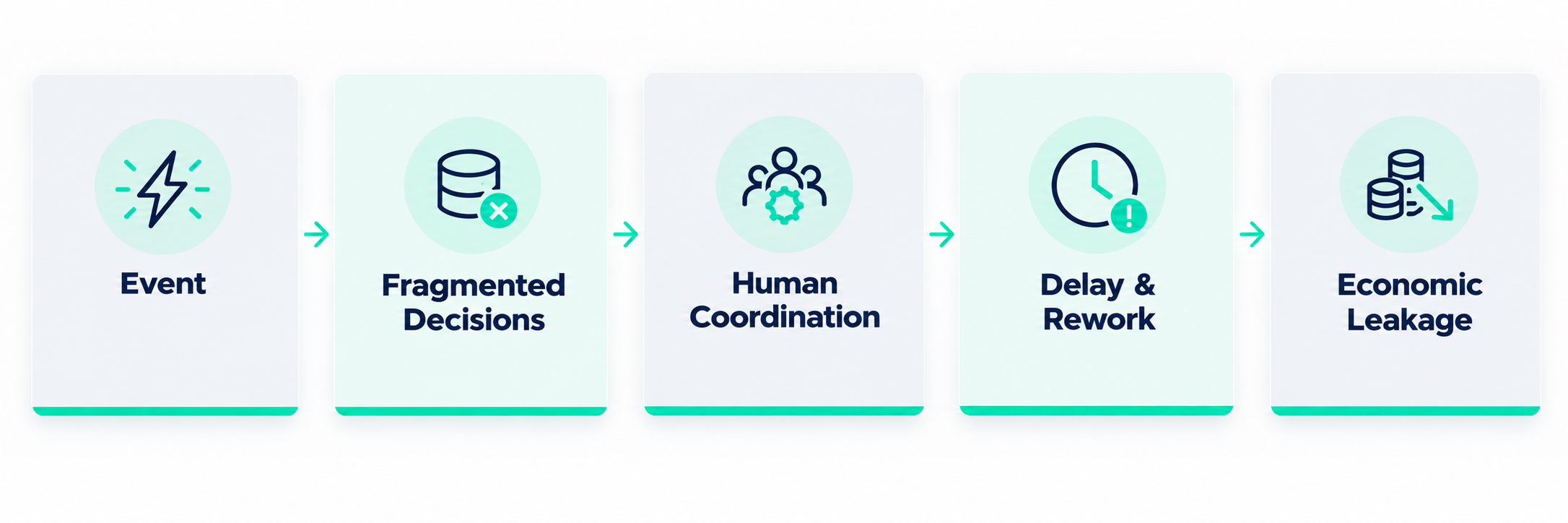
Claims, underwriting, servicing, and compliance can all follow this pattern.
What differs is how frequently it occurs and how expensive each delay becomes.
How Agentic AI Shifts the Economics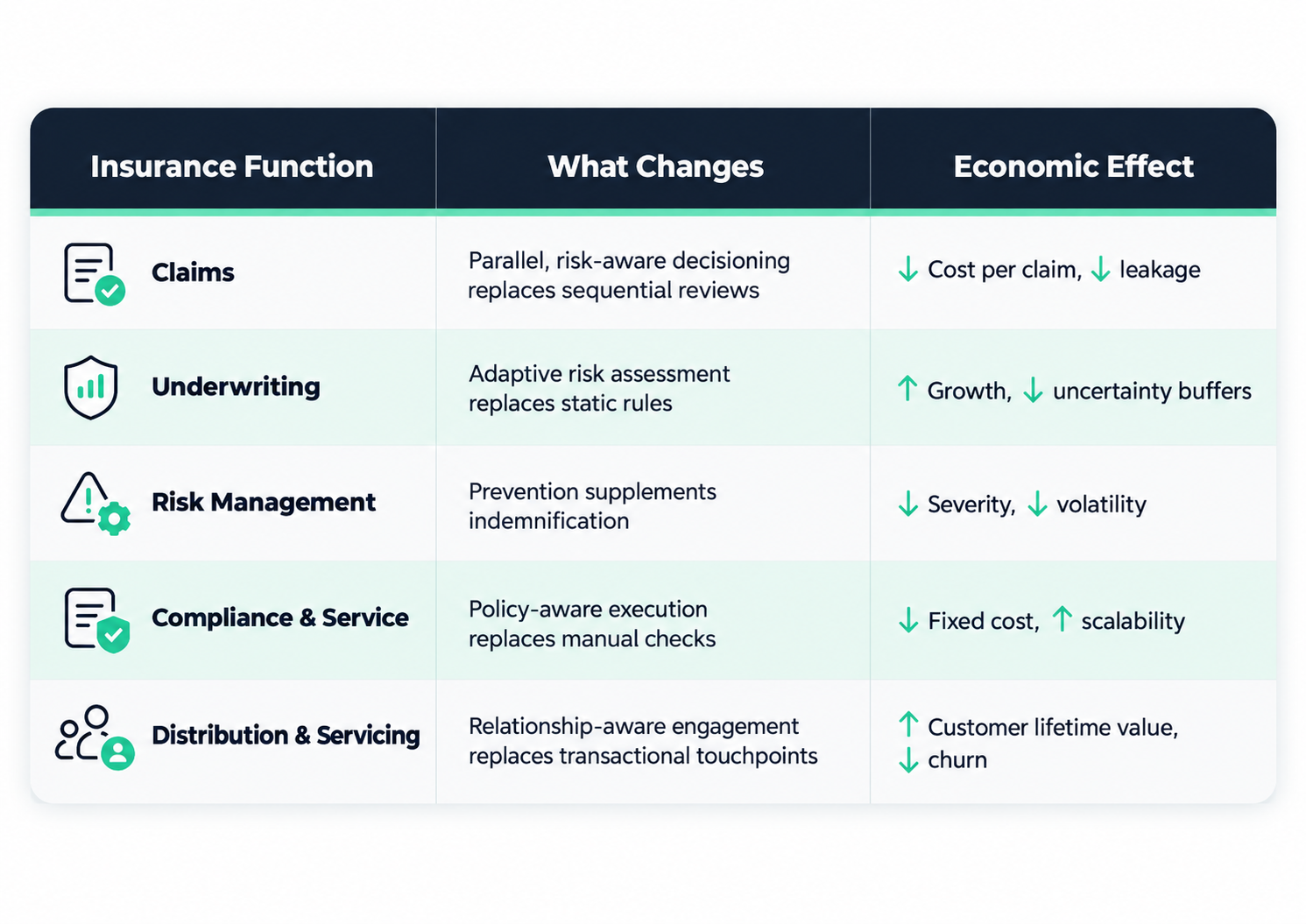
The sections below briefly explain why these shifts matter.
Claims: Reducing cycle time and leakage
Claims economics suffer not by the quality of decisions but also by how long those decisions take and how often they are reconstructed. Each handoff introduces delay and conservatism, pushing up both settlement cost and customer dissatisfaction.
Agentic systems can allow risk, coverage, fraud, and confidence checks to be assessed in parallel within defined governance rules, with people focusing on genuine exceptions and complex cases.
Economic outcome:
Faster settlement reduces expense ratios and indemnity leakage while allowing adjusters to focus on complex, high-risk cases rather than coordination.
Running fraud and confidence checks alongside the core claims process can also help separate routine cases from those that genuinely require investigation, reducing unnecessary delays while keeping attention on higher-risk claims.
Underwriting: Reducing the cost of uncertainty
Underwriting teams respond to incomplete or outdated context by narrowing appetite and increasing manual review. This protects risk against uncertainty but can also constrain growth and increase operating effort.
Agentic AI can help decisions respond continuously to relevant signals, including behavioral data, environmental risk, usage patterns, claims history, telematics, IoT feeds, and third-party risk information, while remaining within established policy and governance requirements.
Economic outcome:
Insurers can expand into previously underserved segments without proportionally increasing underwriting cost or risk exposure.
Beyond behavioral and environmental data, telematics and IoT feeds, claims and payment history, and third-party or geospatial risk scores can further sharpen the picture—provided the underlying data governance and explainability set-in.
Risk management: Moving earlier in the risk cycle
Most insurance operating models remain reactive: a loss occurs, and the response follows. As risk becomes more volatile, early intervention becomes increasingly valuable.
Agentic systems allow insurers to act earlier—monitoring risk signals and coordinating preventive interventions where permitted.
Economic outcome:
Lower loss severity and smoother loss ratios over time, improving capital efficiency and predictability rather than just speed.
As with underwriting, the value compounds with the range of signals monitored—weather and catastrophe data, IoT and telematics feeds, property condition reports, or supply-chain indicators—turning risk management from a periodic review into a continuously informed practice.
Compliance and servicing: Turning fixed cost into scale
Compliance and servicing costs scale with volume because they rely heavily on manual interpretation, documentation, and audit preparation.
With policy-aware, explainable execution embedded into workflows, many routine actions can be handled autonomously, with full traceability.
Economic outcome:
Lower marginal cost of compliance and servicing as the business grows, without sacrificing regulatory confidence.
Distribution and servicing: Scaling without matching cost growth
Much of the customer relationship in insurance is still transactional. Customers interact with insurers when they buy or renew a policy, make a claim, update information, or respond to a required reminder. That leaves limited opportunity to build value between those moments.
By carrying context across servicing, wellness, and risk-prevention touchpoints, agentic systems can support more relevant engagement over time.
Economic outcome:
The economic opportunity lies in making the relationship more useful between major policy events, potentially supporting stronger retention and customer lifetime value rather than relying solely on renewal and claims interactions.
What actually changes
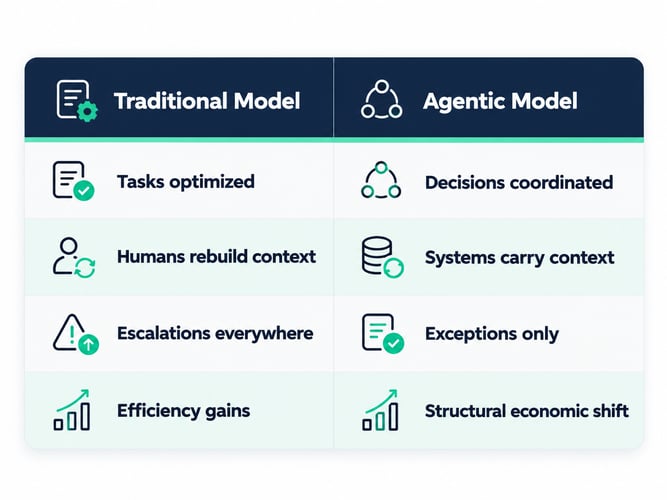
The common thread
Across claims, underwriting, risk management, and compliance, the economic value of Agentic AI comes from the same source:
Removing the need for humans to reconstruct context and coordinate decisions continuously across systems.
Where intelligence can carry intent end-to-end—governed, explainable, predictive and adaptive—insurance economics begin to shift in ways incremental automation never delivered.
6. What changes when systems start owning decisions
The most significant shift is not faster processing or higher automation. It is a change in where decisions live inside the insurance organization.
In traditional operating models, responsibility is distributed across people, tools, and workflows. Systems execute parts of the process, while people assemble context, resolve conflicts, and determine what happens next. As products, channels, regulations, and transaction volumes grow, that model becomes increasingly expensive to coordinate. Decision latency grows, coordination cost rises, and outcomes become inconsistent.
With governed agentic systems, several things can change.
First, decision flow becomes continuous rather than episodic. Context no longer needs to be rebuilt at each handoff. Claims, underwriting, servicing, and compliance decisions propagate forward with intent intact, reducing rework and delay.
Second, human effort shifts up the value chain. Agents, adjusters, and underwriters spend less time coordinating and more time exercising judgment where it matters most—complex cases, edge conditions, and customer moments that require discretion.
Third, risk becomes more consistent rather than more conservative. Instead of relying on buffers and manual checks to manage uncertainty, insurers can encode risk appetite directly into governed autonomy. This improves predictability without slowing the business.
Finally, economics improve structurally, not incrementally. Reduced cycle time improves capital efficiency. Fewer escalations lower operating cost. Embedded explainability reduces compliance friction. These effects compound because they change how work moves, not just how fast tasks execute.
This is why Agentic AI should not be viewed as another layer of automation. It represents a shift from task optimization to decision orchestration and from human-centered coordination to system-led execution with human oversight.
For insurance leaders, the implication is clear: as decision ownership migrates into systems, the operating model itself becomes more resilient, scalable, and economically predictable.
7. Governance as an enabler of scale
In insurance, greater autonomy only works when governance is designed into it.
Governance cannot be added after systems are already making or executing decisions. Decision boundaries, traceability, escalation, and accountability need to be defined from the beginning.
In practice, this means four things.
- First, risk appetite becomes operational, not theoretical. Instead of relying on broad policies or manual checkpoints, insurers can encode decision thresholds directly into system behavior, thus clearly defining where autonomy applies and where human judgment is required.
- Second, explainability becomes a byproduct of execution. Decisions are logged, contextualized, and auditable by design, reducing post-hoc justification and audit friction. This is particularly critical in claims, underwriting, and compliance-heavy workflows where trust depends on traceability.
- Third, regulatory confidence increases, not decreases. Systems that behave consistently, escalate predictably, and explain outcomes clearly are easier to supervise than fragmented human-driven processes. In regulated environments, this consistency becomes a strategic advantage.
- And finally, a counterintuitive lesson for insurance leaders is having strong governance accelerates adoption. When boards, regulators, and risk leaders trust how autonomy is bounded and supervised, organizations can move faster—not slower.
Agentic AI does not reduce the need for human accountability. It sharpens it by making clear which decisions belong to systems, which belong to people, and how responsibility is shared. For insurers, governance is not the brake on intelligent autonomy. It is the condition that makes it viable at scale.
8. A leadership question worth sitting with
For most insurers, the next phase of transformation may not begin as a large technology program. It may become visible first through economic pressure: slower decisions as complexity increases, rising coordination costs, and greater dependence on people to compensate for disconnected systems and processes.
Agentic AI brings these tensions into sharper focus.
Which parts of our insurance economics still depend on people compensating for system limitations—and how sustainable is that as scale, volatility, and regulation increase?
It is ultimately a question about operating design.
In earlier work on moving Agentic AI from pilot to production, we explored why regulated industries tend to struggle less with experimentation and more with disciplined progression—introducing autonomy safely, with governance embedded from the start and decision ownership clearly defined. Those principles apply just as strongly to insurance as agentic capabilities begin to mature.
At Nagarro, our work across BFSI modernization, AI-enabled decisioning, and regulated digital platforms continues to reinforce the importance of approaching this transition deliberately.
The opportunity is not simply to add another generation of AI tools. It is to identify where today's operating model is already under strain and redesign how intelligence, decisions, and human judgment work together. That is where agentic AI has the potential to move insurance beyond digital transformation and begin changing the economics underneath it.
If this perspective resonates, and you are exploring how agentic capabilities could responsibly fit into your own insurance context—without disrupting trust, governance, or delivery discipline—we at Nagarro are always open to a conversation. Not to sell a solution, but to exchange perspectives, stress-test assumptions, and help leadership teams think through what this shift could mean for their economics and operating model.