60 mins


 China
China  India
India  Japan
Japan  Philippines
  Singapore
  South Africa
  Sri Lanka
  Thailand
  Colombia
  Ecuador
  Austria
  Denmark
  Finland
  France
  Germany
  Hungary
  Norway
  Poland
  Portugal
  Romania
  Spain
Spain  Sweden
  Switzerland
  United Kingdom
  UAE
UAE  Canada
  Mexico
  United States

.svg)




This article explores how AI can help connect the EV charging ecosystem, aligning drivers, partners, and the utility operators behind the infrastructure. We’ll unpack why today’s fragmented, point-by-point approach falls short, and how shared data and interoperable systems can reduce friction, improve coordination, and support faster, more scalable decisions across the EV charging value chain.
The Electric Vehicles (EVs) ecosystem is complex; the seemingly simple plug-and-charge experience is an intricate web of multiple interconnected players: OEMs, charging point operators (CPOs), utilities, payment aggregators, experience centers, and digital platforms. Automotive OEMs are responsible for orchestrating this ecosystem and ensuring a seamless, intuitive user experience, but that’s easier said than done.
The EV charging landscape remains fundamentally fragmented. Customers navigate incompatible networks and unpredictable availability. OEMs, utilities, and infrastructure providers operate in silos, unable to share real-time data, coordinate capacity, or make predictive investments.
.png?width=1280&height=720&name=EV%20(2).png)
The consequences cascade: disjointed experiences that frustrate early adopters, infrastructure investments that miss demand, and revenue opportunities that slip away while the grid strains under unmanaged load.
AI-powered ecosystem integration is the shift from point integrations to an end-to-end operating layer that improves driver experience, accelerates delivery, and reduces operational and regulatory risk.
The problem: A fragmented EV charging experience
Despite rapid EV adoption, the public charging landscape remains fragmented and inconsistent. In a McKinsey survey, 70% of EV owners said they're dissatisfied with today's charging infrastructure, and only 10% think there are enough chargers nearby. The infrastructure is growing unevenly, with a scarcity of fast chargers, long waiting times for drivers, unreliable availability, inconsistent speeds, and vague pricing.
A peek behind the scenes reveals further complexity: OEMs, CPOs, and utilities operating with incompatible systems and without access to real-time insights into grid data. Another study stated that only 72.5% of public fast chargers actually worked when tested. The rest had broken screens, payment failures, or network glitches.
Meanwhile, deployment is falling behind the policy targets. The European Automobile Manufacturers' Association estimates that the EU must install 1.2 million public chargers each year to meet its 2030 goals, eight times the current rate.
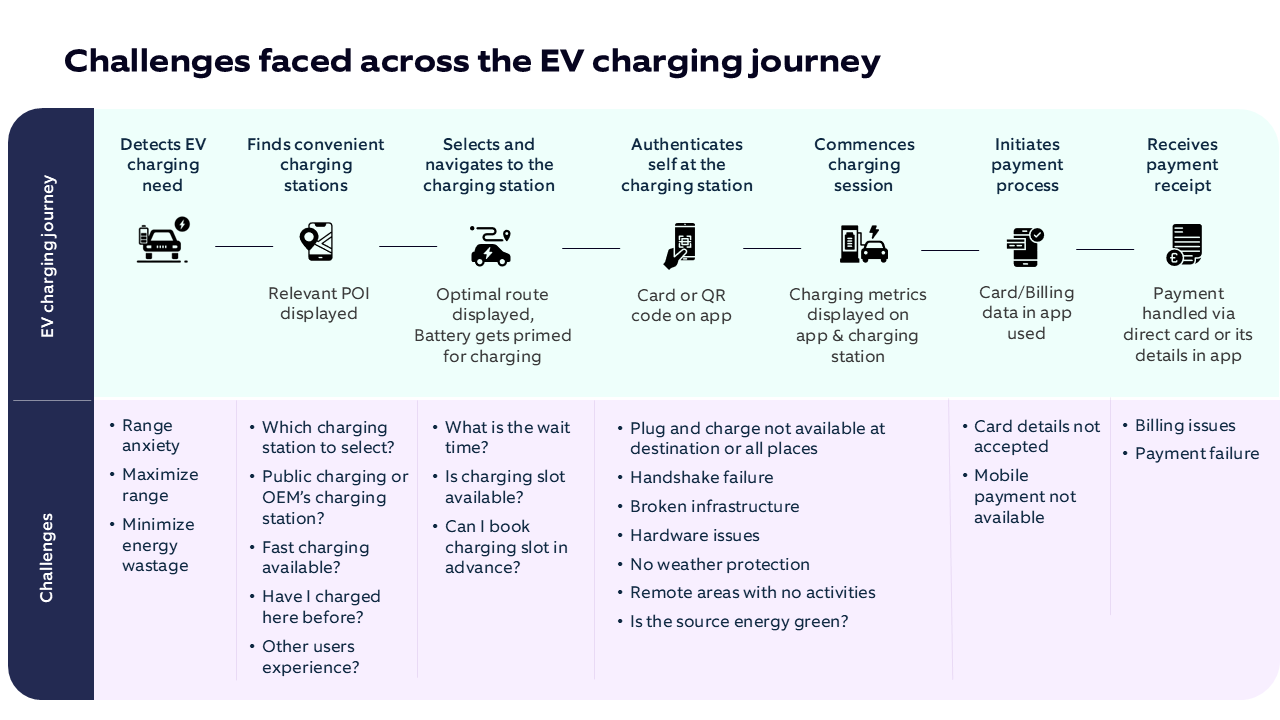
Together, these problems create a fractured customer experience, wasted assets, and lost revenue, necessitating AI-driven integration.
Solution: Reimagining the EV ecosystem through value-driven integration
To address fragmentation and friction in today’s EV landscape, OEMs must reimagine their role not just as vehicle manufacturers but as orchestrators of a connected, intelligent ecosystem.
How do they do that? By identifying where interventions deliver the highest business and customer impact across three critical value lenses:
- Customer-first lens: Map and eliminate friction across the charging journey from access and payments to charging speed and grid responsiveness.
- Business-value lens: Quantify the tangible impact of each improvement, including gains in customer loyalty, revenue per user, and operational efficiency.
- Ecosystem synergistic lens: Align priorities with utilities, renewable energy providers, and regulatory frameworks to ensure sustainable, scalable growth.
Together, these lenses form a strategic roadmap that helps OEMs prioritize high-impact, AI-enabled use cases turning disconnected touchpoints into a seamless, value-generating network.
The four cornerstones of an AI-powered EV ecosystem
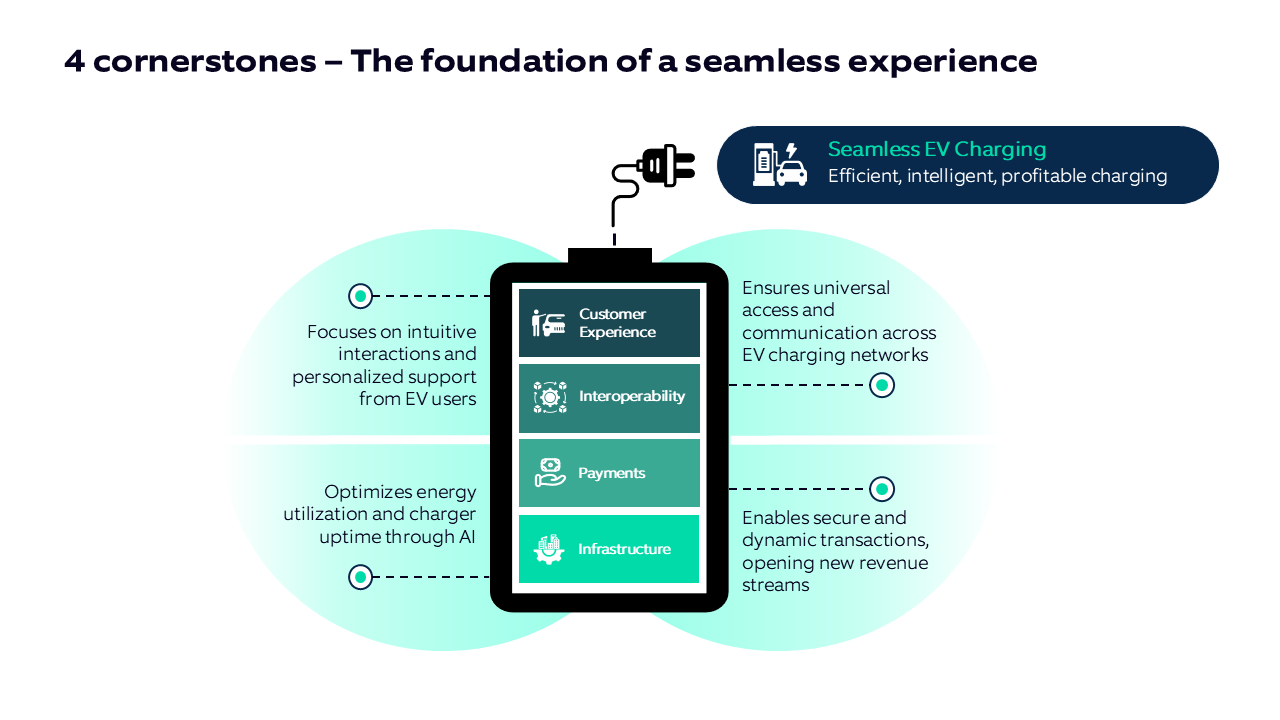
We firmly believe AI-driven integration can bridge existing gaps, making the EV charging experience seamless, intelligent, and profitable for all stakeholders. After defining the priorities, OEMs must embed AI across these four foundational dimensions of their ecosystem:- Customer experience: Deliver intuitive, real-time interactions with prescriptive routing, hyper-personalized offers, and proactive agentic support. Deliver real-time recommendations, seamless authentication, and predictive issue resolution for drivers.
- Payments & transactions: Enable frictionless, secure transactions that open new monetization opportunities through dynamic pricing and partnerships. Automate payments, reconciliation, and revenue sharing with partners through intelligent payment engines.
- Network interoperability: Ensure seamless access across networks and geographies by using protocols such as ISO 15118, OCPP, and OCPI. Use AI to manage cross-protocol communication and enable charging interoperability across global standards.
- Infrastructure & environment: Optimize grid utilization, charger uptime, and energy sourcing through predictive maintenance and renewable prioritization. Integrate with smart grids, anticipate demand surges, and align charging loads with renewable availability.
Transform from fragmentation to intelligence: Architecting an efficient EV ecosystem
By rethinking the EV ecosystem across these four dimensions, automotive leaders can unlock both commercial and environmental value. The result: A connected, self-optimizing ecosystem where customer experience, monetization, interoperability, and infrastructure intelligence reinforce each other, driving sustainable growth and positioning OEMs at the center of the EV revolution.
Use cases and next steps: Unlocking value through AI across the EV ecosystem
Bridging the current gaps requires more than incremental fixes; it demands intelligence that connects the dots across customers, payments, infrastructure, and partners. AI serves as the unifying force that transforms raw data into predictive, actionable insights across every node of the EV charging network.
By embedding AI across these four dimensions—customer experience, payments, interoperability, and infrastructure—automotive leaders can create a continuously learning ecosystem that anticipates user needs, optimizes asset utilization, ensures seamless cross-network operability, and drives sustainable profitability. This marks the shift from reactive management to proactive orchestration of the entire EV value chain.
.png?width=1280&height=720&name=EVs%20(2).png)
1. Elevating customer experience
EV charging can transform from a functional task into a seamless, personalized experience, whether at home, on the road, or at a destination.
- At home, AI-powered energy management systems dynamically adapt to the user's routines to schedule charging during off-peak hours or when renewable energy is most available, thereby reducing both costs and the carbon footprint. This reduces a household's energy costs and its carbon footprint by prioritizing clean energy, demonstrating how machine learning turns passive consumption into intelligent, climate-positive action. E.g. a leading energy supplier in the UK balances grid loads dynamically by ingesting real-time wholesale price data, local weather forecasts, thus allowing its users to effectively act as traders, charging their EVs at rates up to 70% cheaper than standard tariffs by capitalizing on "plunge pricing" (when wholesale prices turn negative due to oversupply).
- On the road, the in-car navigation evolves from simple maps to a predictive mobility co-pilot. It proactively guides drivers to the optimal charger based on real-time battery status, traffic conditions, topography, weather, speed, charging station availability, and grid data, thus reducing the driver’s cognitive load. The smart navigation system doesn't just guide, but also preconditions the battery for optimal charging on arrival based on distance and outside temperature ).
- At destinations such as malls, offices, or hotels, context-aware platforms offer personalized charging options, loyalty rewards, and nearby service recommendations.
Nagarro helped a leading global EV charging network enhance its customer experience through intelligent navigation, real-time station data, and seamless payment integration, enabling higher user satisfaction and network optimization.
These AI-driven personalization engines can tailor offers (e.g., malls can offer shopping, dining, and entertainment-related discounts; offices can bundle EV charging services as an employee benefit; hotels can bundle room packages), charging plans, and in-car infotainment during dwell time, turning idle minutes into engagement and revenue opportunities. For OEMs, this translates into higher satisfaction scores, stronger brand stickiness, and measurable growth in lifetime customer value.
2. Reinventing payments and monetization
Every charging session can be a dynamic, data-driven revenue opportunity when payments, pricing, and partnerships are integrated into a single intelligent ecosystem.
- Agentic payment orchestration enables frictionless transactions across networks, whether via plug-and-charge authentication, mobile apps, wallets, or subscription-based billing. Hence, standardized industry collaborations would reduce drop-off at the point of payment.
- Dynamic pricing algorithms optimize tariffs in real time, balancing demand, grid load, and energy cost while ensuring transparency for customers. ML models analyze patterns such as time-of-day demand, local grid load, and renewable energy availability to recommend optimal pricing windows, a practice already emerging in EV networks that tier pricing by peak and off-peak usage. This action not only encourages load balancing and utilization efficiency but also maximizes revenue per kWh delivered.
- Predictive analytics identify user patterns to tailor personalized offers, loyalty incentives, or bundled services that drive repeat engagement. For example, recognizing frequent commuters may trigger tiered subscription models or rewards that increase repeat engagement and lifetime value. This tactic echoes in retail ecosystems where behavioral segmentation unlocks incremental revenue opportunities.
Nagarro’s collaboration with BMW on the eDrive Zones and BMW Points initiative exemplifies personalization and incentive-led engagement through data-driven gamification and rewards that encourage sustainable driving while deepening brand loyalty.
-
Beyond charging, AI-driven ecosystem partnerships with retail, hospitality, and energy providers unlock cross-selling and co-branding opportunities, transforming dwell time into value creation moments. For instance, AI can trigger contextual retail or hospitality offers, such as a café discount or priority parking based on a driver’s charging duration, location, and past behavior, with automated revenue sharing settled instantly across partners.
For OEMs and operators, this intelligent orchestration streamlines settlement and reconciliation, reduces revenue leakage through automated clearing and fraud detection, and strengthens partner monetization. This system also generates incremental revenue, strengthens partner monetization, and transforms charging from a cost center into a strategic business driver.
3. Scaling seamlessly with interoperability
As EV adoption accelerates, interoperability becomes the backbone of a consistent and trusted charging experience.
- AI enhances open standards like ISO 15118, OCPP, and OCPI by orchestrating how vehicles, chargers, and digital platforms interact across brands, regions, and operators. Applications range from consistent session initiation to reduced integration lead times when onboarding new CPOs or markets.
- Intelligent data translation and anomaly detection actively reconcile protocol mismatches and inconsistent data schemas across heterogeneous networks. By identifying and correcting communication between systems failures in real time, AI reduces billing errors, failed transactions, and avoidable downtime. This directly improves network reliability and customer trust.
- Predictive analytics monitors charger performance across networks, identifying issues such as early signals of degradation, configuration drift, or protocol instability before they impact users. This shifts interoperability operations from reactive firefighting to proactive reliability management.
- AI-driven roaming intelligence automatically routes drivers to compatible stations and manages billing across ecosystems. From the driver’s perspective, charging “just works”; for operators, roaming becomes scalable rather than operationally expensive.
This unified intelligence enables OEMs and CPOs to expand networks faster without operational complexity, improve cross-network uptime, and deliver a consistent, secure experience globally. For automotive leaders, AI-driven interoperability can be a strategic differentiator for scalable, customer-centric growth.
4. Powering sustainability with infrastructure intelligence
Intelligence and foresight need to be the backbone of the EV ecosystem, the charging infrastructure itself.
- By analyzing data from grid demand forecasts, weather patterns, historical usage trends, dynamic electricity rates and battery health metrics in real time, AI-powered infrastructure management systems can predict peak demand, optimize energy distribution and dynamically balance loads to prevent grid stress. Tesla’s Supercharger network uses AI to dynamically adjust power delivery across multiple chargers at a station, preventing overload and improving overall efficiency.
- Machine learning models forecast utilization trends to guide network expansion, site selection, and capacity planning, ensuring every new charger delivers maximum ROI. Studies published in a few scientific journals also support the shift from static planning to predictive, data-driven deployment.
- Integration with renewable sources and AI-driven energy arbitrage enables charging when clean energy is most available or cheapest, improving both economics and sustainability. For example, Shell Recharge also utilises AI for smart grid management, integrating renewable energy sources, optimizing when and where clean energy is used for charging.
- Predictive maintenance algorithms detect anomalies and preempt charger downtime, increasing uptime (up to 25%) and customer trust. Instead of relying solely on fixed thresholds or scheduled inspections, machine learning models can detect subtle anomalies, such as slight temperature rises, minor voltage fluctuations, or changes in charging speed that precede failures.
Nagarro’s Ampvia demonstrates this capability, leveraging AI, IoT, and data platforms to unify EV infrastructure intelligence, grid interaction, and energy optimization across stakeholders.
For OEMs, utilities, and CPOs, this translates into lower operational costs, improved asset efficiency, and new recurring revenue from grid services, creating an ecosystem where energy, intelligence, and profitability reinforce one another.
Building a connected, intelligent, and profitable EV future
By integrating AI at the center of the EV charging experience, automotive leaders can deliver exceptional customer satisfaction, monetize every interaction, scale effortlessly across geographies, and foster a greener future. More fundamentally, they can build the path to sustainable, multi-dimensional growth—where technology becomes the engine powering entire business ecosystems.

tags