Fluidic Intelligence
Events and Webinars
 60 mins

Trending pages:
Our
company
company
Investor
relations
relations
Financial information,
governance, reports,
announcements, and
investor events.
governance, reports,
announcements, and
investor events.
Media
Center
Center
Stay updated with our latest announcements, media coverage, and press resources.
Caring &
sustainability
sustainability
We care for our world.
Learn about our
initiatives.
Learn about our
initiatives.
Thinking about
becoming a Nagarrian?
becoming a Nagarrian?
Check our open positions
Africa & Asia-Pacific

Central & South America
Europe
Middle East
North America
 China
China  India
India  Japan
Japan  Philippines
  Singapore
  South Africa
  Sri Lanka
  Thailand
  Colombia
  Ecuador
  Austria
  Denmark
  Finland
  France
  Germany
  Hungary
  Norway
  Poland
  Portugal
  Romania
  Spain
Spain  Sweden
  Switzerland
  United Kingdom
  UAE
UAE  Canada
  Mexico
  United States
talk to us
Tell us what you're building. We'll help you engineer the path forward.
contacts

locations

.svg)




-
what we dowhat we do
- Forge Nagarro’s proprietary AI accelerators
-
Digital Engineering
Value-driven and technology savvy. We future-proof your business.
- Intelligent Enterprise Helping you master your critical business applications, empowering your business to thrive.
- Experience and Design Harness the power of design to drive a whole new level of success.
- automotive
- banking and financial services
- energy & utilities
- gaming & entertainment
- industry and automation
- insurance
- life sciences & healthcare
- media & publishing
- non-profits and education
- private equity
- public sector
- retail & cpg
- smart buildings
- software & hi-tech
- sports AI
- telecommunications
- travel and logistics
- our work
- AI
- insights
-
careersCareers
- get to know us
-
Africa & Asia-PacificcareersAfrica & Asia-Pacific
-
Central & South America
-
Europe
-
Middle East
-
North America
- contact us
- search
-
en
- privacy policy
- imprint

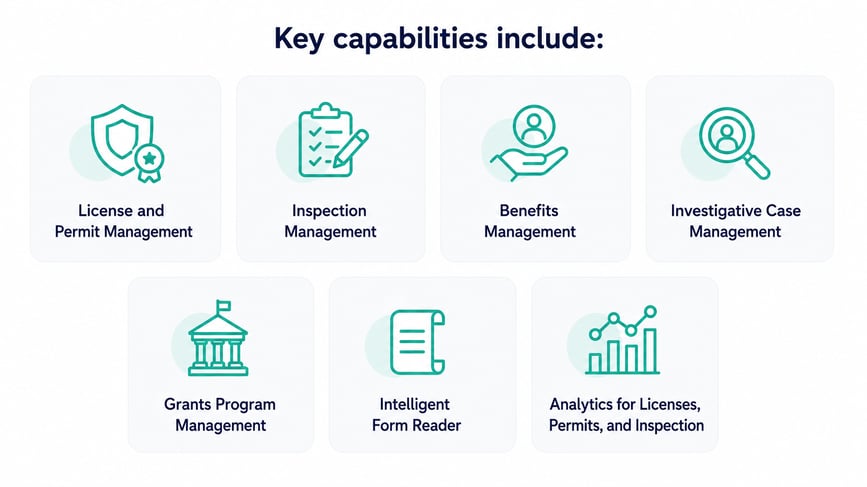
 License and Permit Management
 Inspection Management
 Benefits Management
 Investigative Case Management:
 Grants Program Management
.png?width=300&height=300&name=Document%20Management%20System%20(DMS).png) Intelligent Form Reader
Intelligent Form Reader Analytics for Licenses, Permits, and Inspections
 Nagarro is supporting the department in implementation and supporting its member self-service portal on the Salesforce platform and Government Cloud instance. Our proposed solution comprises Public Sector Solutions, Experience Cloud, Government Cloud, Shield, MuleSoft, DocuSign, and Copado. It is a business-centric portal that will be built using Experience Cloud to provide enhanced and improved levels of service to the end customer. It offers flexibility towards business changes resulting from new or amended laws and regulations as it is built on Government Cloud. The solution provides data encryption and security functionalities through Salesforce Shield to maintain data user security. It is a next-generation platform that will leverage AI and Data Science to help the department implement its future requirements.
 Reduced Turnaround Time for Subcontractor Requests for a Public Sector Education Department