Domain Intelligence
Grounds AI in how your business actually works.
- Business rules and policy modeling
- Organizational structures and priorities
- Industry and domain ontologies
- Operational goals and constraints
Value-driven and technology savvy. We future-proof your business.
As organizations build increasingly capable systems, the next opportunity is enabling them to operate with shared context and coordinated intent. The shift is moving from separate tools to a connected symphony, where information flows easily between departments and every decision works in harmony with the rest of the business.
This is how an enterprise begins to act as one. By aligning these smart systems into a single architecture, the entire organization can think, decide, and respond with collective intelligence.

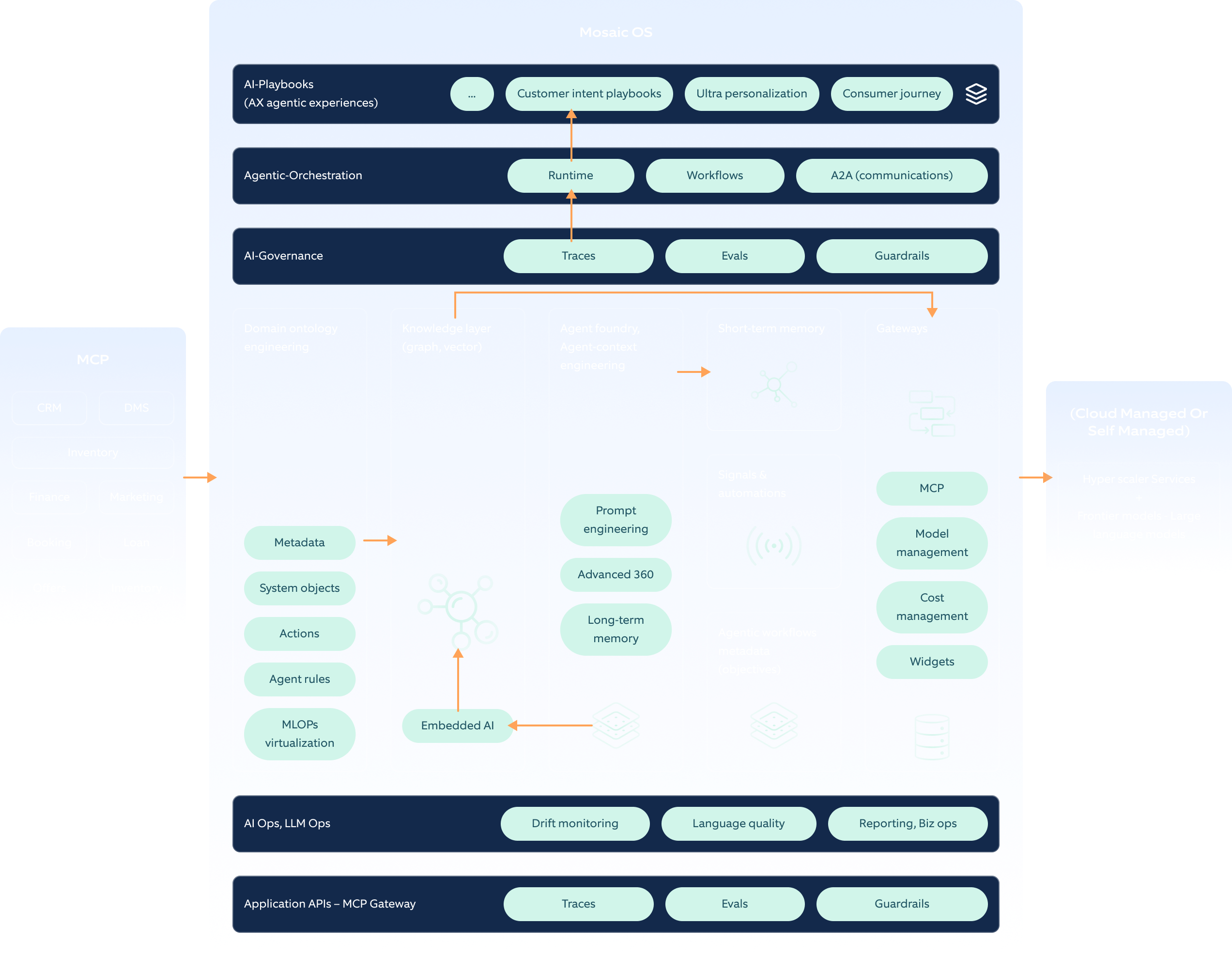
Mosaic OS serves as the unifying layer between AI models and business systems. It ensures every agent, model, and system operates with the same context, the same rules, and the same understanding of what matters.
Mosaic OS turns your enterprise knowledge: data, policies, business logic, and real-time signals into a shared operational context that AI systems and agents can use consistently. The result is a steadier execution, where agents collaborate across workflows, decisions stay consistent across functions, and actions reflect the same rules and priorities without constant manual coordination.
Mosaic OS works with your existing models, systems, and vendors, adding the coordination layer that helps everything work together, reliably and at scale.
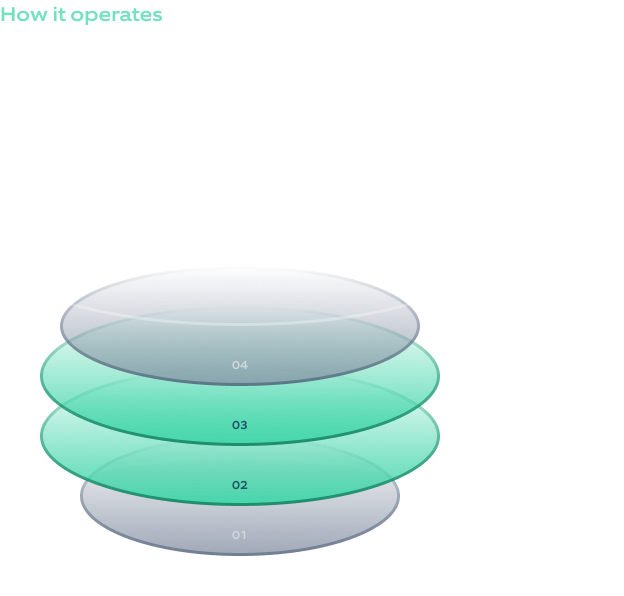
Your systems, policies, and live data merge into a single, shared intelligence layer. Every agent operates with the same enterprise-wide awareness.
Clear goals and guardrails are established before action begins ensuring every agent understands the mission and the limits of its authority.
Workflows coordinate who does what, in what order, with full visibility into every decision and handoff.
Every result feeds back into the core. Policies refine, models adapt, and the entire system grows more capable with every cycle.
Grounds AI in how your business actually works.
Controls how work moves through the system
Lets agents find and work with each other.
Keeps autonomy inside the lines.
Gives agents a shared memory.
Makes the system visible and improvable.
Each new agent inherits the institutional knowledge encoded before it. What required eight weeks to architect in your first deployment takes days by your fifth. The learning curve inverts: marginal cost per capability falls while organizational intelligence grows. This is the compounding return many AI investments promise but rarely achieve.
Misalignment is expensive: the promotional campaign that depletes inventory, the demand forecast disconnected from go-to-market commitments, the pricing model unaware of supply constraints. When pricing, operations, and customer experience reason from unified context, these hidden friction costs disappear. Decisions align across functions through shared intelligence, not more meetings.
Governance becomes dynamic, not bureaucratic. Agents earn greater authority as they demonstrate reliability. Routine decisions execute automatically within defined boundaries. High-impact decisions elevate to human judgment with full context and audit trails already embedded. Risk controls don’t slow the business down, they help it move faster with confidence.
Senior operators in most enterprises spend significant time reconciling fragmented data, translating between systems, and bridging context gaps across functions. Shared intelligence reduces this translation burden. Leadership focuses less on information synthesis and more on strategic decision-making, the work that strengthens competitive position and creates long-term value.
Mosaic OS provides the foundation to create specialized AI agents around your business domains, data, systems, workflows, and policies.
Organizations can build the right mix of agents for their needs, from individual specialists to coordinated multi-agent workflows, and bring them together as part of a connected enterprise intelligence system.
— Rahul Mahajan | CTO, Nagarro

We uncover where fragmented systems, disconnected knowledge, and coordination gaps are limiting enterprise performance. It defines the business priorities, target architecture, governance model, and execution roadmap needed to establish the shared context that Mosaic OS uses to orchestrate enterprise intelligence.
Outcomes
AI readiness assessment
Target architecture
Governance blueprint
Prioritized implementation roadmap
An agentic operating system is the intelligence layer that helps multiple AI agents, models, and systems work together with shared context, memory, and coordination. You need one when AI across your business has outgrown point integrations and manual orchestration. Without it, every agent works in isolation, starts from scratch, and repeats what others already know.
Integration moves data. Mosaic OS coordinates decisions. It helps AI systems not only exchange information, but also operate with shared context, business rules, and enterprise goals. Integration gives you connected systems. Mosaic gives you coordinated intelligence.
No. Mosaic OS is designed to work with what you already have. It is model agnostic and platform agnostic, so it can sit alongside your current vendors, infrastructure, and AI tools. It does not replace your stack. It makes the pieces of that stack work together more intelligently.
It depends on scope. Advisory can take 2 to 4 weeks. Design usually takes 6 to 8 weeks. Build and deployment vary based on complexity. The goal is to deliver value in phases, starting with one domain where coordination failures are already creating cost, delay, or risk.
LLM wrappers and agent frameworks help you build individual agents. Mosaic OS helps those agents work together across the enterprise. It provides the orchestration, memory, governance, and context layer that turns isolated agents into a coordinated system. Vendor agents stay inside their own lanes. Mosaic connects them across lanes.
Mosaic OS includes governance, observability, and orchestration from the start. Agents are registered, monitored, and governed within a common system. That reduces shadow AI, duplication, and uncontrolled growth. Governance is built into the architecture and can evolve over time as trust and performance increase.
Adaptive Quotient is a measure of how intelligently your AI systems work together as an enterprise. It does not measure the power of one model. It measures how well your overall AI estate coordinates, learns, and adapts. AQ is assessed across four areas: system coherence, contextual awareness, adaptive governance, and organizational memory.
The Conscious Core is the organizational intelligence layer that gives systems shared context, cross-functional reasoning, adaptive governance, and memory that compounds over time. It is not a standalone product and it is not AGI. It is an architectural pattern that helps the enterprise act with more coherence across decisions, workflows, and touchpoints.