Beyond generation: What Reuters Global Energy Forum revealed about the future of utilities

insight
September 08, 2026
9 min read

Reuters Global Energy Forum 2026 made one thing clear: utilities are entering a demand cycle unlike anything the sector has managed before. AI data centers, electrification, EVs, heat pumps, reshoring, advanced manufacturing and extreme weather are not simply increasing electricity consumption. They are changing shape, speed, location and volatility of demand.

The industry response cannot be limited to adding generation. The harder challenge is systemic: connecting new load faster, using existing infrastructure more effectively, managing supply chain and workforce constraints, integrating a more complex energy mix, protecting affordability, and building the intelligence layer needed to operate the full value chain.

Five themes stood out:
01
Speed-to-power is becoming a strategic constraint 
The challenge is not only generating enough electricity but also delivering it to the right location, on the required timeline and at an acceptable cost.
02
Utilities must unlock more capacity from existing infrastructure.
Grid-enhancing technologies, digital twins, predictive analytics, demand flexibility and asset optimization can create headroom without waiting for large-scale expansion.
03
AI is both driving demand and enabling the response.
While AI infrastructure is increasing load, domain-specific AI can help utilities forecast demand, assess constraints, accelerate connections and optimize operations. 
04
The “all-of-the-above” energy mix must be managed as an integrated system.
Renewables, gas, nuclear, storage, distributed resources and demand response must be orchestrated around reliability, flexibility, affordability and speed.
05
Supply chains, workforce capacity and affordability are now reliability constraints.
Equipment availability, skilled labor, regulatory structures and cost allocation will increasingly determine how quickly the sector can respond.
Frame 4267


The energy transition has become an operating-system problem

Electricity demand is rising faster, arriving in more concentrated locations, and becoming harder to predict. AI data centres, advanced manufacturing, industrial electrification, electric vehicles and increasingly extreme weather are reshaping load patterns that utilities once planned around with relative stability.

Yet demand is only one side of the problem. Interconnection queues are congested. Transformers, turbines, switchgear and power electronics remain difficult to procure. Experienced workers are retiring. Aging assets must be maintained while new infrastructure is built. And affordability continues to limit how much of the challenge can be solved through capital expenditure alone.

Frame 4311 (3)


Theme I

Speed-to-power is becoming an economic constraint

For much of the industry’s history, utilities planned against gradual, distributed increases in demand. That model is being disrupted by large, concentrated loads from data center campuses, semiconductor facilities, or advanced manufacturing that can emerge faster than traditional planning and regulatory cycles.

But whether that load can be served depends on far more than available generation. Utilities must simultaneously understand transmission capacity, distribution constraints, interconnection queues, permitting timelines, equipment availability, customer flexibility, and the cost implications for existing ratepayers.

The challenge is therefore not simply forecasting demand. It is to determine where demand can be connected, how quickly it can be served, and which combination of infrastructure, procurement, and commercial structures can do so at the lowest system cost.


That requires an integrated decision layer.

Utilities need planning environments that integrate geospatial network data, asset capacity, customer load forecasts, market conditions, project schedules, and regulatory constraints. Digital twins can help model network behavior. Scenario engines can test infrastructure alternatives.

One utility has already applied this model through a decision-support platform that integrates real-time information from internal and external systems. The platform uses advanced optimization to model how demand can be met with the most cost-effective mix of generation and energy procurement across short-, medium-, and long-term horizons. The value is the ability to make capital and operational decisions using a common, continuously updated view of the system.

Frame 4311 (1)

Commercial design will be equally important.

 
But these mechanisms work only when the utility can model them accurately. Every commercial option changes system demand, risk exposure, and infrastructure requirements. The grid does not distinguish between a constraint caused by a transformer, a tariff or a permitting queue. The planning system must see all three. Speed-to-power has therefore become more than an engineering metric. It is now part of regional competitiveness, capital strategy and economic development.
The following structures can accelerate connections while protecting other customers from disproportionate cost increases
Energy-Utilities_2009498393
renwable
marubeni-mobile
 
locked personal-2

Large-load tariffs
note

Interruptible service agreements
increment

Demand response participation
speed

Behind-the-meter storage
add puzzle

Bring-your-own-generation structures

Theme II

Existing infrastructure will have to work harder

New infrastructure will remain essential. But permitting delays, interconnection backlogs, equipment shortages and workforce constraints mean that much of it will not arrive quickly enough to address near-term demand. The immediate opportunity is to extract more capacity, reliability and resilience from assets already in the field.

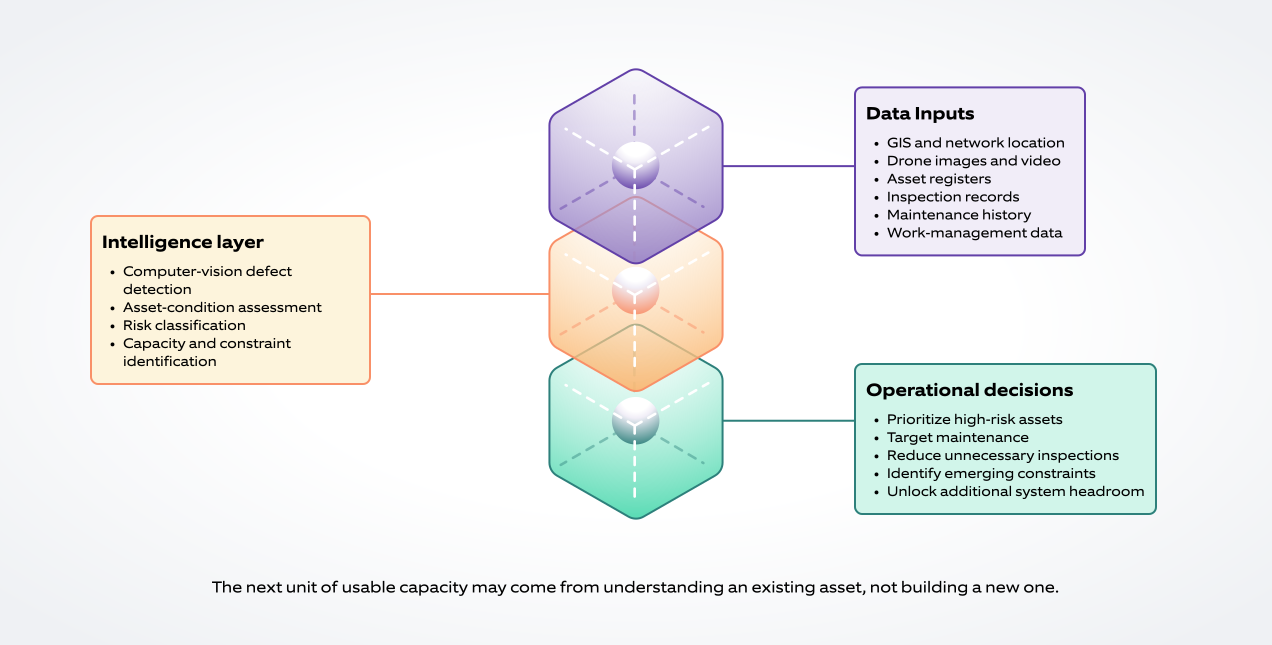
Utilities often possess large volumes of network, maintenance and inspection data, but that information remains fragmented across geographic information systems, asset registers, work-management platforms and field records. As a result, operators may know that an asset exists without having a current, reliable view of its condition, risk or available capacity.

The solution is an operational asset-intelligence layer.

For a transmission and distribution services provider, a GIS-based platform was developed to map and visualize distribution assets across the network. The platform was then integrated with an AI-powered visual inspection capability that analyzes drone-captured images and videos to automatically detect, classify, and annotate defects.

This combination matters. GIS provides the location and network context. Computer vision identifies physical deterioration. Asset data reveals maintenance history. Together, these capabilities allow utilities to prioritize interventions based on condition and operational consequences rather than on fixed inspection schedules alone.

Frame 4311


The impact extends beyond reducing inspection effort. Better asset intelligence allows operators to identify emerging constraints earlier, target maintenance more precisely and determine where relatively small interventions could unlock additional system headroom.

The same principle applies across grid-enhancing technologies, storage optimization, dynamic line ratings, predictive maintenance and demand flexibility.

The next unit of usable capacity may not come from building a new asset. It may come from understanding the existing system well enough to operate it closer to its real limits without compromising safety or reliability.

Theme III

AI is both the pressure point and part of the answer

AI appeared throughout the Reuters discussion in two seemingly contradictory roles.

It is one of the fastest-growing sources of electricity demand, driven by the expansion of large, power-dense data centres. At the same time, it is becoming one of the few technologies capable of helping utilities operate systems whose complexity is increasing faster than human planning capacity.

That does not mean utilities need more generic AI pilots. The highest-value applications are domain-specific and embedded in operational workflows: 


graph pop up-1
Load and renewable-generation forecasting
cone
Congestion prediction
search document
Asset inspection
service
Outage-risk assessment
bottleneck
Interconnection screening
insights-4
Market bidding
barricade (1)
Storm response
dollar increase
Capital prioritization.


AI becomes useful when it is connected to the data, rules and decisions that define utility operations.

The customer domain illustrates this shift. One European utility used its existing smart-meter and data foundations to create a conversational experience that allows customers to interact directly with their energy data. Customers can ask questions about consumption, understand usage trends, and receive personalized recommendations.

The utility also implemented an AI-powered alerting capability that identifies unusual consumption patterns and notifies participating customers before they receive an unexpectedly high bill.

These are not simply customer-service features. They convert smart-meter data from a billing input into an active decision tool. Better-informed customers can respond to abnormal usage, participate in demand-management programs and engage more meaningfully with dynamic energy services.


The same principle applies on the supply side.

Renewable operators are using generation and price forecasting to support bidding decisions across day-ahead and real-time markets. By combining weather data, asset performance, historical generation and market prices, operators can improve bid accuracy, increase asset utilization and reduce the financial consequences of forecast error.

AI becomes useful when it is connected to the data, rules and decisions that define utility operations.

Theme IV

The “all of the above” energy mix must operate as a portfolio

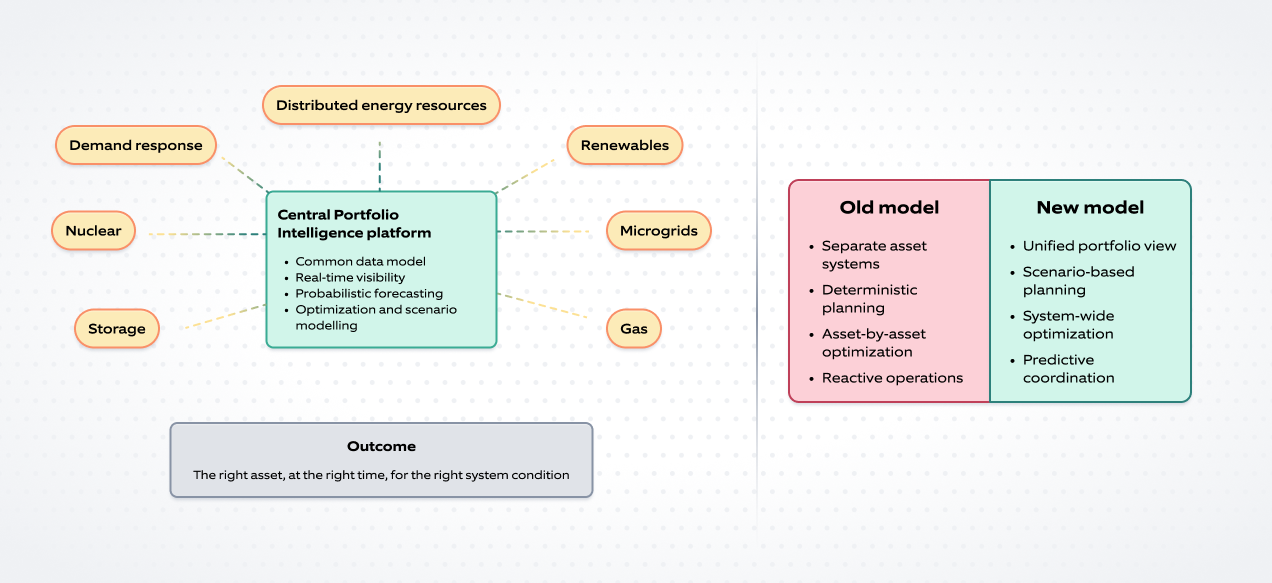
There is broad recognition that no single generation source can meet future demand while simultaneously satisfying reliability, affordability and decarbonization objectives. Distributed energy resources, microgrids and demand response can contribute, but only when utilities can see and coordinate them. The strategic concept may be “all of the above.” Operationally, however, it must become “the right asset, at the right time, for the right system condition.”

That requires portfolio intelligence.

Utilities and energy companies need:

  • common data models across generation sources
  • real-time operational visibility
  • probabilistic forecasts
  • optimization engines capable of comparing resources with very different operating characteristics.


Frame 4311 (1)

A renewable energy operator with wind farms across multiple geographies faced this problem precisely. Its turbines came from several manufacturers, each with a separate proprietary monitoring system. A centralized monitoring cockpit was developed to consolidate data from those systems into a unified, real-time view of asset performance.

The platform did more than aggregate information. It incorporated service-management capabilities that automatically detected performance and connectivity issues, triggered incidents and supported faster operational response.This is the operating model an increasingly diverse energy system requires: a common layer that can observe, compare and coordinate assets that were never designed to work through the same interface.

Digital twins and advanced scenario modelling can further extend this capability.

Utilities can simulate how changes in weather, demand, market prices, outages or asset availability affect the portfolio before making an operational commitment.

Frame 4315

In a more volatile energy system, the ability to rapidly compare alternative operating strategies will be more valuable than relying on a single deterministic plan.


Theme V

Supply chain, workforce and affordability are now reliability issues

The ability to build and operate the future energy system is increasingly constrained by execution capacity.

Transformers, switchgear, turbines, cables and power electronics are strategic dependencies. A project may be approved, financed and technically sound—and still be delayed because a critical component cannot be delivered.

Workforce constraints create a similar risk. Utilities are modernizing aging infrastructure as experienced employees retire. The issue is not simply replacing headcount. It is preserving operational knowledge while increasing the productivity of the remaining workforce.

Frame 4311-3


Technology can help in three ways.

 1-1Supply-chain intelligence can combine project pipelines, inventory, lead times, supplier performance and asset criticality to identify shortages before they delay construction or maintenance.


2-1Remote monitoring and predictive maintenance can reduce unnecessary field visits and focus scarce technical resources on the assets with the greatest operational risk.
3-1Digital work-management tools and AI copilots can provide field teams with contextual information, maintenance history, technical documentation and recommended actions at the point of work.


This does not replace domain expertise. It makes that expertise easier to scale.

The same is true of affordability.

Utilities cannot treat affordability as a downstream rate-design question. It must be modelled directly into planning decisions.

Scenario and optimization platforms should allow planners to compare not only reliability and capital requirements, but also:

  • Customer-rate implications
  • Procurement exposure
  • Long-term system costs

A technically feasible plan that creates unsustainable rate pressure is not a viable plan.

The reliability equation is therefore widening. It now includes the availability of equipment, people, data and customer financial capacity not only megawatts and network assets.

Frame 4311 (1)-1


From asset expansion to system intelligence

The central message from Reuters Global Energy Forum 2026 was that the complexity of the energy system is beginning to exceed the capabilities of fragmented planning, data and operating models.

Utilities will still need to build generation, storage, transmission and distribution infrastructure. But physical expansion alone will not resolve the constraints discussed at the forum.

The next phase requires a digital and data foundation that connects:

  • Planning with operations
  • Assets with markets
  • Customers with system conditions
  • Investment decisions with affordability

The energy transition has become an operating-system problem. It is time to engineer the operating system.

Frame 4311 (2)


meet our experts

Mitali
Mitali Medhe
Go-To-Market Lead
North America
Nagarro
Joteep_Mahato
Joteep Mahato
Global Business Head
Energy & Utilities
Nagarro
Saurabh Diwakar
Saurabh Diwakar
Global Practice Head
Energy & Utilities
Nagarro

Connect with us