Transformation success:
Building stability for sustainable value

Organizational readiness is the bridge between transformation activity and business value realization.


insight
October 06, 2026
9 min read

Authors


circular_ram_reddy


Ram Reddy
is Chief Technology Officer (CTO) at Nagarro. His focus is on developing scalable and sustainable solutions that are primarily designed to deliver valuable information.


1710780134134


Tiffany Welsh is Principal Engineer at Nagarro. Her focus is Enterprise Transformation & AI Adoption. She advises executives on business readiness, operating model evolution, and value realization across utility, public sector, and enterprise transformation programs.

Executive summary

Transformation success depends on more than deploying technology. Organizations often achieve technical readiness long before organizational readiness, creating a gap between implementation and business value realization. Sustainable outcomes emerge when change management focuses not only on adoption, but also on building the leadership alignment, accountability, capabilities, and behaviors needed to make new ways of working successful.


Drawing on real transformation examples,  organizational readiness is shown why it must begin early and extend beyond training and communications. Measuring success through system usage alone is insufficient; enterprises must assess operational stability, business performance, clear ownership, and institutionalization of knowledge. In an era of AI-enabled transformation, the organizations that create lasting value will convert technological possibility into sustained business performance.

Technology readiness and organizational readiness rarely arrive at the same timeFluidic-Intelligence-Line-2

A technology platform can be fully deployed while the organization is still unprepared to operate effectively with it. The system works fine, the data has migrated, the training is done, and the launch date is on schedule. And yet, weeks later, leaders, faced with uncertainty, ask all kinds of questions. Why are people still relying on workarounds? Why does the new process feel harder than the old one? Why do teams approach the same workflow inconsistently? So, where is the productivity gain, the investment was meant to unlock?

These questions don’t always arise due to the technology’s failures. They often signal that technology deployment has outpaced organizational change - in behaviors, accountability, confidence, and capacity. That distinction matters as enterprises take on more ambitious transformations, from core system modernizations to AI-enabled ways of working. McKinsey research draws a similar conclusion. Merely using a tool is not evidence enough of value creation. The real value is in redesigning how work gets done, how decisions are made, and how the operating model supports the new capability.

Change management needs a playbook - not a script

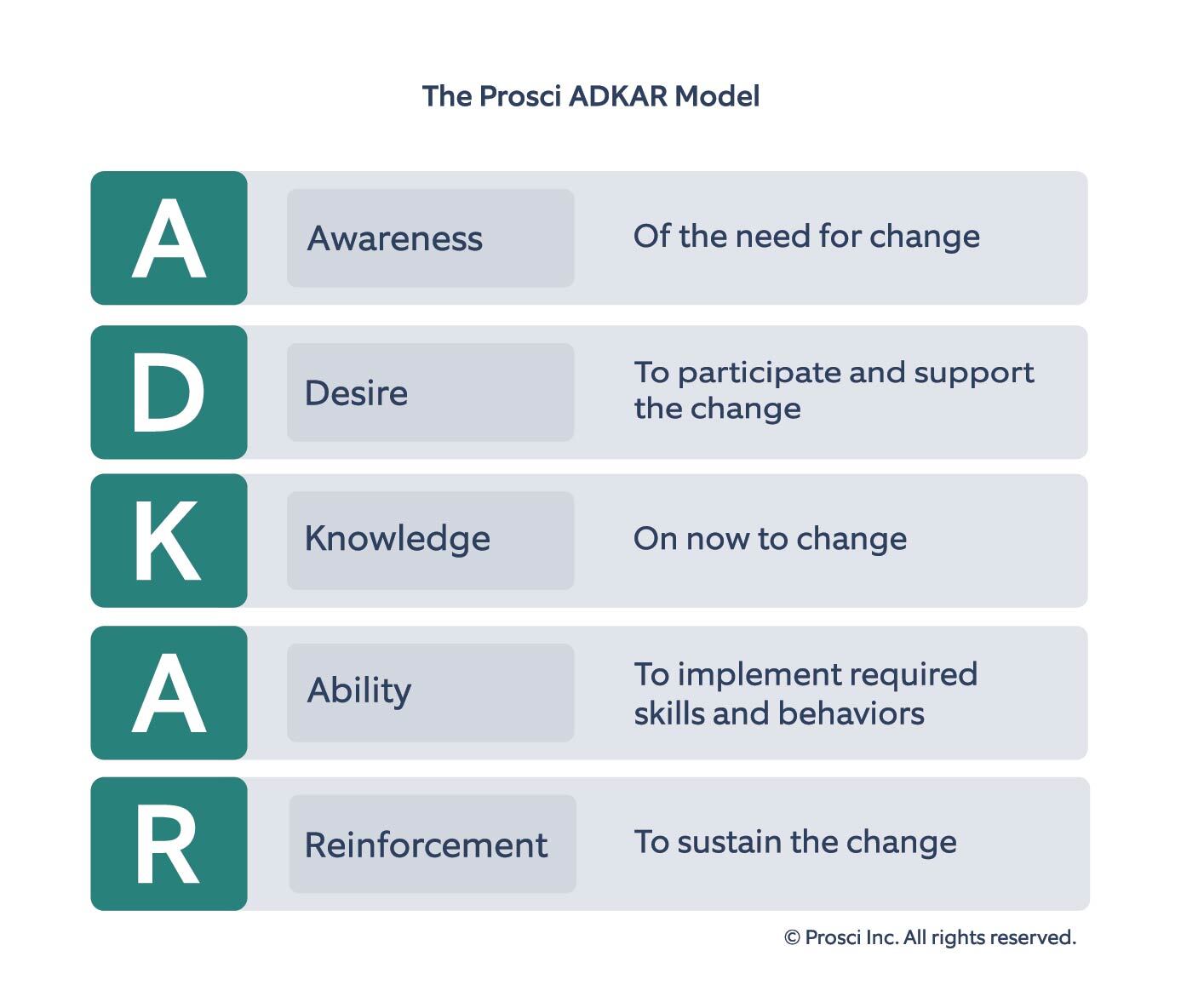
Established approaches - such as Prosci’s ADKAR model - provide organizations with valuable disciplines for understanding how individuals navigate change. We likewise believe effective change management must be structured while remaining adaptable to the organization living it. The Organizational Change Management (OCM) approach should be deliberately modular and human-centric rather than one-size-fits-all.

Here is a fun example. What does a squash player think about? The game fundamentals, i.e., stance, preparation, efficient movement, and recovery.
But not every match is played the same way. She adjusts accordingly to the opponent, the pace of the game, and what’s happening on the court.

dzvdv-1

Change management works much the same way.


We need repeatable disciplines without assuming that every workforce, technology, business model, or transformation requires precisely the same intervention.

Importantly, organizations must absorb several transformations at once. Alarmingly, Prosci reports that 73% of employees affected by change initiatives reported experiencing moderate to high stress levels - at or beyond change saturation. The volume and pace of change are stretching their capacity to absorb it successfully. We have to address this.

The question, therefore, is not simply how quickly an organization can implement change - but how much change the organization can absorb while continuing to perform and serve its customers.

Readiness starts before adoption

For a large public-sector organization’s transformation, significant assessment and change-planning work was completed. The templates existed, the plan was in place, and the technology transformation program was underway.

But two functions that would be essential to successful transition - Learning & Development and Corporate Communications - had not yet been meaningfully engaged. It was understandable. The new system was still developing, so the details could change. Why communicate before everything was known?

Well, you do so because people need time.

They need time to understand what is changing, figure out what it means for them to ask questions, and start adjusting to a future that may look different from today.

To address this, rather than simply producing another communications asset, the scope of collective buy-in around the transformation was expanded.

Initially, when leaders approached the change management team, there was understandable anxiety that surfaces in transactional and logistical ways: When is the first survey? When will we see the next communications draft? What exactly are you asking us to do?

But as those stakeholders became part of the transformation rather than recipients of it, their questions changed dramatically. Collective concern made way for enthusiasm and granularity: When can we see the integrated communications calendar? Who will publish each message? How should we brand the transformation? How do we connect the community to what we are building?

The client allocated adequate resources across communications and learning activities, started assessing capacity within its learning-management environment, and prepared for a broader campaign well ahead of the anticipated transition.

AI adoption readiness


Organizational Change Management (OCM) evolved from being viewed as a function that produced transactional assets to becoming a critical driver of organizational readiness and transformation success.

That’s why change management belongs near the beginning of a transformation, and not shortly before training.

The important outcome was not another communication memo, but shared ownership.

When disengagement is not always resistance

In a second transformation example, a different challenge surfaced altogether. This was to serve an industrial infrastructure organization, scaling across all business units and regions with an entirely new ecosystem.

Two important business leaders - one responsible for sales and business development and another closely connected to pricing and estimations - had largely disengaged from the transformation. It would have been easy to label that behavior as resistance.

They had customers to serve, teams to manage and businesses to operate. The sales organization already had a CRM, and the next release did not appear consequential enough to justify competing with daily priorities.

The narrative shifted gears. Instead of asking, “What does the program need from you?” it became, “Why does this matter to your business?”

Change practitioners often describe this through WIIFM - What’s In It For Me? But at the enterprise level, the question is larger. What becomes possible if we change? What remains at risk if we don’t? What behavior will need to change? And not simply which application will people need to open?

Once those implications were clearer, the leaders, increasingly, became active participants. They engaged during testing, and after deployment, helped their teams work through the uncomfortable period between learning something new and becoming genuinely proficient at it.

And the underlying business transformation produced a strikingly tangible outcome.

Previously, moving a customer requirement from sales through pricing and estimation, and then into the field for validation could take as long as three weeks. The redesigned technology and operating process changed how that happened, and found steep efficiency gains via automation and better internal cooperation. Product knowledge was codified into a searchable catalog and integrated more closely with pricing and estimation, making expertise accessible at the point of decision-making. Routine quotes could be produced more consistently, reducing reliance on field subject-matter experts. Guided selling and advanced quoting capabilities enabled the sales organization to accelerate proposal development, improve pricing consistency, and respond to customer requirements more effectively. A quote turnaround time that once took weeks was reduced to less than a single business day.

That outcome did not happen because of OCM alone. It resulted from the combination of technology, process redesign and human change. And that is exactly the point.

Usage metrics tell us whether people are using the new system.

They do not always tell us whether the business is performing effectively through the change.

A person can log into Salesforce every day and still use an inefficient workflow. A team can complete 100% of its training and still struggle with unclear accountability. A platform can deliver excellent technical performance while the organization rewards behaviors that undermine the intended change. While usage metrics matter, they reveal only part of the transformation narrative.

Broader enterprise change architecture can help organizations look beyond the launch through four interconnected building blocks.

These building blocks do not replace ADKAR, Agile, project management or other proven transformation methodologies; they only extend the coverage.

Instead of asking only, “How do we help people get through this change?”, we can also ask, “What does this organization need in order to thrive after it?”

Structural clarity
Ownership needs to be explicit. Who has the authority to act? Who sponsors the change during and six months later? Which teams must work together - but differently? It’s essential to understand that technology cannot compensate for ambiguity in accountability, roles, or decision rights.
Readiness gates & business continuity
Is the organization genuinely ready to move? System testing confirms that the technology works; organizational readiness confirms that the business can work with it. It includes leadership, people, processes, dependencies, and the organization’s ability to continue serving customers while the transition occurs.
Adaptive/ operational stability & metrics 
What happens when the designed solution meets the reality of the organization? Sure, system usage is one signal. But so are workflow performance, employee confidence, exception handling, workarounds, business outcomes, and operational friction. Usage metrics tell us whether people used the solution. Operational stability tells us whether the organization can perform while change is underway.
Institutional-ization of enterprise knowledge
Can the organization sustain the capability without permanent dependence on the implementation team or a handful of experts? Knowledge, ownership, and capability need to be democratized so the organization can improve, grow, and scale.

The destination is performance,
and not merely usage

When change management succeeds, its execution becomes nearly invisible. People stop talking about the new system because they are comfortable working on it, and it becomes routine. Ownership is clear, the new processes feel normal, managers reinforce the right behaviors and knowledge no longer lives solely with the project team. This redirects energy consumed by the transformation effort toward continuous improvement, innovation, creativity, and growth.

This is especially important in the AI era. Technology may dramatically increase what an enterprise can do, but organizations still need the structure, readiness, stability, and institutional capability to convert possibility into performance.

That outcome matters especially as AI and related capabilities expand what enterprises can do. The bottleneck is rarely the technology. It is whether the organization can convert the possibilities into sustained performance through structure, readiness, operational stability, and institutional capability.

So, when the outcome of an ambitious transformation feels uncertain, the answer may not be another layer of technology.

FAQs

Organizational Readiness, Change Management, and Business Value Realization

Get in touch

Build stability for sustainable value