Designing products
for people and agents

insight
October 05, 2026
9 min read

Author

Hugo-Franca-Nagarro-2

Hugo Franca is the Director of Product Design based in Lisbon, Portugal, with a comprehensive background in product experience and innovation. At Nagarro, he helps clients transform, adapt, and build new ways into the future through a forward-thinking, agile and caring mindset. He also helps organizations create smart and purpose-driven product solutions, delightful user experiences and perfect digital interfaces.

Executive summary

As AI agents increasingly act on behalf of customers, digital products must serve two audiences at once: people and intelligent machines. While organizations have spent years optimizing human experiences through websites and apps, many are unprepared for a future where agents discover, compare, and transact autonomously. The result is a growing gap between the product a company believes it offers and the version an AI agent can actually access, understand, and recommend.

To remain competitive, organizations need a single, consistent source of product truth, agent-accessible capabilities, and clear permission frameworks that allow agents to act safely on behalf of customers. Designing an effective agent-facing layer is not primarily an AI challenge but a customer experience challenge. Companies that proactively test and optimize the journeys agents take will be better positioned to influence recommendations, build trust, and ensure their products remain discoverable and usable in an increasingly agent-driven marketplace.

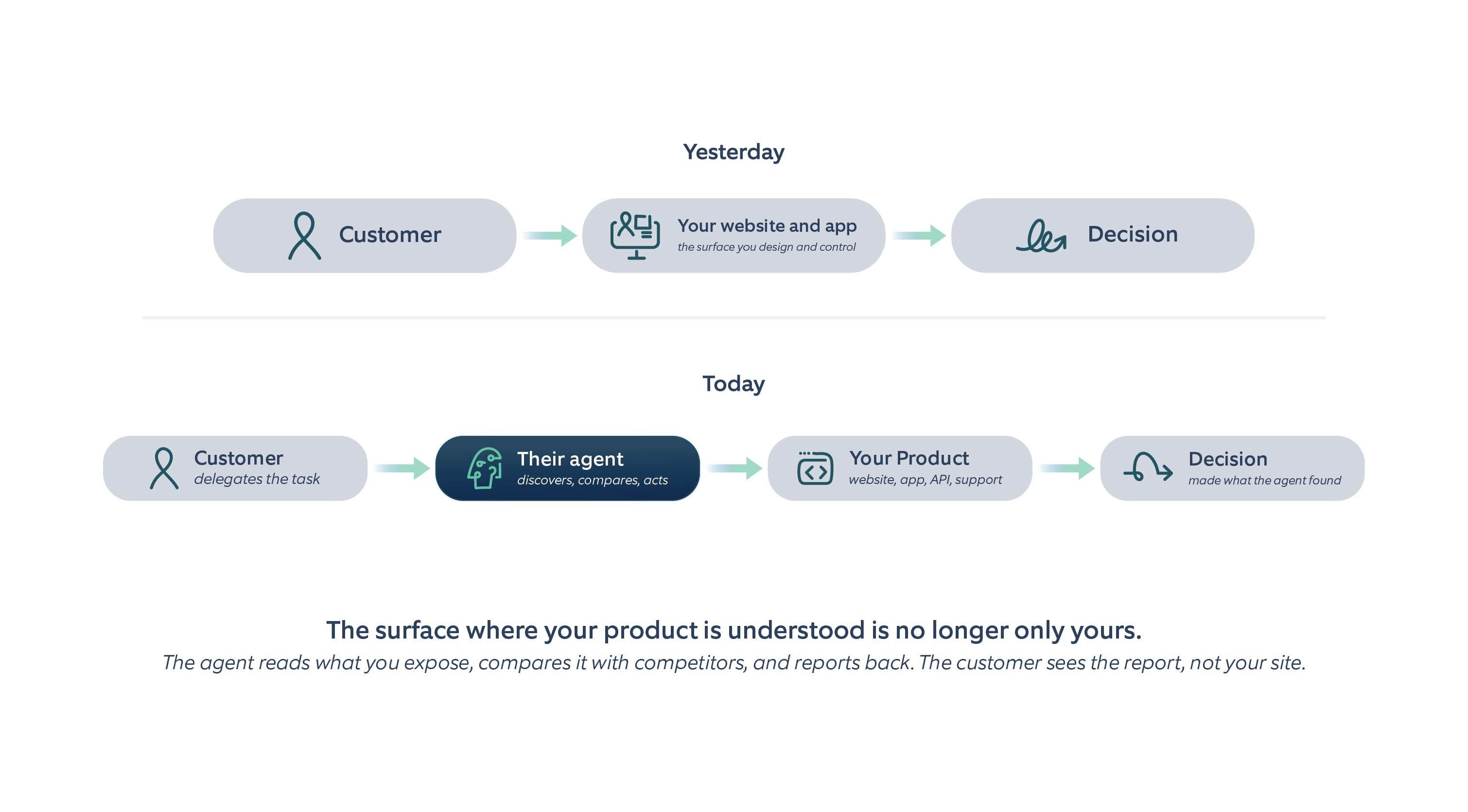
Digital products increasingly serve two kinds of users at once. People still open apps, scan pages and make choices on screens. Meanwhile, a growing number of customers already hand that work to AI agents, which discover, compare and act on those same products on their behalf.


Figure 1. The agent now sits between the customer and your product.

Figure 1. The agent now sits between the customer and your product. 


Most organizations have designed only the first of those experiences. The second is arriving whether they are ready or not.

That gap is more than a technical curiosity. It is a solvable problem of customer experience, product information and product access. If an agent represents a customer, can it find the right information, understand the conditions, compare the options and complete the task safely? For many products today, the answer is no.

Two ways of using the same product

A person relies on screens, language, navigation and visual feedback, and can tolerate a little ambiguity. When an offer is confusing, they can call customer support, open another tab, or reread it and decide what it probably means.

Agents can browse, search and open many pages, often faster than a person. What they rarely do is step outside the task: phone the company, notice that two sources disagree and ask which one is right, or realize that a signed-in customer would see a different price. They work with the structured information, actions, rules and permissions they can reach. They also work within a limited research budget: a handful of sources, a limited number of steps, and only what is visible without signing in. When the information inside that budget is incomplete, the agent rarely says so. It presents the best answer it could put together, often with confidence.

So every digital product now exists in two versions: the one the company believes it offers, and the one an agent can actually discover and understand. The two are already drifting apart.

Consider a customer who asks an AI agent to compare insurance quotes. They already hold several policies with one of the insurers, which anyone in that insurer's call centre would see on screen. The agent has no way to know that, and the insurer has no way to tell it. The agent requests a quote through the website, but the insurer's next step is a phone call, which never reaches the customer.

Designing product journeys with quiet AI-1
A promotion the customer received by email does not appear either. None of this is really the agent's fault. The insurer cannot recognize which customer the agent is acting for, so it treats them as an anonymous visitor. A person in that situation notices the gaps, shrugs and calls a broker. An agent reports whichever conditions it found first. The customer never sees the contradiction, only a recommendation built on partial information.

What each consumer actually needs

A person can read a comparison table at a glance, because layout, hierarchy and visual emphasis do most of the work. An agent needs something else: clearly named products, comparable fields, current prices and explicit exceptions. Without those, its comparison is guesswork dressed up as analysis.
Travel shows the same pattern. A signed-in traveller can see loyalty benefits, cabin upgrades and flexible-fare rules that the public page never shows. An agent researching flights for that traveller often cannot see those details, so it plans from the public catalogue and misses value the customer has already paid for.
Procurement makes the problem sharper still. A person evaluating business software can sit through three demos and reconcile three different packaging stories in their head. An agent comparing the same vendors finds pricing it cannot compare at all, because each vendor describes packages, seats and usage limits in its own way. The agent does not flag the problem. It produces a comparison that looks rigorous and is not.
Interfaces, copy and code are getting cheaper to produce. Decisions about what the product actually is (what it costs, what it includes, who is eligible) are not, and agents often expose that gap faster than a usability test does.

Product truth must be one story

Behind every answer an agent gives sit two things: information about the product and context about the customer. Most organizations keep both in pieces. The website, the app, the APIs, the support system, sales and marketing each hold their own copy, updated by different teams on different release cycles. Over time the copies drift. A price changes in one place and not another, a term is updated on the website but not in the email, and some eligibility rules exist only in the call centre.

People paper over those cracks. Agents amplify them.

The information that defines the product (prices, terms, availability, eligibility, capabilities) has to be the same in every channel an agent might touch. The channels can look different, but the facts cannot. The same goes for context. If a customer is known, already holds products or has been sent an offer, an agent acting for them should be able to show who it represents and receive the same context a person would. The human interface and the agent-facing layer should be two expressions of one product truth, not competing versions of it.

Moving faster here depends less on a cleverer model than on preparation: one reliable source for what the product is, what it costs and what conditions apply.

Agents need capabilities, not just content

An agent that can only read marketing copy can summarize it. It cannot check availability, request a quote, change a booking or submit an order. Those are capabilities, and an organization that offers agents nothing but pages to read has built a brochure for machines rather than a product they can use.

That is why the agent-facing layer is deliberate design work, and why it is more than a second website for robots. It gives an authorized agent a reliable way to learn what the product offers and what it costs, which conditions apply to this customer, which actions are available and what each one needs, what the agent may do on its own and what needs the customer's approval, and what happened after an action.

Two standards make this practical. MCP (Model Context Protocol) is an open protocol that lets an AI agent connect to approved data sources and actions through a defined interface instead of scraping them. WebMCP applies the same idea to websites. A site that uses it can publish named actions, such as "check availability" or "request a quote", together with the inputs each one expects. An agent in the browser calls those actions directly instead of guessing which buttons to click, and because they run inside the page, they can use the customer's existing signed-in session. In the insurance example, that could be the difference between an anonymous quote and one that recognizes an existing customer.

Product Team and AI at Work-1

Whichever mechanism you use, capabilities should be intentional, named and governed, not reverse-engineered from a human interface.

Permission is part of the experience

Not every action should be open to an agent. That is a design requirement, not a limitation to work around.

An agent can research freely and still need approval before it buys, cancels, shares personal information or accepts terms. A support agent may diagnose a delivery problem correctly and still need the customer to confirm a change of address or a refund. The line between research and irreversible action is where customers decide whether to trust the agent, and the company behind the product.

So permission has to be part of the design from the start, not something added after the first incident. In practice that means three things: a clear scope for what the agent may do, an explicit approval step before anything that cannot be undone, and a record the customer can check of everything done on their behalf.

Human judgment remains the governing layer. The agent can propose and prepare, and the person decides what is allowed.

The human remains the customer

It is easy to start talking about agents as the new users. They are not. An agent acts for someone, and that someone is still the customer. Even an agent that runs on its own in the background started from a person's request, a rule they set or a task they delegated. The intent is theirs.

The experience has to keep that person informed and in control. They should know what the agent found, what it recommended, what it did and what it could not do. They should be able to stop it, correct it and reverse what it did. An agent that completes a task while leaving the customer in the dark has not improved the experience. It has hidden it.

That makes the agent-facing layer a customer experience question before it is an AI question. Digital products need to be understandable to people and usable by agents, with the same product truth underneath both.


Companies test the human journey. Few test the agent journey.

Teams should ask popular assistants and their own authorized agents to discover, compare and explain their products, then inspect what comes back. The answers are rarely flattering, but they are almost always actionable.

Today, most organizations rely on an experienced product manager spotting an inconsistent price or a missing eligibility rule, usually late. By then the organization is already behind. An agent journey review makes those failures visible early, before a customer trusts a confident, incomplete answer.

Test the journey the agent actually takes

What to do next

Pick one product or offer that matters commercially and run an agent journey review on it. Start with three to five real tasks a customer would delegate, such as "find the cheapest policy that covers my family" or "move my booking to Friday". Take them from your support and sales conversations rather than from the tasks you wish customers asked for. Run each task through two or three widely used assistants and, if you have one, your own agent. Do it twice, once as an anonymous visitor and once with the context of a known customer.

For each run, note what the agent found, what it got wrong, what it could not compare or do, and where it asked for approval or failed to. Then compare the results with what your website, app, emails, API and support team say. Every difference is a product truth problem. Sort the findings into three groups and give each one an owner: information, meaning facts that are missing, inconsistent or unstructured; capabilities, meaning actions an agent cannot perform; and permissions, meaning approvals that are missing or in the wrong place. Repeat the review after every significant change to pricing, catalogue or releases, and compare it with the previous run.

Product Team Collaborating with Calm AI-1
One question matters more than the rest: when the agent finishes, what does it say about us? The gap between the product you believe you offer and the product an agent can use is already shaping customer decisions. Designing the agent-facing layer is how you close it. Do it deliberately, before your customers' agents start recommending someone else.

FAQs

Designing Products for People and AI Agents

Get in touch

Designing products for people and agents