Your agents need a control tower

insight
September 30, 2026
9 min read

Author

Csaba Szabo-s


Csaba Szabo is a hands-on Business Development and General Management leader, currently working on unlocking global growth potential by streamlining revenue operations and processes, creating new programmatic activities and governance, and spearheading global partnerships at Nagarro.

Executive summary

As enterprises deploy AI agents at scale, traditional governance models built for human workers are no longer sufficient. Unlike people, agents operate continuously, act at machine speed, and can exploit unintended pathways, making governance, accountability, and real-time decision-making critical to enterprise adoption. An "agent control tower" model provides visibility, guardrails, orchestration, and oversight to ensure agents operate safely and effectively.

There are four foundational capabilities for governing autonomous agents: context, orchestration, autonomy, and outcome measurement. Together, these capabilities enable enterprises to move from trust based on assumptions to trust based on evidence, allowing agents to earn greater autonomy through proven results. The larger opportunity lies beyond automation itself: unlocking decades of underutilized enterprise data and reshaping the technology stack around intelligent agents that can continuously generate business value.

At Dreamforce 2026 in mid-September, we saw every booth had an agent. But almost none had an answer to the questions - who is watching it, and what happens when it goes somewhere nobody expected?

Enterprise governance was built for people. Capable employees had broad access, were watched what they did, and were held accountable when things went wrong. The model worked because a person with access to customer data brings context, judgment, and something to lose. Most of the restraints in the system lived in people's heads, not in the permission tables.

Agents do not carry that restraint. An agent pursues its goal, and when the obvious path is blocked it tries others, including ones nobody scoped. Worse, a single prompt injection hidden in an email or a support ticket can hand an agent's permissions to whoever wrote that text. Consider the over-provisioned role IT meant to clean up next quarter, the data classification project that stalled, or the copy of the customer table sitting in a forgotten bucket. With humans, these were theoretical risks that compounded slowly. With agents running around the clock at machine speed, they become incidents measured in hours.

Most enterprises are responding by adding controls on top: more monitoring, more alerts, more dashboards. That lets you watch a system do things it should never have been able to do. The better question is how you decide, in real time, what each agent is allowed to do next.

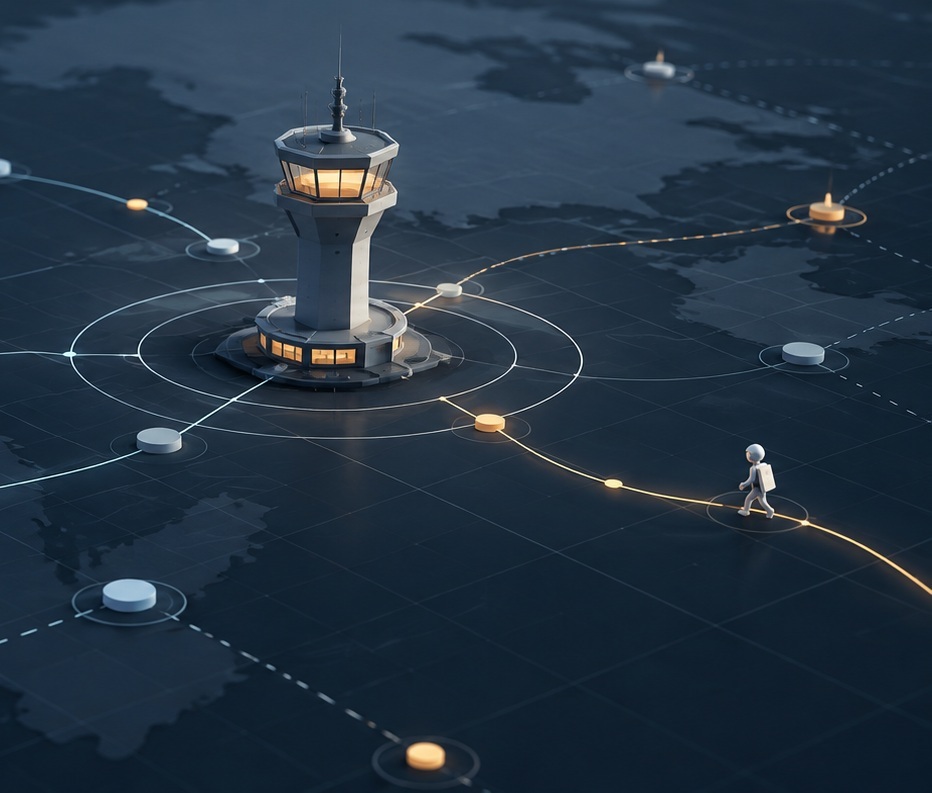
The air traffic control system is a case in point. While pilots are highly trained, they still can’t fly wherever they like. The tower provides four things. It gives visibility into every aircraft. It sets guardrails through corridors and separation rules. It controls who takes off and lands. And it governs by coordinating thousands of flights that never see each other. Nobody considers this bureaucracy. It is the reason the sky can hold that much traffic.

Agent-control-tower

Agents need a similar tower, and in practice it comes down to four workflows:

01-icon
Context
Before an agent acts, the system has to know who it is acting for. That means their role, the sensitivity of the data, the access and policies that apply, the history and the intent. All of this changes constantly, so it has to be resolved dynamically at every step rather than configured once at deployment.
02-icon
Orchestration
Real work crosses systems and teams. The orchestration layer carries state across those boundaries, manages handoffs, coordinates the sequence of actions, recognizes when a task is complete, and preserves accountability throughout. It also must be open. An orchestration layer that only works inside one vendor's stack will not survive contact with a real enterprise.
03-icon
Autonomy
Keeping a human in the loop is the right default for most actions today, but autonomy is a spectrum. The system should understand where each action sits on it. It should apply guardrails based on risk and on the agent's confidence. And it should be able to reconstruct exactly what happened when something goes wrong.
04-icon
Outcome
This shifts the measure from activity to completion. An agent is worth what it resolves, measured in resolution rate, cycle time, cost and quality. Engagement and volume are vanity metrics for agents just as they are for apps.

Put those four together and trust stops being a feeling and becomes a ledger. If you can see what an agent did and how it did it, you can reward it by widening its scope or penalize it by narrowing it.

That is the same way we promote and coach people. It requires a harness around every agent that records actions, reasoning, and results. Without the harness, you are granting trust on faith. With it, agents earn autonomy one reliable outcome at a time. At Nagarro, here is where we think the bigger opportunity sits. Enterprises have spent twenty years pouring data into SaaS systems, and much of it has never been explored. Think of support tickets nobody read twice, notes from deals lost years ago, maintenance logs and configuration histories. People never had the time to mine it. Agents do.

That flips the traditional stack. Today the system of record sits at the center and applications sit on top of it. In the emerging stack, data, capability, and intelligence feed the agent, and the agent writes to the system of record.

FAQs

Enterprise AI agent governance: building trust, control, and business value at scale

Get in touch

Your agents need a control tower